


Before Brian Elstein opened this firm, he was an insurance defense lawyer. His job was to hold down what carriers paid injured people, and one of the most reliable ways to do that has nothing to do with denying that the crash happened. It is to argue that the injured person caused some of it. That argument now has a hard target in Florida law. Past a certain percentage, a claim is not reduced. It ends.
Why Elstein Legal
A former insurance defense lawyer, now representing the injured. Brian spent years building the arguments that are about to be made against you, which is why this page can tell you what they look like. Elstein Legal is a solo practice, so the lawyer who evaluates your share of fault is the lawyer who handles your file. Over $50 million recovered. No fees unless we win. Brian’s background on the defense side.
Florida changed its comparative negligence rule on 24 March 2023
For decades Florida followed pure comparative negligence. Under that system every share of fault reduced an award and no share of fault ended a claim, so a person found 90 percent responsible still collected 10 percent of their damages. Many websites still describe Florida that way. Some of them were written before the change and never revisited.
That is no longer the law. CS/CS/HB 837, chapter 2023-15, was approved and took effect on 24 March 2023, and it added subsection (6) to Florida’s comparative fault statute. The current rule, at § 768.81(6), reads:
“In a negligence action to which this section applies, any party found to be greater than 50 percent at fault for his or her own harm may not recover any damages.”
Florida is now a modified comparative negligence state. Two things follow from that one sentence, and most summaries carry only the first.
The first is the part people expect. If your share of the fault is 50 percent or less, your damages are reduced by that share. Nothing is forfeited and nothing is barred. You recover what is left.
Above 50 percent, the outcome inverts. A claim does not shrink there. It is gone. There is no partial recovery for a claimant found 60 percent responsible, or 75 percent, or 99 percent. Under the law Florida used to have, all three of those people had a claim worth something. Under the law Florida has now, none of them has a claim at all.
Read carefully, the statute also settles a question people get wrong in the other direction. The bar applies to a party found greater than 50 percent at fault. A claimant found exactly 50 percent responsible is not above the line, so that claimant still recovers, reduced by half. Summaries that shift the threshold down by a point, so that an even split becomes a bar, move the line a whole tier and write off a person the statute protects.
What the 50 percent line does to a real number
Percentages are easier to argue about than to picture, so the table below runs the same claim through four different findings of fault. The damages figure is illustrative arithmetic chosen because it divides cleanly. It is not a typical, average or expected value for any Florida claim, and no figure here predicts what any particular case is worth.
| Your share of the fault | Type of claim | Damages found | What you recover |
|---|---|---|---|
| 20 percent | Ordinary negligence | $200,000 | $160,000. Reduced by your share |
| Exactly 50 percent | Ordinary negligence | $200,000 | $100,000. You still recover. Half |
| 51 percent | Ordinary negligence | $200,000 | Nothing. Barred entirely |
| 80 percent | Medical negligence, chapter 766 | $200,000 | $40,000. Pure comparative fault is retained here, so there is no bar |
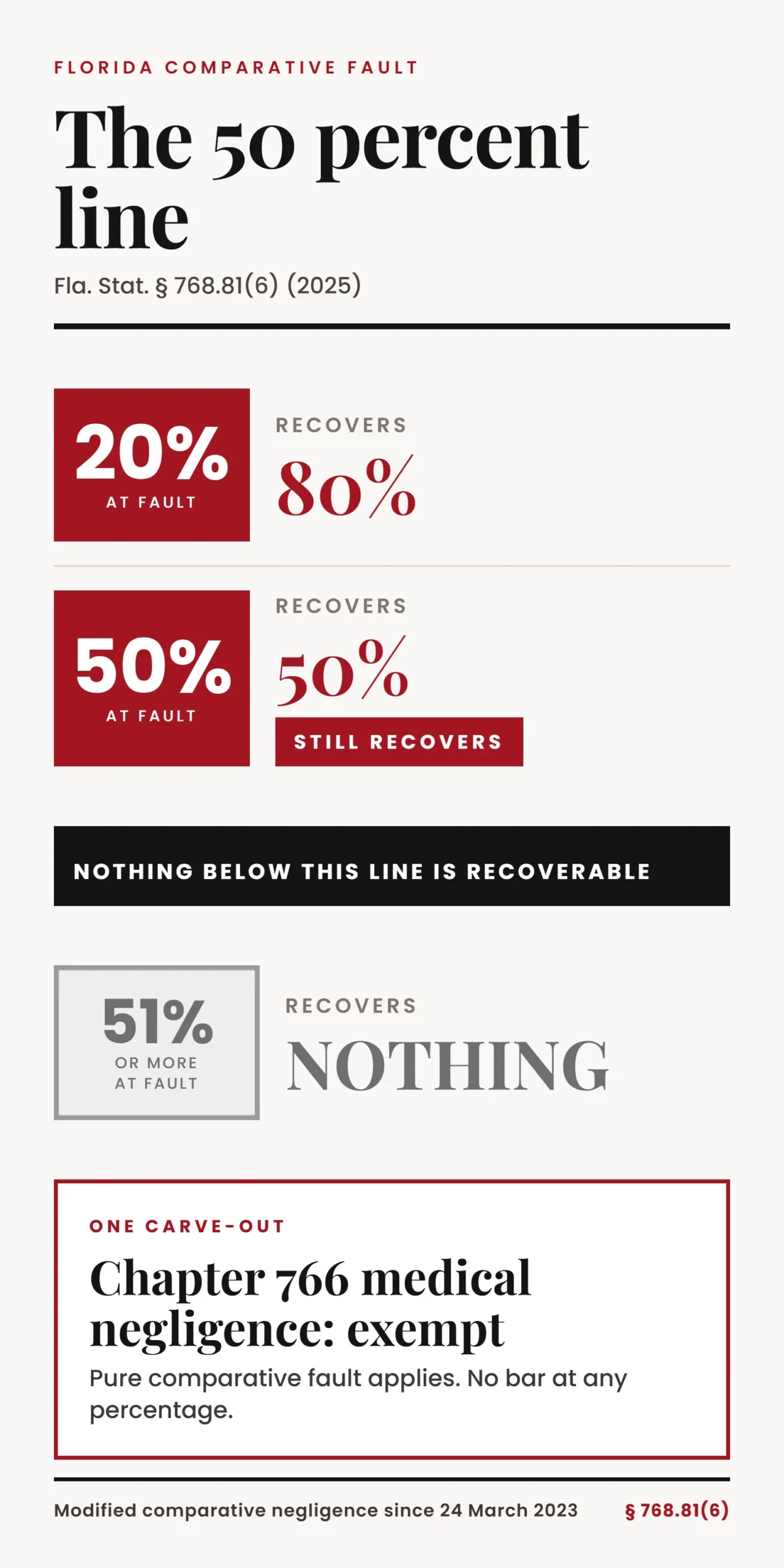
Look at the middle two rows together, because that is the whole of it. Same crash, same injuries, same medical bills, same damages figure. Between 50 percent and 51 percent, the difference is half the money or none of it.
No other number in a Florida injury claim behaves like that. Every other variable moves an outcome by degrees. This one has a cliff in it, and a single percentage point is the whole distance between the two sides.
That is also why fault allocation is where a contested claim is actually fought. In a rear-end collision or a red-light crash, liability is often not seriously in dispute. What is in dispute is your share, because the other side does not need to win on liability to win outright. It needs to move one number past 50.
The exception that survives, medical negligence under chapter 766
There is one place where pure comparative fault is still the law in Florida, and it is written into the same subsection that created the bar. The second sentence of § 768.81(6) reads:
“This subsection does not apply to an action for damages for personal injury or wrongful death arising out of medical negligence pursuant to chapter 766.”
Medical negligence claims under chapter 766 keep pure comparative fault, so the above-50-percent bar does not reach them. A patient found 80 percent responsible for their own harm in a medical negligence case still recovers 20 percent of their damages. The same patient, with the same percentage, in an ordinary negligence case recovers nothing.
This matters in practice more than it looks on paper, because the conduct a defense argues about in a medical case is often the patient’s own: a missed follow-up appointment, a symptom not reported, an instruction not followed. In an ordinary negligence case those arguments carry the risk of ending the claim. In a chapter 766 case they reduce it and stop there.
One caution about the citation, since this is where summaries go wrong. Section 768.81 contains a subsection (5) headed “MEDICAL MALPRACTICE,” and it is not this rule. Subsection (5) is a narrow provision about apportioning fault to a teaching hospital. The exemption that keeps chapter 766 claims on pure comparative fault lives in (6). Anyone citing § 768.81(5) for the carve-out has cited the wrong subsection, and the two sit close enough together to be confused by a reader working from a summary rather than the statute.
If a doctor, hospital or other provider is involved in what happened to you, how the exemption plays out in a medical negligence claim is worth understanding before anyone puts a percentage on your conduct.
Which claims the 50 percent bar reaches, and which sit outside it
The bar applies in a “negligence action,” and the statute defines that term itself rather than leaving it to ordinary usage. Section 768.81(1)(c) reads:
“‘Negligence action’ means, without limitation, a civil action for damages based upon a theory of negligence, strict liability, products liability, professional malpractice whether couched in terms of contract or tort, or breach of warranty and like theories. The substance of an action, not conclusory terms used by a party, determines whether an action is a negligence action.”
Two consequences of that definition are worth knowing before anyone tells you the rule does not apply to your kind of case.
Strict liability claims are inside it, by name. A Florida dog bite claim under § 767.04 is a strict liability claim, and people sometimes assume strict liability means the injured person’s own conduct cannot matter. The statute says otherwise. The claim is a negligence action as § 768.81 defines the term, so the above-50-percent ceiling sits over it. The same is true of products liability claims, which the definition also names.
The closing sentence of the definition is the one carriers pay attention to. Substance controls, not labels. Pleading a claim under a different heading does not move it outside the section if the substance of what is being alleged is a negligence action.
What the section does not reach is set out separately, at § 768.81(4):
“This section does not apply to any action brought by any person to recover actual economic damages resulting from pollution, to any action based upon an intentional tort, or to any cause of action as to which application of the doctrine of joint and several liability is specifically provided by chapter 403, chapter 498, chapter 517, chapter 542, or chapter 895.”
| Claim type | Does the 50 percent bar apply? |
|---|---|
| Negligence | Yes |
| Strict liability, including a § 767.04 dog bite claim | Yes, named in § 768.81(1)(c) |
| Products liability | Yes, named in § 768.81(1)(c) |
| Professional malpractice, in contract or in tort | Yes, named in § 768.81(1)(c), subject to the chapter 766 exemption |
| Breach of warranty and like theories | Yes, named in § 768.81(1)(c) |
| Medical negligence under chapter 766 | No. Exempt under § 768.81(6). Pure comparative fault is retained |
| An intentional tort | No. Outside the section entirely, § 768.81(4) |
| Actual economic damages from pollution | No. Outside the section entirely, § 768.81(4) |
The intentional tort line is worth a sentence, because a single incident can sit on both sides of it. Where someone is assaulted on a business’s property, a claim against the assailant rests on an intentional tort and falls outside § 768.81. A claim against the property owner for failing to provide adequate security is a negligence action, and the 50 percent bar does apply to it.
Who decides your percentage of fault
A percentage is not a measurement. Nobody arrives at the scene with an instrument that reads out how much of this was your fault. It is a position that somebody argues for, and it becomes binding only when a decision-maker adopts it.
In a case that goes to trial, the jury decides. It hears both accounts of what happened, and it assigns the shares.
Most injury claims never reach a jury. They resolve in negotiation between your lawyer and the carrier, and the percentage that ends up governing the settlement is a negotiated one. Both sides are pricing the same thing: what a jury would probably do with these facts, discounted for the risk of being wrong. A carrier that believes it can credibly argue you were 55 percent responsible is not negotiating over a reduction. It is negotiating from the position that it owes you nothing, and that position is worth a great deal to it.
Adjusters put a number on a file early, often within days, and that number tends to anchor everything that follows. It is not a finding and it carries no legal weight on its own. What gives it weight is time, because a figure that sits unchallenged in a file starts to look like the agreed baseline to everyone who opens that file later.
This is the practical reason the number is worth contesting early and with evidence, rather than conceding a share because it sounds reasonable. Once a percentage is accepted in principle, the argument moves to how far above or below it the final figure lands, and the starting point has already been given away.
What actually moves a percentage
Because a share of fault is argued rather than measured, it moves on evidence, and the evidence that bears on it is often different from the evidence that proves your injuries. Medical records establish what happened to you. Allocation turns on what happened in the seconds before.
Most of that evidence has a short life. Intersection and business camera footage is commonly overwritten within days or weeks, depending on the system. Vehicles get repaired or sold, and with them goes the physical record of the impact angle. Skid marks and debris wash away. Witnesses who stopped at the scene become harder to reach every week that passes, and their memory of sequence, which is precisely what allocation turns on, fades faster than their memory of the event.
A crash report is a starting point and not a verdict. An officer’s narrative or a citation can shape how a carrier reads a file, but it does not fix your percentage, and an officer who did not see the crash is working from the same accounts you are.
Some of the most useful material is the sort people throw away. The shoes you were wearing, the clothing you had on, the bicycle or helmet itself, the phone records that show you were not on a call. Each of those answers an allegation that would otherwise be argued in the abstract, and each is easy to preserve on day two and impossible to reconstruct in month six.
Worth preserving in the first week, before anyone asks you for it:
- Photographs of the scene, from more than one angle, including what you could and could not see from where you were
- The vehicle, the bicycle or the helmet itself, unrepaired and unsold, until somebody has examined it
- Names and numbers for anyone who stopped, even briefly
- The clothing and footwear you had on
- Your phone records for the relevant window, which answer a common allegation before it is made
- A note written while it is fresh, setting out the sequence in your own words
None of this requires you to know the law. It requires somebody to identify, early, which of your own actions the other side will put in issue, and then to go and collect the things that answer them before they disappear. That is the practical difference an early call makes on this particular question, and it is why the value of a conversation is highest at the point when a claimant is least sure they have a case.
What the other side argues to move your number up
The arguments are not improvised. They attach to specific duties that Florida law places on the injured person, and the strongest ones point at a statute. Here are the places where your own conduct most often enters a case, each with the provision it is argued under.
| The situation | What is argued | The provision |
|---|---|---|
| You were on foot | You crossed outside a crosswalk or failed to yield where the law required it | § 316.130 |
| You were on a bicycle at night | Your lighting did not comply. A front lamp must be visible from 500 feet, and the rear needs both a lamp and a reflector visible from 600 feet. A rear reflector by itself is not compliant | § 316.2065 |
| You were on a bicycle and under 16 | A helmet was required | § 316.2065 |
| You were on a motorcycle | Headgear, or eye protection, which the statute requires of the operator. A rider over 21 may ride without headgear if covered by a policy providing at least $10,000 in medical benefits | § 316.211 |
| A dog bit you | You provoked the animal. Under § 767.04 provocation reduces the award in proportion to any negligence on the part of the person bitten. It does not end the claim | § 767.04 |
| You fell on someone’s premises | You should have seen the hazard yourself. This is the mirror image of the notice element the claim itself turns on | § 768.0755 |
Each of these is a real, pincited place where your conduct is put in issue, and each rewards a specific answer rather than a general denial. A rider’s headgear does not settle anything on its own, for instance: § 316.211 sets a condition, and it does not make a rider automatically at fault for a crash somebody else caused.
Carriers also make allegations that carry no statute behind them at all. Speed, a phone in your hand, the shoes you were wearing, a seatbelt. Those may be argued as facts about what happened, and they are not rules you broke. Treating them as though they were is how a claimant talks themselves into a percentage nobody had actually established.
If your case involves one of these, the detail matters more than the category: the crossing argument a carrier makes against someone on foot, a missing rear lamp turned into a percentage, what the defense does with a rider’s headgear, the argument that you should have seen it yourself, and provocation reduces the claim rather than ending it each turn on evidence that is easier to preserve early than to reconstruct later.
Fault gets divided among the defendants too
Your own share is half of what this statute governs. It also decides how fault is divided among everyone else involved, and two rules there change what you actually collect.
Under § 768.81(3), the court enters judgment against each liable party on the basis of that party’s own percentage of fault, and not on the doctrine of joint and several liability. Joint and several liability no longer applies in Florida negligence cases with multiple defendants. A defendant found 20 percent at fault pays 20 percent, even where a co-defendant cannot pay at all. So the financial health and the insurance coverage of each defendant matter to you directly, in a way they would not have under the old rule.
Then there is the empty chair. A defendant can try to shift fault onto somebody who is not in the case, which reduces the share it pays without adding anyone who can pay it. Section 768.81(3)(a) sets conditions on that. The defendant must affirmatively plead the nonparty’s fault and identify the nonparty, or describe them as specifically as practicable, and to get that nonparty onto the verdict form it must prove the nonparty’s fault at trial by a preponderance of the evidence. Naming an absent party is not enough. The defendant carries the burden of proving that allocation.
Stated correctly: Florida abolished joint and several liability in negligence cases at § 768.81(3). Each defendant pays its own percentage and no more, so a defendant with no insurance and no assets does not have its share picked up by the others. Whether the parties who are liable can actually pay is a separate question from whether they are liable, and on a serious claim it is often the one that decides what you collect.
Why this matters to you rather than only to the defendants: every percentage assigned to somebody else is a percentage not assigned to you. Fault has to add up, so the shares are competing for the same hundred points. A defendant arguing that an absent contractor or a second driver caused most of this is, in that moment, arguing against your share as well as its own. That does not make the empty chair good news, because a share parked on a nonparty is generally uncollectible. It does mean the allocation fight has more than two sides, and that where your percentage lands depends partly on arguments being made between other parties about each other.
If your accident happened before 24 March 2023
Claims that accrued before the change still exist and some are still in litigation. Which standard governs an older claim is a question about your specific file, and it is not one to settle from a web page. This page states the current rule. If your accident predates 24 March 2023, that is a conversation to have with a lawyer looking at your actual dates, and it is worth having sooner rather than later.
How long you have to file
A negligence claim in Florida must generally be filed within two years, under § 95.11(5)(a). HB 837 cut that from four years in the same act that created the 50 percent bar, which is why older articles still say four. Deadlines carry their own exceptions and their own traps, and this page is not the place that works through them. Two years is the number to plan around, and the clock is not waiting on your decision.
Being partly at fault is a reason to call, not a reason not to
Plenty of people with real claims never make one, because somebody told them the crash was partly their fault and they concluded that settled it. Under Florida law, it settles nothing until a percentage is fixed, and a percentage is argued rather than observed.
Consider what that means in light of the table above. The gap between a claim worth half your damages and a claim worth nothing is one percentage point, and that point is contested by people who do this professionally. The other side has someone whose job is to push the number up. Whether you have someone pushing back is a choice you make, and it is worth making before the record is set.
Brian’s record on that specific problem is on the firm’s results page, and it is worth being precise about what it does and does not show. the firm’s published settlements include a $15,000 policy limit that became a $2,250,000 bad faith recovery, and a $35,000 highest offer that became $240,000 in under two months. Those are results against carriers that had taken a position and were moved off it. None of the firm’s published settlements is identified as a case that turned on a comparative fault apportionment, so read them as the firm’s record rather than as proof about this doctrine. Past results do not guarantee, warrant, or predict future outcomes.
If you are not yet sure what kind of claim you have, or whether you have more than one, start with working out what kind of claim you actually have. If you already know, reach the firm about your claim and put the question of your percentage in front of someone who used to argue the other side of it. Consultations are free and the firm works on contingency.
Frequently Asked Questions
Is Florida a pure comparative negligence state?
No. Florida has been a modified comparative negligence state since 24 March 2023, when HB 837, chapter 2023-15, added subsection (6) to § 768.81. A party found greater than 50 percent at fault for their own harm may not recover any damages. Before that date Florida did follow pure comparative negligence, which is why many websites still describe it that way. One exception survives: medical negligence claims under chapter 766 are exempt and keep pure comparative fault.
What happens if I am found exactly 50 percent at fault?
You still recover, reduced by half. Section 768.81(6) bars a party found **greater than** 50 percent at fault, so exactly 50 percent is not above the line. On a claim with $200,000 in damages, a claimant found exactly 50 percent responsible recovers $100,000. That figure is illustrative arithmetic, not an estimate of any real claim.
What happens if I am found 51 percent at fault?
You recover nothing. At 51 percent you are greater than 50 percent at fault, so § 768.81(6) bars the claim entirely rather than reducing it. There is no partial recovery above the line, at 51 percent or at any higher share.
Does the 50 percent bar apply to a medical malpractice claim?
No. Section 768.81(6) states that the subsection does not apply to an action for personal injury or wrongful death arising out of medical negligence under chapter 766. Those claims keep pure comparative fault, so a patient found more than 50 percent responsible still recovers, reduced by their share. Note that the exemption is in subsection (6) and not in subsection (5), which is a separate provision about teaching hospitals.
Who decides my percentage of fault?
In a case that goes to trial, the jury does. Most claims settle instead, and the percentage that governs a settlement is negotiated between your lawyer and the insurance carrier, with each side pricing what a jury would likely do. A percentage proposed by an adjuster is a position, not a finding.
Should I still speak to a lawyer if I think the crash was partly my fault?
Yes, and the reason is the size of the cliff. Half your damages and nothing at all are one percentage point apart under § 768.81(6), and the carrier has people whose job is to move that number. Brian Elstein defended insurance companies before he represented injured people, so he knows how the argument against you is built. Consultations are free.
How long do I have to file a Florida injury claim?
Two years for most negligence claims, under § 95.11(5)(a). HB 837 reduced it from four years effective 24 March 2023, so anything you read stating four years as the current rule is out of date. Deadlines differ for some claim types, so confirm yours rather than assuming.


