

Someone in your family died because another person was careless, and most of what you will read about who brings the claim is wrong. Brian Elstein defended insurance companies before he started bringing claims against them. In Florida the action belongs to the estate, it is brought once, and two years is the deadline.






A wrongful death claim in Florida does not belong to the family. It belongs to the estate, and that one distinction decides who signs the complaint, what has to happen before anything can be filed at all, and why four relatives cannot each hire a lawyer and go four separate ways.
Most pages written on this subject state the rule correctly once and then lose it. They open with the personal representative and drift back to “surviving spouses and children” a few paragraphs later, which leaves a reader holding two contradictory answers and no way to tell which one is real. Florida gives one answer. Section 768.20 puts the action in the hands of the decedent’s personal representative, who is appointed through probate and who recovers for the benefit of the survivors and the estate.
That is not a filing technicality. The first practical step after a death is often a probate step and not an injury step, the identity of the personal representative matters early, and no survivor sits waiting on a separate lawsuit of their own, because there is only ever one.
Causes vary and the structure does not. A death during surgery, a crash on the Palmetto Expressway and a shooting in a parking garage all run through the same two statute sections at this stage, so if you are not yet sure what kind of claim the estate has, the broader Miami injury overview is a reasonable place to start and work back from.
This page states the rule once and keeps it. Where the answer depends on facts nobody can know from a web page, it says so instead of guessing.
Why Choose Elstein Legal
Brian Elstein used to work for the insurance companies. He defended personal injury claims before he began bringing them, so he has seen how a carrier builds its file on a death claim: which parts of a medical record get flagged, how a delay in appointing a personal representative gets used later, and what an adjuster does with a crash report that assigns any share of blame to the person who died.
That is why this page opens with who brings the action and what the deadline is instead of with condolences. The decisions that are hardest to undo get made in the first few weeks.
Cases are handled personally by Brian, from one office in South Miami, on a contingency fee. No fees unless we win. Over $50 million recovered. Call (305) 299-2835, days, nights or weekends.
Past results do not guarantee, warrant, or predict future outcomes.
Who Brings a Florida Wrongful Death Claim
The statute itself is short. Fla. Stat. § 768.20 provides that the action “shall be brought by the decedent’s personal representative, who shall recover for the benefit of the decedent’s survivors and estate all damages… caused by the injury resulting in death.”
Two roles sit inside that sentence and they are routinely collapsed into one. The personal representative brings the action. The survivors receive through it. A widow does not file. An adult son does not file. A parent does not file. The personal representative files, once, on behalf of all of them.
| Role | Provision | What it actually does |
|---|---|---|
| Personal representative of the estate | § 768.20 | Brings the action. Appointed through probate. Recovers for the benefit of the survivors and the estate, and identifies the potential beneficiaries in the complaint |
| Survivors | § 768.18(1) | The spouse, children, parents and certain dependent relatives. They are beneficiaries who recover through the action. They do not bring it |
| The estate | § 768.21 | Recovers certain losses in its own right, alongside what the survivors recover |
Where the will names a personal representative, that is where the appointment starts. Where there is no will, or the will names nobody who can serve, the court appoints one. Either way the appointment is a probate proceeding and it comes first, because until somebody holds that authority there is nobody with standing to bring the claim.
Elstein Legal is a personal injury firm, and the line blurs easily here. This page explains that a personal representative has to be appointed. It is not an offer to administer an estate, and no page on this site should be read that way.
For a reader this is a question of sequence, not paperwork. A family that spends three months deciding who should serve has spent three months of a two year period, and the evidence that decides a death claim does not wait politely in the meantime. Vehicle data gets overwritten, video from a business or a garage is recycled within days, and witnesses move. A hospital chart is complete on the day it closes and gets no more accurate afterward.
One Action, Brought Once, for Every Survivor
Florida runs a single action for each person who died, not one action per grieving relative. The personal representative brings it, the complaint names the potential beneficiaries, and what each survivor recovers is sorted out inside that one case.
Families are frequently told the opposite, usually by someone well meaning. The idea that a mother, a spouse and three adult children each need their own lawyer and their own filing is wrong. It is also expensive, and it produces exactly the conflict it was meant to avoid. One action means one set of deadlines and one record, which is the arrangement a defendant’s insurer finds hardest to pick apart.
Two people killed in the same crash are a different matter. That is two estates and two actions, because the statute follows the decedent rather than the event.
Death is also not the only outcome that reshapes a claim this way. Across Florida in 2024 there were 14,026 incapacitating injuries against 3,098 deaths, so roughly four and a half people survive the most severe injury classification for every one who does not (FLHSMV, 2024, finalized). “Incapacitating injury” is FLHSMV’s severity classification, not a legal category. An accident that a person survives but never recovers from runs as an injury claim brought by the injured person, on different rules and a different clock, and confusing the two is one of the quickest ways to file the wrong case.
Two Years, and the Statute Most Pages Cite for It Is the Wrong One
The deadline for a Florida wrongful death action is two years, and it sits at Fla. Stat. § 95.11(5)(e).
Pages that get the two years right often attach it to the wrong provision, usually section 768.19. That section is the right of action. It is what creates the claim where a death is caused by a wrongful act, negligence, default or breach of contract or warranty. It is not the limitations period, and citing it as one tells a reader to look in a place where the deadline is not written.
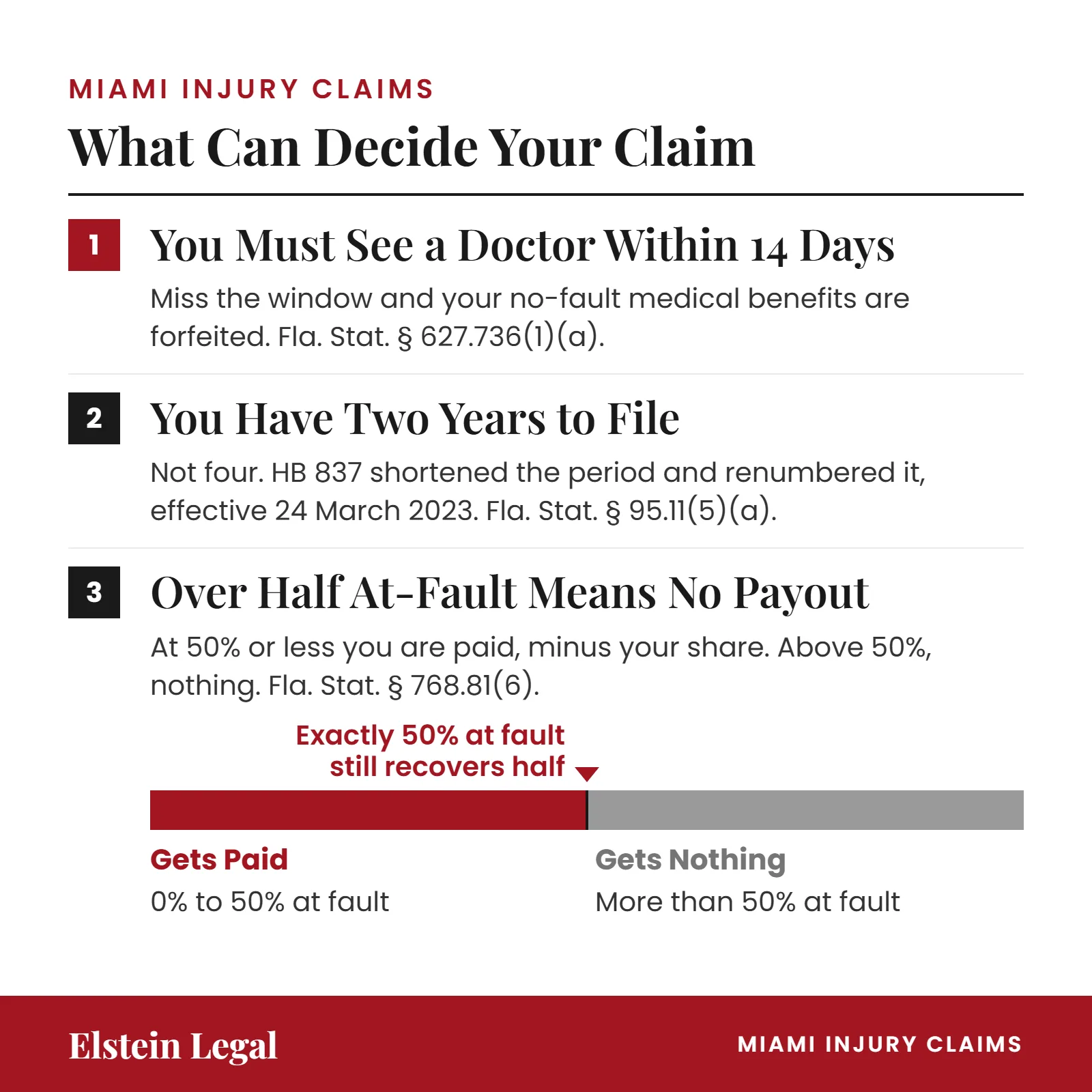
Subsection lettering matters here as much as the number does. HB 837 both shortened several Florida deadlines and renumbered section 95.11, effective 24 March 2023. Subsection (3) is now the four year subsection. Subsection (5) is the two year one. There is no two year subsection (4), so a page citing that subsection for any deadline is using lettering the legislature retired.
| Claim | Deadline | Provision |
|---|---|---|
| Wrongful death | Two years | § 95.11(5)(e), within the § 768.19 framework |
| General negligence, where the person survives | Two years | § 95.11(5)(a) |
| Medical negligence | Two years, with a four year repose | § 95.11(5)(c) |
| Product liability | Four years, with a twelve year repose | § 95.11(3)(d), repose § 95.031(2)(b) |
| Claim against a government entity | Separate presuit notice rules apply. No flat period is stated here | § 768.28 |
The first two rows both run two years, and they run from different events. An injury claim runs from the injury. A death claim runs from the death, which in a case involving weeks of hospital care is a different date entirely.
Product liability is the one genuine four year exception on this list, and it does not change the wrongful death deadline. Where a defective product caused the death there may be a separate product claim on a four year clock with a twelve year repose under section 95.031(2)(b), while the wrongful death action stays at two years under section 95.11(5)(e).
What the Miami-Dade Numbers Actually Count
Two figures describe fatal crashes in this county and they are not the same figure. Miami-Dade County recorded 272 people killed in crashes in 2024. Those deaths came out of 259 fatal crashes (FLHSMV, 2024, finalized), from a county total of about 60,000 crashes that year.
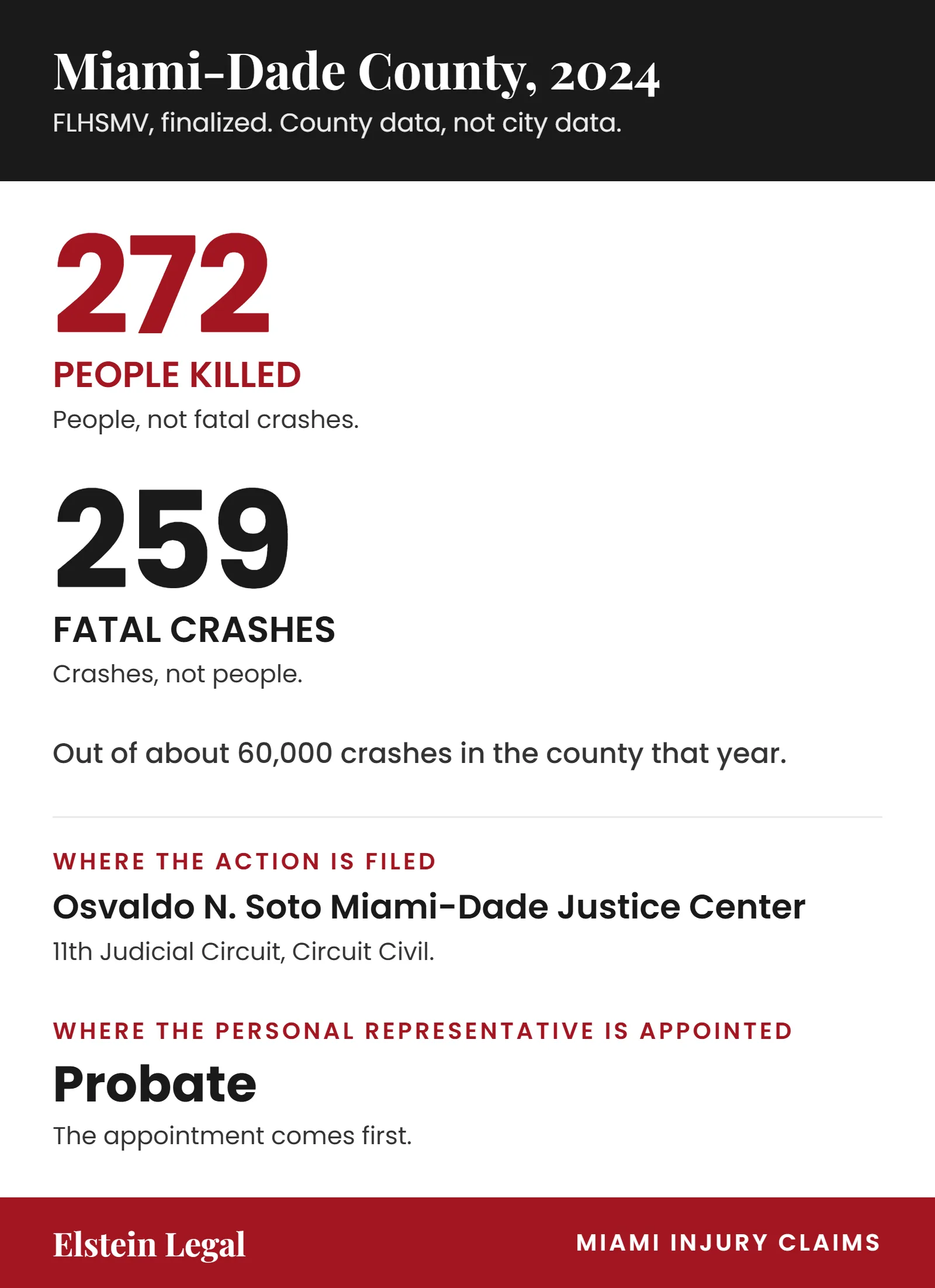
The gap between the two numbers matters. More people died than there were fatal crashes, which means some of those crashes killed more than one person. That is where the structure of the statute stops being abstract. Two people killed in one collision are two decedents, two estates and two actions, each brought by its own personal representative for its own survivors, even though the crash report is a single document.
Plenty of pages restate one of these numbers as the other, and a page that writes “259 people were killed” or “272 fatal crashes” has told you something no agency published. A county figure also settles nothing about fault in any one collision, which turns on evidence and not on a rate. County data is also the finest grain Florida publishes. There is no city-level crash count for Miami, so these are Miami-Dade County figures and they are labeled that way here. Behind a claim like this one, a fatal crash on a Miami-Dade road is the most common cause, though far from the only one.
When the Death Happened During Medical Care
Deaths that follow a missed diagnosis, a surgical error or a failure to treat run on the same two year clock and pick up a set of rules that no crash case carries.
The one that surprises people most is a limitation on damages. Section 768.21(8) bars adult children aged 25 and over, and the parents of an adult child, from recovering non-economic damages in a medical malpractice death case. Non-economic damages are the loss of companionship and the mental pain and suffering, as distinct from bills and lost support. The provision has been on the books since 1990 and it is still in force.
Scope is where this gets misstated. Section 768.21(8) applies to medical malpractice deaths and to non-economic damages. It is not a general ranking of survivors, it does not create a tier of “secondary survivors” in ordinary cases, and it has nothing to say about a crash death, a fall death or a shooting death. Any page that puts an age 25 line on a general diagram of who may recover has taken a narrow medical rule and applied it to every case on the site.
Repeal keeps being attempted and keeps failing. HB 6017 passed both chambers in 2025 and was vetoed on 29 May 2025. HB 6003 passed the House 88 to 17 on 15 January 2026, the Senate companion SB 1700 was never heard, and the measure died at adjournment. Sources telling you the provision was repealed are wrong, and a family relying on one of them is planning around a rule that does not exist.
Other features of a medical death claim are worth knowing before anyone calls a lawyer:
- Comparative fault works differently. Medical negligence claims under chapter 766 keep pure comparative fault, so the 50 percent bar does not apply to them.
- There is a repose period as well as a deadline. Section 95.11(5)(c) runs two years from the incident or from discovery, with a four year statute of repose, seven years where there was fraud or concealment, and an exception tied to a minor’s eighth birthday.
- Nothing gets filed straight away. Sections 766.106 and 766.203(2) require a notice of intent, a 90 day presuit investigation period and a verified written expert opinion before suit. That process is set out on the page dealing with a death during medical treatment.
Fault Assigned to the Person Who Died
Every defense in a death case eventually reaches for the same argument, which is that the person who died contributed to what happened. Florida answers it with a percentage, not a yes or a no.
Under section 768.81(6), a party found more than 50 percent at fault recovers nothing. At 50 percent or less, the recovery is reduced by that share, so a finding of exactly 50 percent still leaves half. Pages telling a reader that the decedent must have been under half responsible have the rule backward, and Florida is a modified comparative negligence state rather than a pure one.
On a death page the difference is whose conduct gets weighed. The personal representative brings the action, but the share being argued about usually belongs to the decedent, who cannot explain what he or she saw, was told or was doing in the seconds before it happened.
| Fault assigned to the decedent | Effect on a $1,000,000 claim |
|---|---|
| 0 percent | $1,000,000 |
| 25 percent | $750,000 |
| 50 percent | $500,000, the last point at which recovery survives |
| 51 percent | Nothing |
Those percentages come out of evidence, and the evidence in a death case is thinner from the start because the one person who knew most about it is gone. Scene photographs, vehicle event data, security video, maintenance and inspection records, and the accounts of witnesses who were never asked for contact details all decay on their own schedules. An insurer is assembling its version of that record within days. The estate is often still waiting for a court date to appoint anybody.
Cases arising from a fatal fall or a shooting on someone’s property turn on a further layer of records, since the property owner holds most of the documents that show what was known about the hazard and when.
A Criminal Prosecution Is Not the Civil Claim
Where a death involves a crime, two separate cases can arise from the same event, and they are not versions of each other.
A prosecution is brought by the state against the accused, and it ends in a conviction or an acquittal. The civil action is brought by the decedent’s personal representative against whoever is civilly liable, which can include people the state never charged, such as a business whose security failures allowed the attack, or an employer whose driver caused the collision. The parties differ, the burden of proof differs, and the outcomes are not tied together.
Families most often get the practical consequence wrong. An acquittal does not end a civil claim, and a decision not to prosecute does not either. Meanwhile the two year civil deadline keeps running while a criminal case moves at its own pace, which is why waiting for the prosecution to finish before speaking to anyone about the civil side is a costly instinct.
Where the Action Is Filed, and Where the Appointment Happens
A Miami-Dade wrongful death action is a circuit civil matter in the 11th Judicial Circuit, filed at the Osvaldo N. Soto Miami-Dade Justice Center, 20 NW 1st Avenue, Miami, Florida 33128. That building opened on 10 November 2025 with 46 equipped courtrooms and replaced the historic courthouse that had served the county since 1928, so older pages and older directions still point people to an address where civil cases are no longer filed.
Probate is the separate proceeding, and it is where the personal representative is appointed. The two run in parallel, not one after the other: the probate side establishes who holds the authority, and the civil side is where the claim itself is heard.
Order matters more than most families expect:
- The estate is opened and a personal representative is appointed through probate.
- The personal representative brings the wrongful death action in circuit civil court.
- The complaint identifies the survivors who may benefit under section 768.18(1).
- Any recovery is distributed among the survivors and the estate under section 768.21.
None of that requires a family to have made decisions about anything else. It does require somebody to start, and the sooner the appointment is under way, the sooner evidence can be demanded from the people who currently hold it.
What the Action Can Recover
Section 768.21 sets out what a Florida wrongful death action recovers, and it splits into losses belonging to the survivors and losses belonging to the estate. Survivors can recover for the support and services they lost, for medical and funeral expenses they paid, and, depending on their relationship to the decedent, for loss of companionship and for mental pain and suffering. The estate can recover for losses that belong to it, including earnings lost between the injury and the death and medical and funeral expenses it paid.
None of that converts into a number that can be published on a web page. Two constraints already covered do real work here: section 768.21(8) removes non-economic damages for certain survivors in a medical malpractice death, and section 768.81(6) reduces everything by the decedent’s share of fault. A third applies to the medical side of any claim, since section 768.0427 limits recoverable past medical damages to amounts actually paid or payable rather than amounts billed.
The firm’s published results include a $7,900,000 recovery in a car accident wrongful death matter, which is the closest thing on this site to the situation this page describes. Other results are further afield and still useful as evidence of how a carrier gets handled, including a $2,250,000 bad faith recovery on a matter the insurer treated as a $15,000 policy limits case. The full list sits at the firm’s published settlements.
Past results do not guarantee, warrant, or predict future outcomes.
Talk to Brian
Bring whatever exists, which on day one is usually very little. The will if there is one, any incident or crash report or its number, the name of any insurer anyone has mentioned, the hospital or facility involved, and the contact details of anyone who saw what happened. Nobody is expected to arrive with a file.
Before the first call, avoid giving a recorded statement to the other side’s insurer about what the person who died was doing, because that answer goes straight to the percentage question described above. And find out who is willing to serve as personal representative, since that appointment gates everything else.
No fee applies to the conversation and none applies unless there is a recovery. Call (305) 299-2835 or bring the question to Brian directly. The first conversation tends to be about deadlines and coverage instead of sympathy, and that comes down to the years he spent on the insurance side.