
A rider hit in Miami-Dade starts with none of the no-fault benefits a driver takes for granted, because Florida’s PIP scheme was written around vehicles with four wheels. Brian Elstein defended insurance companies before he represented injured people, so he knows how a carrier values a rider’s claim and where the coverage that pays for it is actually found.






The difference between a rider and a driver shows up within hours of the crash, at a hospital registration desk.
A driver hurt in a Miami-Dade collision hands over an auto policy, and a benefit starts working immediately. Personal injury protection pays 80 percent of medical bills and 60 percent of lost wages up to the policy’s limit, and it pays whether or not that driver caused anything. A rider hands over a motorcycle policy and gets a different answer, because no equivalent benefit exists on it.
That answer is correct, and it surprises almost everyone. Florida’s no-fault statute defines the vehicles it covers, and Fla. Stat. § 627.732(3) defines a “motor vehicle” as a vehicle with four or more wheels. A motorcycle has two. It never enters the no-fault scheme at all, which is why personal injury protection is not required for a motorcycle and why the no-fault rules a driver relies on do not reach the person on the bike.
Everything about the claim follows from that one definition. A car occupant has a benefit paying bills while liability is argued in the background. A rider has nothing doing that job, so the at-fault driver’s coverage, plus the rider’s own uninsured and underinsured motorist coverage, has to carry the entire case from the first week. The driver is claiming a benefit and the rider is proving one.
Florida injury law, stated correctly. Two of the rules on this page are published wrongly across a large number of Florida law firm sites, including sites that currently outrank this one. The deadline for a negligence claim is two years, not four. Florida applies modified comparative negligence, so a rider found more than 50 percent at fault recovers nothing, while a rider found exactly 50 percent at fault still recovers half. Both appear below with the statute and the subsection, so you can check them rather than take anyone’s word for it.
There is a second fact here that most Florida drivers do not know about their own policies. Nothing in Florida law requires an ordinary private driver to buy bodily injury liability coverage. The person who turned across a lane and put a rider in a trauma bay can be entirely compliant with the statute and still carry nothing that pays for a broken femur.
Brian Elstein spent years on the other side of that problem, defending insurance companies against injury claims before he began bringing them. This page is written the way he works a rider’s file. Find the coverage, because without it nothing else in the case has anywhere to land, then prove the liability and get the law right in a market where competitors still publish a filing deadline that would cost you the case.
Why Choose Elstein Legal
Brian Elstein used to work for the insurance companies. He defended personal injury claims before he started bringing them, so he knows how a carrier builds a file against a rider, what gets flagged and reserved on it, and which parts of a helmet-and-lane-position story an adjuster is trained to lean on.
That background is why this page spends more time on coverage than on sympathy. When there is no no-fault benefit behind you, locating every policy that can pay is the case.
One published result on this firm’s own record makes the point. A motorcyclist struck by a car faced a $15,000 policy limit that the carrier failed to tender in time. The recovery was $2,250,000, and it came out of the carrier’s bad faith rather than the policy. Look at the rest of the firm’s published settlements.
Cases are handled personally by Brian, from one office in South Miami, on a contingency fee. No fees unless we win. Over $50 million recovered. Call (305) 299-2835, days, nights or weekends.
Past results do not guarantee, warrant, or predict future outcomes.
Why Florida’s No-Fault System Never Included Motorcycles
Section 627.732(3) is a definition rather than an exclusion, which is what makes it so easy to miss. The statute never says motorcycles are thrown out of no-fault. It defines the class of vehicles the scheme applies to as those with four or more wheels, and a two-wheeled vehicle simply falls outside the definition. Section 627.733 then requires security, meaning personal injury protection, of the owners of the vehicles inside that class. A motorcycle owner is not among them.
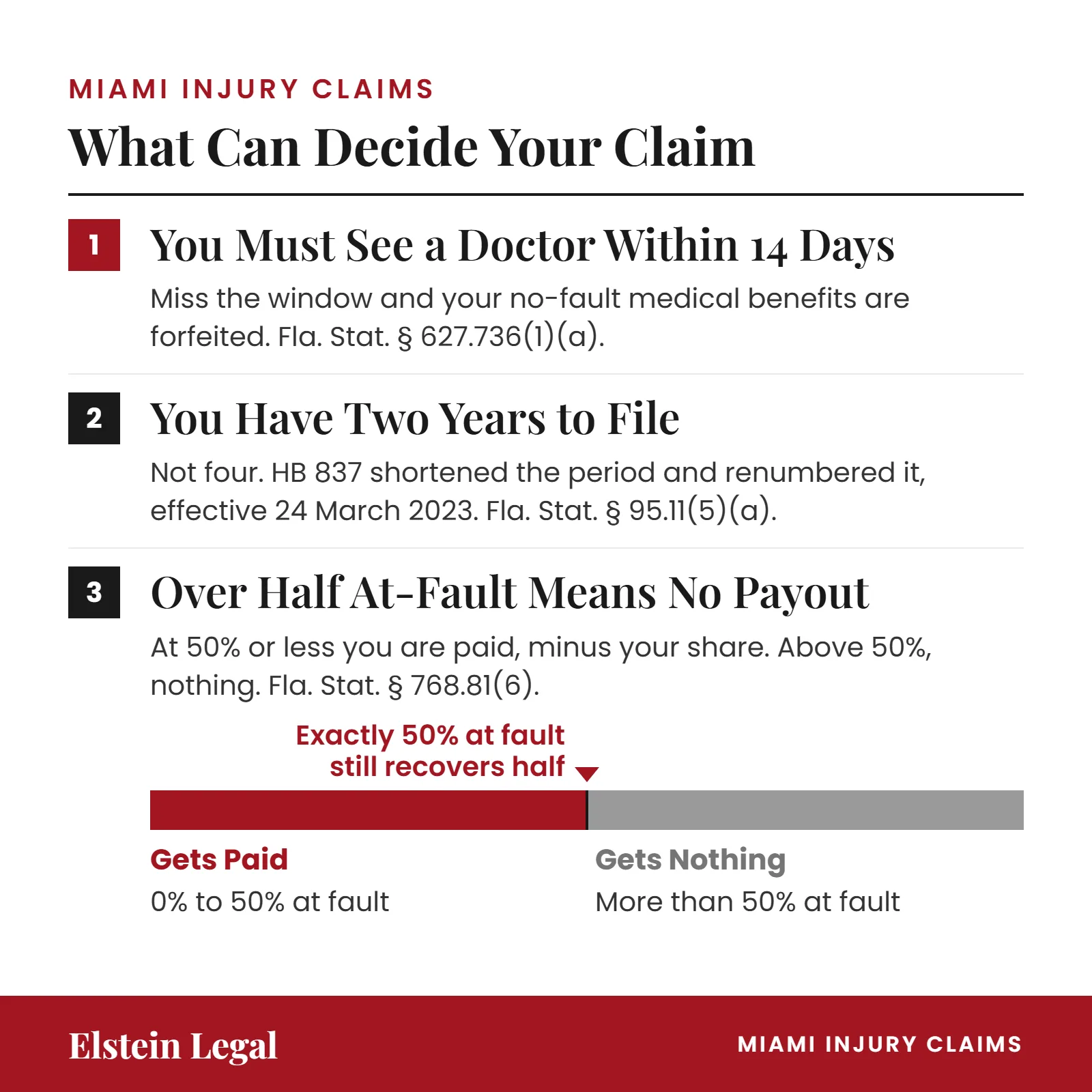
Personal injury protection is worth understanding anyway, because it is the yardstick the other side will measure your claim against. Section 627.733(1) is what requires it and § 627.736 is what sets out what it pays. A car occupant’s policy carries at least $10,000 of the benefit. Medical benefits run at 80 percent and lost wages at 60 percent, and the benefit is capped at $2,500 unless a qualified provider makes an emergency medical condition finding. It carries the 14-day rule, so a car occupant must start treatment within two weeks of the crash or the benefit is gone.
Set the two side by side and the gap stops being abstract.
| On the day of the crash | Car occupant | Motorcycle rider |
|---|---|---|
| No-fault medical benefit | At least $10,000 of PIP, § 627.736 | None. A motorcycle is not a “motor vehicle” under § 627.732(3) |
| Share of medical bills paid without proving fault | 80 percent, subject to the $2,500 cap absent an emergency medical condition finding | Nothing paid without proving fault |
| Lost wages | 60 percent | Nothing paid without proving fault |
| The 14-day treatment rule | Applies, and missing it forfeits the benefit | No PIP benefit to preserve on the motorcycle policy |
| What funds treatment while liability is argued | The occupant’s own PIP carrier | The rider’s own health coverage, then the liability claim |
One caution belongs beside that table, because the honest answer to “do I have any PIP at all” is sometimes yes. A rider injured while riding in a car, or a rider whose household holds an auto policy, may have a benefit through that vehicle. Whether coverage responds is a question about specific policies, not something to assume in either direction, and it gets checked rather than guessed.
Personal injury protection was not repealed in 2026. Repeal bills SB 522 and HB 769 died in committee and the session adjourned on 13 March 2026, so the $10,000 minimum, the 80 and 60 percent split and the 14-day rule are all still in force under § 627.736. A great deal of material published this year says otherwise. If you have read that no-fault is gone, do not conclude that riders and drivers now stand in the same position. They do not, and the reason is the four-wheel definition rather than anything the legislature did this year.
Where the Money Comes From When There Is No PIP
With no no-fault benefit under you, a rider’s recovery is assembled out of whatever policies actually exist. Finding them is early work rather than something to do once treatment settles.
Start with what Florida requires of the driver who hit you, because the list is shorter than most people expect.
| Coverage | What Florida actually requires | Provision |
|---|---|---|
| Personal injury protection on a registrable four-wheel vehicle | $10,000 of security, maintained continuously | § 627.733(1), § 627.736 |
| Property damage liability | $10,000, or a policy carrying at least $30,000 combined property damage and bodily injury for any one crash | § 324.022(1) |
| Bodily injury liability, ordinary private driver | Nothing. There is no purchase requirement | § 324.022(1) is the only mandate and it covers property |
| Proof of financial responsibility, once it is demanded | $10,000 per person, $20,000 per crash, $10,000 property damage | § 324.021(7), biting under § 324.051 after a reportable crash |
| After a DUI conviction, for three years | $100,000 per person, $300,000 per crash, $50,000 property damage, or a $350,000 certificate of deposit | § 324.023 |
Read the third row twice. The familiar 10/20/10 figures are a definition of proof of financial responsibility, which is something the state can demand after a reportable crash under § 316.066(1). They are not a universal purchase mandate, and Florida does not require a private driver to carry bodily injury liability coverage at all. Suspending that driver’s license months later recovers nothing for the person who was hurt.
So the work runs outward from the at-fault policy rather than stopping at it:
- Uninsured and underinsured motorist coverage on your own policy and on resident relatives’ policies. For a rider this is frequently the largest single source of recovery, and it is the coverage that answers a hit-and-run. Whether policies stack depends on what was purchased, so it gets read rather than assumed. The same reasoning drives uninsured motorist coverage after a Miami-Dade hit-and-run.
- Commercial policies, where the vehicle that hit you was working. A delivery van, a box truck or a company car brings commercial limits and often an umbrella layer above them, which nobody finds without asking for declarations pages.
- Additional and vicariously liable parties, including an employer whose driver was on the clock, a vehicle owner under Florida’s dangerous instrumentality doctrine, or a road contractor whose work zone created the hazard.
- Bad faith exposure. A carrier that mishandles a clear claim within its limits can stop the limit being the ceiling. That is exactly what happened on the $15,000 policy that produced a $2,250,000 recovery for a motorcyclist on this firm’s own results page.
For the full picture of how those tiers sit on top of each other, read which policy layers can be made to pay. Where a crash leaves permanent impairment rather than an injury that heals, the valuation work changes as well, and what a claim looks like when a rider is left permanently disabled covers that ground.
Damages themselves come with one evidentiary rule worth knowing. Under § 768.0427, recoverable past medical damages are limited to amounts actually paid or payable rather than amounts billed. Which figure applies to your treatment depends on how it was funded, and it is one of the first things the defense will test.
What the Miami-Dade Numbers Show, and What They Do Not
Miami-Dade County recorded 1,398 motorcycle crashes in 2024, and 67 people died in them (FLHSMV, 2024, finalized). Those two figures measure different things, and the difference is the point. Sixty-seven counts people killed, not fatal crashes, and a page that swaps one for the other is telling you something the data does not say.

They are also county figures. No agency publishes motorcycle crash data for the city of Miami on its own, so any page showing you a Miami-only rider figure has divided a county number by something. This firm labels county data as county data instead.
The state comparison is where the risk sits. Florida recorded 642 motorcyclist deaths in 2024, more than any other state, ahead of Texas at 583 and California at 522, per IIHS, from NHTSA fatality data. That ranking, rather than the count, is the durable fact. It belongs to IIHS and to federal fatality data. Florida’s own crash agency publishes no national rankings at all, so treat any state-versus-state claim attributed to it as unchecked.
Figures like these set context and they decide nothing. What decides your claim is the coverage behind the driver who hit you and the share of fault an adjuster assigns you.
Why a Rider’s Injuries Run Worse, and What That Changes
A motorcycle has no cage around it, no belt, no airbag and no crumple zone, so the energy of a collision goes into the rider instead of into sheet metal. An impact that leaves a driver with a sore neck can leave a rider with an open fracture.
State data carries that difference, and the honest way to state it is as a ratio rather than a headline count. Across Florida’s preliminary 2026 year-to-date crash data, covering 1 January to 30 July 2026, crashes of all kinds produced a death in 0.73 percent of cases while motorcycle crashes produced one in 5.47 percent, roughly seven and a half times the ordinary rate. Three labels travel with that figure and none is optional: the data is preliminary rather than finalized, it is statewide rather than Miami-Dade, and it covers 211 days rather than a full year. The ratio holds because both halves come from the same window. Annualizing it, or setting it beside a completed year, would produce a number no agency published.
Severity is what then drives the value of a claim, and rider files concentrate in a few patterns:
- Traumatic brain injury, including in riders who were wearing a helmet
- Open and comminuted fractures of the leg, ankle and pelvis, frequently needing hardware
- Road rash deep enough to require grafting, with permanent scarring
- Spinal injury, from disc damage through to paralysis
- Amputation, traumatic at the scene or surgical afterwards
- Internal injuries from handlebar and roadway impact
Each of those follows a different arc, and that arc is what a claim gets valued on, because the question is what the injury will still be costing years from now. Permanent scarring and disfigurement deserves particular attention, since it is best documented photographically over time rather than described once in a discharge summary and never mentioned again.
The Florida Laws That Apply Only to Motorcycles
Rules that apply to a rider specifically are narrower than the internet suggests, and they are the ones the defense will reach for first.
Helmets and eye protection
A rider over 21 may legally ride without a helmet, provided they are covered by at least $10,000 in medical benefits, under § 316.211(3)(b). Riders under 21 must wear one at all times. That is a coverage condition written into the traffic code rather than a safety opinion, and it is the one place Florida law does require a rider to carry something.
Section 316.211(2) requires an eye-protective device of the operator of a motorcycle. Enclosed cabs are exempt from the headgear and eye protection requirements, and a moped rider under 16 must wear headgear.
Two things follow for a claim. Riding without a helmet is not a bar to recovery, and it is not a reason to keep quiet about it either. Head injury with no helmet becomes an argument about your share of fault, which is a percentage question rather than an on-off switch. Head injury with a helmet removes that argument entirely, so the helmet, the damage to it, and where it ended up are all evidence worth preserving.
What a motorcycle policy has to carry
Personal injury protection is not required for a motorcycle, for the reason set out above. Property damage liability requirements still apply to registered vehicles under § 324.022(1), and there is no bodily injury liability minimum for a private driver of any vehicle.
If you were the passenger
A passenger on a motorcycle sits in the same position as the rider on the no-fault question. Section 627.732(3) keeps the motorcycle outside the scheme whoever is on it, so no personal injury protection benefit exists on the bike for a passenger either, and the same search for coverage follows: the at-fault driver’s liability policy first, then uninsured and underinsured motorist coverage on the passenger’s own household policy.
What differs is fault. A passenger had no hand on the controls and made no decision about lane position, speed or visibility, so the comparative fault argument that dominates a rider’s file has much less to work with. That is a practical consequence rather than a rule of law. It can also point a passenger’s claim at two defendants rather than one, since the rider and the other driver may both have contributed and may carry very different coverage. Cases in that shape get looked at carefully before anything is said to either carrier.
The endorsement, and what the defense does with it
A motorcycle endorsement on your license is a licensing requirement rather than a condition of recovery. If you were riding without one, expect the defense to raise it, and expect it to be framed as evidence about your conduct rather than as a bar. It reduces recovery only to the extent a jury ties it to how the crash actually happened. Being unlicensed does not end the claim.
Note that Florida tightened the related rules recently. Under § 322.264, as amended by HB 35 effective 1 July 2026, driving without a valid license now counts toward a habitual traffic offender designation. That matters far more often for the driver who hit you than for the rider.
Lane position, and a rule this page will not invent
Plenty of Florida law firm pages state a confident rule about riding between lanes of traffic. This page does not, for a simple reason: the firm publishes a statute citation with every legal statement on a page like this, and it will not print a rule it cannot point at. What is safe to say is what the defense will do with your lane position, your speed and your visibility, which is to argue them as your share of fault under the comparative fault statute below. How that argument runs on your facts is worth a conversation, not a paragraph of guesswork.
The Deadline Is Two Years, and Plenty of Sites Still Say Four
Most Florida negligence claims must be filed within two years of the injury, under Fla. Stat. § 95.11(5)(a).
That figure changed on 24 March 2023, when HB 837 cut the negligence period from four years to two. The same bill renumbered the statute, so the citation moved as well as the number. Subsection (3) is now the four-year subsection and subsection (5) is the two-year one, and there is no two-year subsection (4). Pages written before 2023, and a striking number written since, still publish the old figure or the old lettering. One of the best-resourced competitor pages in South Florida cites the pre-2023 subsection twice while stating the correct duration. Do not rely on any deadline you read online, including this one, without having your own dates checked.
| The claim | Deadline | Provision |
|---|---|---|
| Negligence, meaning nearly every motorcycle crash claim | Two years | § 95.11(5)(a) |
| Wrongful death | Two years from the date of death | § 95.11(5)(e) |
| Medical negligence, if treatment after the crash caused further harm | Two years, with a four-year repose | § 95.11(5)(c) |
| A defective helmet, tire or brake component | Four years, with a twelve-year repose | § 95.11(3)(d), repose § 95.031(2)(b) |
| Anything involving a government vehicle or road authority | Separate presuit notice rules. No period stated here | § 768.28 |
The product row is the only four-year exception on this subject, and it is a genuinely different claim rather than a longer version of the same one. If a component on the bike failed, that theory runs alongside the negligence claim against the driver and it runs on its own clock.
One more thing about the wrongful death row, because it decides who is able to start the case. A Florida wrongful death action is brought by the personal representative of the estate under § 768.20, appointed through probate. The spouse, children and parents are beneficiaries under § 768.18(1) and they recover through the action, but they do not file it. Several ranking Florida firm pages state that backwards. Where a rider does not survive, a fatal crash and who is entitled to file sets out how that claim is structured.
Comparative Fault Is the Insurer’s Main Lever Against a Rider
Riders get blamed for their own crashes more readily than any other road user, so the fault rule is not an academic section on this page. Expect the carrier to use it.
Under Fla. Stat. § 768.81(6), a person found more than 50 percent at fault recovers nothing at all. At 50 percent or less, the award is reduced by that share. Read the phrasing carefully, because a large number of websites state it backwards: someone found exactly 50 percent responsible still recovers, reduced by half. Florida has been a modified comparative negligence state since HB 837 took effect on 24 March 2023. It is not a pure comparative negligence state, whatever an older page tells you.
| Share of fault assigned to you | Claim value | What you recover |
|---|---|---|
| 0 percent | $100,000 | $100,000 |
| 20 percent | $100,000 | $80,000 |
| 50 percent | $100,000 | $50,000 |
| More than 50 percent | $100,000 | Nothing |
That last row is the whole reason this rule matters to a rider. The gap between a 50 percent finding and a 51 percent finding is the entire claim, which is why an adjuster’s file on a motorcycle case tends to be built around your conduct rather than the driver’s. No helmet, lane position, speed, whether the bike was visible, whether you had the endorsement.
Countering that is evidence work, and it is time-sensitive. Scene photographs, the vehicles themselves before they are repaired or sold, dashcam and business camera footage, the 911 audio, and the damage pattern on the bike and on the car all speak to who did what. Camera footage in particular is often overwritten within weeks, so the request has to go out early. Where the other vehicle was commercial, the electronic data on board is a further layer, and the timing problems there are the same ones that shape a claim against a commercial vehicle changing lanes.
The rule bites in a negotiation rather than in a courtroom. Nobody assigns a percentage until a jury does, so until then the number is an argument, and a carrier that can make 40 percent sound plausible has discounted your claim by 40 percent without proving anything. Answering that early, with evidence rather than indignation, is what keeps the percentage low. Leaving it until the file is old means answering it with whatever evidence happens to have survived.
Medical negligence claims are the one carve-out from the 50 percent bar and they keep pure comparative fault, but that exception does not reach an ordinary crash claim. On your motorcycle case, the bar applies.
The Serious Injury Threshold, and Why It Gates You Less
Section 627.737(2) sets out the four-prong threshold a claimant must meet to step outside no-fault and pursue the at-fault driver for pain and suffering. One of the following is required:
- Significant and permanent loss of an important bodily function
- Permanent injury within a reasonable degree of medical probability, other than scarring or disfigurement
- Significant and permanent scarring or disfigurement
- Death
Those four prongs exist to let a claimant out of a system a rider was never in. The threshold is the gate between no-fault and the tort claim, and a motorcycle rider starts on the tort side of it, because § 627.732(3) kept the motorcycle outside no-fault in the first place. So the threshold analysis does not gate a rider’s claim the way it gates a car occupant’s.
One consequence is worth spelling out, because for once the four-wheel definition works in a rider’s favor. A car occupant with a soft-tissue injury can spend months arguing about whether the injury is permanent enough to leave no-fault at all before the claim against the at-fault driver even begins. A rider is already outside that system and can pursue the at-fault driver directly. That removes a gate rather than making the claim easier to prove, and it is the only respect in which § 627.732(3) helps you.
Knowing the prongs still helps, for two reasons. Insurers argue in the vocabulary of the statute even where it does not strictly apply, and the same medical proof that satisfies a prong is what establishes permanency and future care in any serious claim. Note also that § 627.737 sets no insurance minimums whatsoever. It is a threshold and tort exemption provision, so any coverage figure attributed to it is misattributed.
The First Weeks After a Miami Motorcycle Crash
Treatment comes first, and it is worth knowing where a serious rider injury in Miami-Dade is likely to be handled. Ryder Trauma Center at Jackson Memorial is the county’s ACS-verified Level I trauma center. Verified trauma capacity in the county also includes HCA Florida Kendall at Level I, Jackson South and HCA Florida Aventura at Level II, and Nicklaus Children’s, which holds the only ACS-verified Level 1 pediatric verification in South Florida.
After that, five things are worth doing straight away:
- Get evaluated even if you walked away. Adrenaline masks fractures and head injuries, and a gap between the crash date and the first medical record is the single most useful thing you can hand an adjuster.
- Do not let the bike be repaired, sold or scrapped. It is evidence of impact direction, speed and force, and once it is gone that evidence is gone.
- Photograph the helmet and keep it. Damage to headgear is proof of a head strike and it answers the argument the defense will make about protective equipment.
- Report the crash and get the report number. A crash reportable under § 316.066(1) is also what triggers the state’s proof of financial responsibility machinery against the other driver.
- Say nothing recorded to the other carrier before you have advice. A recorded statement in the first week is taken to establish your share of fault, and it will be read back to you months later.
Records are the other half of the first month. Ask for the crash report by its number rather than waiting for it to arrive, keep every discharge instruction and imaging report, and write down the responding agency and any witness details while they are fresh. Where treatment crosses more than one facility, meaning a trauma center, then an orthopedic follow-up, then physical therapy, the file has to be assembled from all of them rather than from whichever provider discharged you last. Gaps between those records are the first thing an adjuster looks for.
Rider claims overlap with the rest of the Miami traffic work this firm handles. The most common liability fact pattern of all is the driver who turned across the lane, where the coverage stack behind that driver is the whole question. Crashes involving people hurt outside a vehicle entirely turn on similar visibility and right-of-way arguments, with a different insurance answer behind them.
Where a Miami Motorcycle Case Is Filed
Miami-Dade sits in the 11th Judicial Circuit, and circuit civil claims are heard at the Osvaldo N. Soto Miami-Dade Justice Center, 20 NW 1st Avenue, Miami, Florida 33128, which opened on 10 November 2025 and replaced the historic downtown courthouse for these filings. Older law firm pages still list the previous Flagler Street address, which is another small test of whether a page has been checked recently.
Most claims resolve without a filing at all, and the venue still matters, because where a case would be tried shapes how it is valued while it is being negotiated.
The riding itself concentrates on a handful of corridors that any Miami rider will recognize: I-95, the Dolphin Expressway (SR-836), the Palmetto Expressway (SR-826), Biscayne Boulevard (US-1), the Brickell corridor and the MacArthur Causeway. Florida law applies identically on all of them. What changes from one to the next is the practical detail of a claim, meaning which agency holds the crash report, which cameras were running, and whether a road authority had a work zone in place. Ranking those roads against each other by danger is something plenty of sites do without data, and this page does not.
Talk to Brian
Bring whatever you have: the crash report or its number, hospital paperwork, the other driver’s insurance details, photographs of the bike and the helmet, and the declarations page of every policy in your household. If you have none of that, it is normal three days after a crash. Assembling it is the work rather than a condition of starting.
There is no fee to talk and no fee unless there is a recovery. Call (305) 299-2835 at any hour, or put the crash in front of Brian and Brian will read it himself. If you want to know why the insurance-defense background changes how a rider’s file gets handled, that is set out in how a carrier decides what a rider’s claim is worth.