







Somebody’s dog bit you, and about a minute later the owner started explaining. He has never done that before. She is good with kids. Something must have startled him.
Under Florida law, none of that is a defense. Fla. Stat. § 767.04 makes a dog’s owner liable for a bite “regardless of the former viciousness of the dog or the owners’ knowledge of such viciousness,” and those are the statute’s own words. There is no one bite rule in this state, so the owner does not get a free first incident, and you do not have to prove the dog had a history in order to recover.
That is the half of the law that helps you. The other half decides what a claim is worth, and strict liability is not unlimited liability. Your own conduct still counts against you, a prominently posted sign can change the analysis, and Florida bars recovery outright once your share of the fault crosses a threshold. A carrier looking at your file is already working on that half.
What the owner knew is irrelevant to whether you have a claim at all. What you did, where you were, and whether a sign was up all matter to what that claim is worth, and there is a line past which it is worth nothing at all.
Why Choose Elstein Legal
Brian Elstein used to work for the insurance companies. He defended injury claims before he brought them, and a dog bite claim is usually paid by a homeowner’s or renter’s liability policy rather than by the owner personally. That means an adjuster, not a neighbor, decides what happens next.
The questions that adjuster opens with are predictable. Were you where you were allowed to be? Did you do something to the dog? Was there a sign? None of it is small talk. Each question maps onto a specific provision of § 767.04 or § 768.81, and the answers get written down long before anyone talks about money.
Brian handles cases himself, from his office in South Miami, on a contingency fee. No fees unless we win. Over $50 million recovered. Call (305) 299-2835, days, nights or weekends.
Past results do not guarantee, warrant, or predict future outcomes.
Florida Has No One Bite Rule
Several states still apply some version of the old common law idea that an owner answers for a dog only once the animal has shown itself to be dangerous. Florida is not one of them. The legislature replaced that rule with a statute, and the statute is blunt about what it is doing.
Under Fla. Stat. § 767.04, the owner of a dog that bites a person is liable for the damages that person suffers, whether the bite happens in a public place or while the person is lawfully in a private place, and the liability attaches “regardless of the former viciousness of the dog or the owners’ knowledge of such viciousness.”
That clause disposes of the single most common thing a bite victim gets told. The dog’s history does not matter, and neither does the owner’s belief about the dog, or a neighbor who will swear the animal was gentle for nine years. All of that can be true without being a defense.
| What people assume they must prove | What § 767.04 actually requires |
|---|---|
| The dog had bitten before | Nothing about the dog’s history |
| The owner knew the dog was dangerous | Nothing about the owner’s knowledge |
| The owner was careless with the dog | No proof of negligence by the owner |
| That they were lawfully present | Yes. In a public place, or lawfully in a private place |
| That a dog owned by the defendant bit them, and the damages | Yes. This is the claim |
Lawful presence is the element worth understanding, because it is where the real arguments happen. In a public place you are covered. On private property you are covered while you are lawfully there, which takes in anyone who was invited and anyone whose job brings them onto the property, so a mail carrier or a delivery driver walking up a path is lawfully present in the ordinary case. Somebody who climbed a fence is in a different position, and a carrier will push that argument if the facts give it any room at all.
The statute speaks of a dog that bites, and the question of what happens otherwise comes up constantly. A dog that injures someone without biting, such as a large dog that knocks an elderly person down a step, is not outside the law. It is outside this statute, but it can fall under a separate one, § 767.01, which makes dog owners liable for damage done by their dogs. An attack by an animal that is not a dog goes forward as an ordinary negligence claim against whoever was responsible for the animal. Those cases are winnable. They are proved differently, and it is better to sort that out at the start than a year in.
Strict Liability Is Not Unlimited Liability
Section 767.04 does not end with the strict liability sentence. Two qualifications sit inside the same section, and both of them are about your conduct rather than the owner’s.
One of them is a proportional reduction. Any negligence by the person bitten that is a proximate cause of the biting incident reduces the owner’s liability by the percentage that the negligence contributed. That is a discount, not a door closing. Provocation is argued under this provision, and carriers reach for it constantly because raising it costs them nothing. Teasing the dog, reaching over a fence, stepping between two animals, continuing to approach after a warning growl: all of it gets characterized as negligence contributing to the bite. A provoked bite is still a claim worth bringing, and how far the recovery drops is a question of evidence rather than a foregone conclusion.
The sign defense is the other one, and it carries two carve-outs worth knowing before anyone tells you your claim is finished. Where the owner had displayed in a prominent place on the premises an easily readable sign including the words “Bad Dog,” the owner is not liable, except as to a person under the age of six, and unless the damages were proximately caused by a negligent act or omission of the owner.
| The provision | What it does | The limit on it |
|---|---|---|
| Strict liability | Liability attaches regardless of the dog’s history or the owner’s knowledge | The person bitten must have been lawfully present |
| Negligence of the person bitten | Reduces the owner’s liability by the percentage that negligence contributed | A reduction, not a bar. The § 768.81(6) threshold sits above it |
| The “Bad Dog” sign | A prominent, easily readable sign can defeat the claim | Does not apply to a child under six. Does not apply where the owner’s own negligence caused the injury |
Both carve-outs do more work than they sound like they do. A parent whose four year old was bitten in a yard with a sign on the gate is frequently told the claim is over, and it is not: the statute exempts a child under six from the sign defense in terms. An owner whose own negligence caused the injury, a gate left open, a dog let out unsupervised, a chain known to be failing, does not get behind the sign either. Whether the sign was prominent and easily readable is a factual question rather than a given, and photographs taken early are what answer it.
Comparative Negligence in Miami-Dade Dog Bite Claims
Above the § 767.04 reduction sits a general rule that applies to the claim as a whole, and it is the rule that sets the outer limit on what you can recover.
Under Fla. Stat. § 768.81(6), if you were found to be more than 50% at fault, you cannot recover any compensation. At 50 percent or less, your recovery is reduced by your share, so a person found exactly 50 percent responsible still recovers half. Florida is a modified comparative negligence state rather than a pure one, and the difference is not academic. Fault here does not simply trim what you are paid. Once your share of it passes the halfway mark, the claim is worth nothing rather than worth less.
| Fault assigned to you | Effect on a $200,000 claim |
|---|---|
| 0 percent | $200,000 |
| 25 percent | $150,000 |
| 50 percent | $100,000, the last point at which recovery survives |
| More than 50 percent | Nothing |
There is no gradual fade in that table. Recovery survives at exactly half and disappears one percentage point later, which is why the fight over that number starts immediately, and why it is fought with evidence that decays fast.
Get medical care first. After that, photographs of the injury, the location, the gate and any sign are worth more in the first week than in the sixth month. Animal control and police reports fix an account while memories are fresh, and witness names walk away if nobody writes them down. Medical records made at the time are hard to argue with later. Whatever a carrier assembles in that same period will be the version of events that puts your percentage as high as it will go.
Being partly at fault does not end a dog bite claim. It sets a number, and that number stays arguable right up to the point where it crosses half.
Miami-Dade Dog Bite Law, What Changed and What Did Not
Miami-Dade readers usually arrive with one specific local question, because the county had one of the best known breed ordinances in Florida for decades. That ordinance is gone.
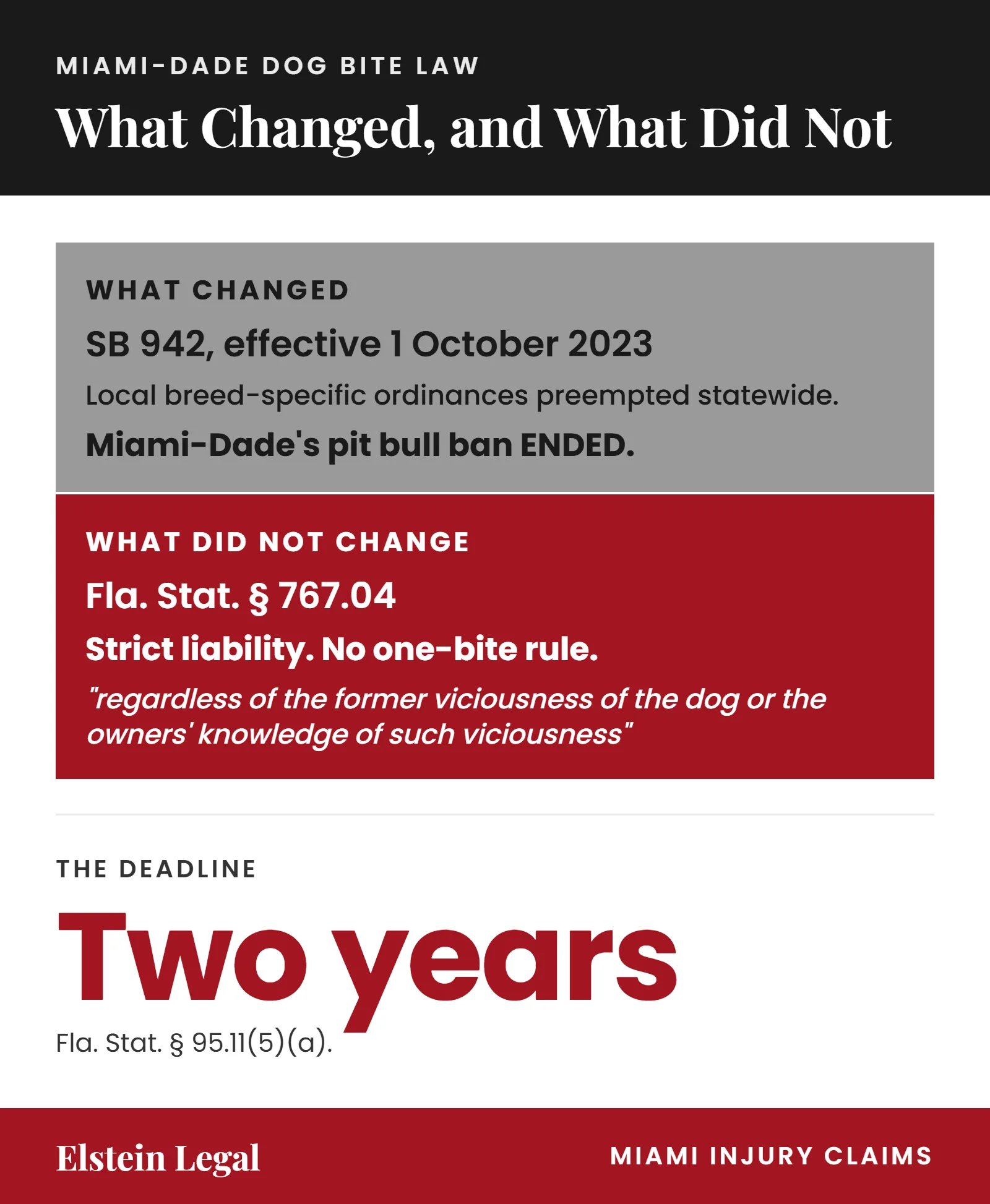
SB 942 took effect on 1 October 2023 and preempted local breed-specific ordinances statewide. Miami-Dade’s pit bull ban ended with it. A county or a city in Florida may still regulate dangerous animals, and local requirements exist and vary, but they can no longer be written around a breed.
What did not change is the part of the law your claim actually runs on. Section 767.04 never turned on breed in the first place. It asks who owned the dog, whether you were lawfully present, and what the bite cost you. It has never asked what the animal was.
The end of a breed ban reads to a lot of people like a loss of protection, and it is not one. A claim against the owner of a dog that bit you is exactly as strong today as it was before the preemption, and a breed list is not what made it strong in the first place. If someone tells you your claim depends on what kind of dog it was, they are describing an ordinance that no longer exists rather than the statute that governs your case, and the two were never the same thing.
Who You Are Actually Claiming Against
Two separate duties can run at the same time after an animal attack, and they often point at different people.
Section 767.04 gives you a claim against the dog’s owner, one person, identified by ownership rather than by who happened to be holding the leash. Running alongside it is an ordinary premises duty owed by whoever controlled the property, a different question with a different defendant whenever a tenant’s dog injures somebody in a landlord’s building, or a dog being walked by a friend bites a visitor at a third person’s home. Where the property side of the case is the real one, the occupier’s separate duty to keep the property safe is what carries it, and the two claims can be brought together.
Payment is a third question again. In most cases the money comes from a homeowner’s or renter’s liability policy rather than from the owner’s pocket, which is why a dog bite claim becomes an insurance negotiation almost immediately. Florida sets no minimum liability coverage for animal claims, so how much coverage exists is a fact to be established in your case rather than a number anyone can quote you in advance. Treat a specific figure with suspicion until it comes out of the policy itself.
People often expect PIP to step in here. Personal injury protection is a motor vehicle benefit and no part of it stands behind a dog bite, so there is no no-fault layer paying your medical bills while liability is sorted out.
| The claim | Against whom | On what basis |
|---|---|---|
| Strict liability for the bite | The dog’s owner | Fla. Stat. § 767.04 |
| Premises liability | Whoever controlled the property | The occupier’s duty of reasonable care |
| Who usually pays | A homeowner’s or renter’s liability carrier | Liability coverage. No statutory minimum exists for it in Florida |
Sorting all of that out early is ordinary case work, not something you should be expected to solve before you call anyone. It is also where Brian’s years on the defense side help, because those questions come up in the same order an adjuster works through them. There is more on that in how a carrier builds an injury file before you call anyone.
Two Years to File a Miami Dog Bite Claim
A dog bite claim in Florida must be filed within two years, at Fla. Stat. § 95.11(5)(a).
That period used to be four. HB 837, chapter 2023-15, shortened it for causes of action accruing on or after 24 March 2023, and a 2024 amendment renumbered the statute, which is why the two-year rules now sit in subsection (5) and an older citation to subsection (4)(a) is out of date.
Older figures survive online because they were once correct, which is exactly what makes them convincing. Four years still gets published for a personal injury claim in places, sometimes alongside a link to an archived version of the statute that genuinely said so when it was current. Check the year on any statute page you are sent before you rely on it.
Miami-Dade County sits in Florida’s 11th Judicial Circuit, and circuit civil matters are heard at the Osvaldo N. Soto Miami-Dade Justice Center, 20 NW 1st Avenue, Miami, Florida 33128. The old Flagler Street courthouse, which still turns up in directions online, no longer takes these filings.
Most dog bite claims settle without anyone seeing a courtroom. Where the case would go otherwise still matters, because every settlement position gets measured against that forum.
When a Bite Is Catastrophic or Fatal
Dog bite injuries land unevenly. A bite to an adult’s forearm and a bite to a small child’s face are the same statute and a completely different case, and severe facial injuries to young children are the version of this claim that most often needs reconstructive work over years rather than months. Among the trauma facilities in the county is Nicklaus Children’s Hospital, the only pediatric trauma center in South Florida verified at the highest level by the American College of Surgeons.
Where an attack kills someone, the rules change in a way that costs families weeks if they get it wrong. A wrongful death action is brought by the personal representative of the estate under § 768.20. It is not brought by the spouse, the children or the parents, who are survivors under § 768.18(1) and who recover through the action rather than filing it. Somebody has to be appointed through probate before the case can be brought at all, and that step runs inside the same two year deadline. A case involving an attack a child does not survive proceeds on that footing.
Talk to Brian
Bring whatever you have. Photographs of the injury and of where it happened, the owner’s name and address if you got them, any animal control or police report number, the names of anyone who saw it, and your medical records so far. Most people have some of that and not all of it.
Photograph the gate, the fence and any posted sign quickly, before anything gets changed, because whether a sign was prominent and easily readable is a question of fact that photographs answer. And be careful about giving a recorded statement describing what you were doing in the moments before the bite, at least until somebody has explained how that answer gets used under § 767.04 and § 768.81(6).
The firm’s published settlements do not include a dog bite matter, so what follows is the firm’s record rather than a result in this practice area. It is worth showing anyway, because a dog bite claim is a fight with a liability carrier and that is what the record is about.
| The insurer’s position | The recovery |
|---|---|
| $15,000 policy limit, carrier failed to timely tender | $2,250,000 in bad faith |
| $35,000 highest offer before Elstein took over | $240,000, in under two months |
Past results do not guarantee, warrant, or predict future outcomes. Read those as evidence of how the firm handles a carrier rather than as a prediction about your case, and see the recoveries the firm has published for the rest.
There is no fee to talk and no fee unless there is a recovery. Call (305) 299-2835 or send Brian what happened.