

You were riding in a Lyft when the crash happened, and the first number anyone quoted you was almost certainly the wrong one. Brian Elstein defended insurance companies before he represented injured people. He knows which policy is supposed to answer for a rideshare crash, and which parts of it Florida law never promised you at all.






A Lyft crash is an ordinary Miami collision with an extra layer of paperwork on top, and the paperwork is where the confusion starts. You were a passenger, you chose neither the driver nor the route, and you are now being told about a million dollars of insurance by people who have not explained what kind of insurance it is or when it applies.
Florida does regulate rideshare coverage, closely, at Fla. Stat. § 627.748. That statute is why a figure like a million dollars gets quoted at all, and it is also why the quoting so often misleads. The statute attaches a dollar amount to one kind of coverage and deliberately attaches none to another.
This page sets out which is which, and what the deadlines are. Where an answer depends on a policy nobody can read from a web page, it says so rather than filling the gap with a number that sounds right.
Why Choose Elstein Legal
Brian Elstein used to work for the insurance companies. He defended personal injury claims before he began bringing them, so he has read the side of a rideshare file a passenger never sees. He knows how a carrier decides which tier of coverage it will concede applied, and what an adjuster does with a passenger who gave a recorded statement in week one. He has watched a treatment gap come back months later.
That background is why this page leads with coverage rather than with sympathy. In a rideshare case the argument about which policy responds is usually settled before anyone argues about who drove badly.
Cases are handled personally by Brian, from one office in South Miami, on a contingency fee. No fees unless we win. Over $50 million recovered. Call (305) 299-2835, days, nights or weekends.
Past results do not guarantee, warrant, or predict future outcomes.
Case Results, and What They Do and Do Not Show
Be clear about what the firm’s published results are evidence of. None of the published settlements is a rideshare matter, so nothing here should be read as a prediction about what a Lyft claim is worth. What they show is how the firm handles a carrier that has already decided what a file is worth, which on a page about policy limits is the relevant part.
| The insurer’s position | What was recovered |
|---|---|
| $13,780 offered | $100,000, the policy limits |
| $35,000, the highest offer before Elstein took the file over | $240,000, in under two months |
| $15,000 policy limit, where the carrier failed to tender in time | $2,250,000 in bad faith, on a motorcyclist’s claim |
Read the first row against everything below. A limit is a ceiling. An offer is just a position somebody has taken. Those two get confused constantly, and the confusion almost always runs in the insurer’s favor. The full list sits at the settlements the firm publishes.
Past results do not guarantee, warrant, or predict future outcomes.
Lyft Accidents in Miami
Paid trips are how a lot of people move through this city. A ride out of the Brickell corridor at the end of an evening is the normal way to get home, and the vehicle carrying you meets the same traffic on I-95, the Dolphin Expressway and Biscayne Boulevard as everything else on the road.
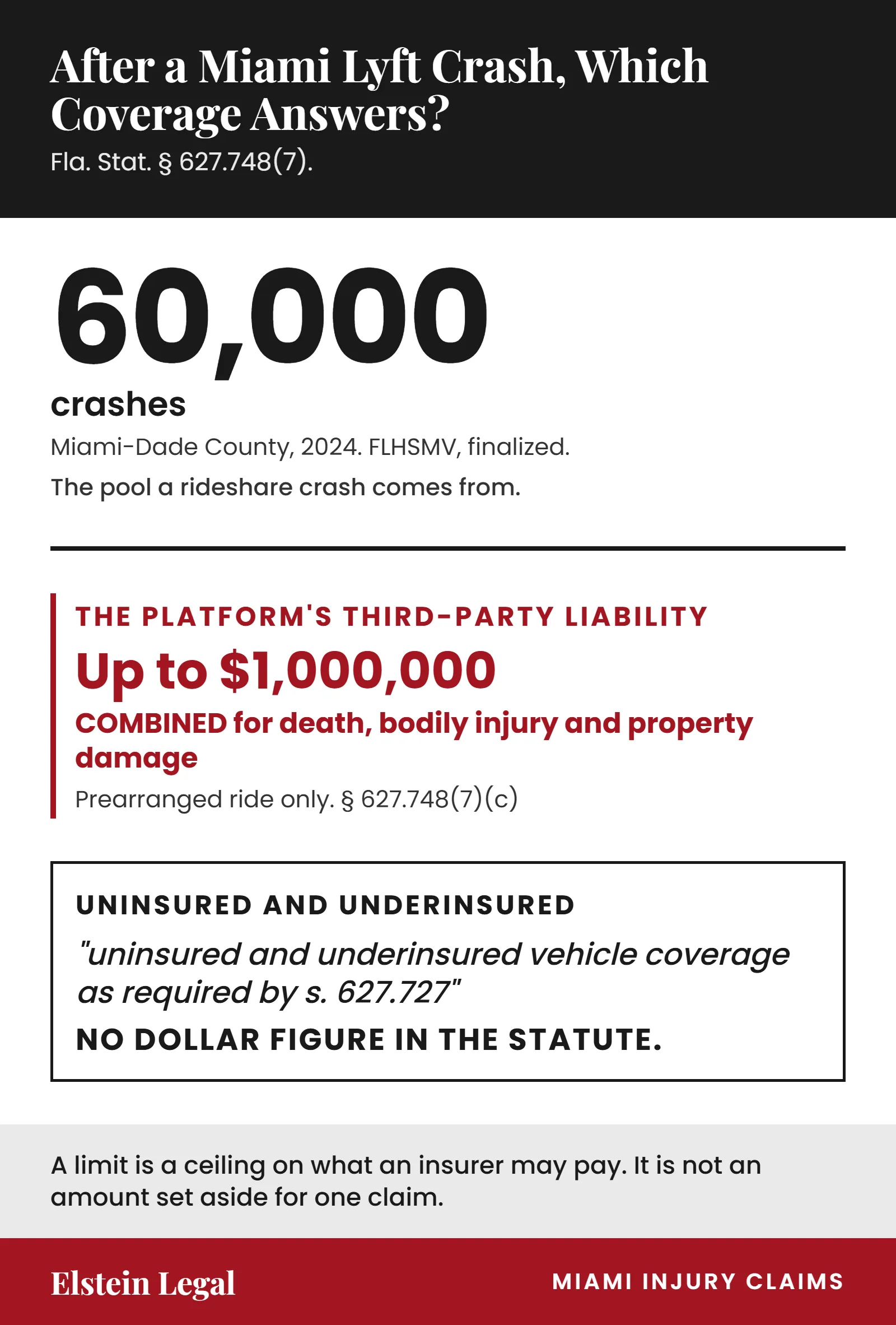
For scale, Miami-Dade County recorded 60,000 crashes in 2024 (FLHSMV, 2024, finalized). That is the pool a rideshare crash in this county comes out of, and it is county data rather than city data.
It is also the only honest number available here. No agency publishes rideshare crash data by county, by city, or at all. The Florida Highway Safety and Motor Vehicles department does not, the Florida Department of Transportation does not, and neither does the Miami-Dade open data portal. So no page, including this one, can tell you how many of those 60,000 crashes involved a Lyft, or whether rideshare travel here is more dangerous than any other kind. Any such figure came from somewhere other than a data source.
Where a suit is eventually filed is more concrete. Miami-Dade sits in the 11th Judicial Circuit, and circuit civil matters are heard at the Osvaldo N. Soto Miami-Dade Justice Center, 20 NW 1st Avenue, which opened in November 2025 and replaced the courthouse that had served the county since 1928. Most claims resolve well before a courtroom is involved, but the venue has recently changed.
What Lyft’s $1 Million Coverage Actually Is
Written the way the statute writes it, the rule goes like this.
When a driver is engaged in a prearranged ride, § 627.748(7)(c) requires at least $1 million for death, bodily injury and property damage, combined. It is the platform’s own third-party liability coverage, and it is a limit on what that insurer may pay across an entire incident. It is not a fund reserved for one injured passenger, and not a separate million dollars for medical bills with property damage stacked on top.
Most of the weight sits in the wording:
- “Up to.” A limit describes the maximum available, not the amount payable.
- “Combined.” Death, bodily injury and property damage all draw on the same figure. Several injured people in one vehicle draw on the same figure too.
- “Engaged in a prearranged ride.” The top tier applies during the trip. It is not the coverage that applies at every moment a driver has the app open.
Florida sets out the tiers in the statute itself:
| The driver’s status | What § 627.748(7) requires |
|---|---|
| Engaged in a prearranged ride, § 627.748(7)(c) | At least $1 million combined for death, bodily injury and property damage, plus personal injury protection and uninsured and underinsured motorist coverage |
| Logged on, no ride accepted, § 627.748(7)(b) | $50,000 per person and $100,000 per incident for death and bodily injury, $25,000 property damage, plus personal injury protection and uninsured and underinsured motorist coverage |
| App off | No rideshare requirement applies. The driver is an ordinary Florida motorist |
That third row deserves its own warning. When the app is off, all that exists is the driver’s personal policy, and Florida does not require a private driver to carry any bodily injury liability coverage at all. Section 627.733(1) requires personal injury protection. Section 324.022(1) requires the ability to respond in damages of $10,000 for property damage, or alternatively a policy providing at least $30,000 combined property damage and bodily injury. Neither obliges anyone to buy coverage that pays for a broken collarbone. A driver can be fully compliant with Florida law and carry nothing that answers an injury claim.
No Statute Puts a Dollar Figure on Uninsured Motorist Coverage
This is the part that a great deal of material written about Florida rideshare law gets wrong.
Both tiers of § 627.748(7) require uninsured and underinsured coverage. Neither one says how much. The statutory language is a cross-reference and nothing else:
uninsured and underinsured vehicle coverage as required by s. 627.727
No dollar figure is attached to that requirement anywhere in § 627.748(7). The million dollars in the paragraph above it belongs to the platform’s third-party liability coverage. It is not an uninsured motorist fund, it was never described as one by the Legislature, and reading it as one is how a passenger ends up believing they are protected against an amount the law never specified.
Two qualifications belong with that.
A platform may carry uninsured or underinsured limits higher than any minimum, by contract. That is a policy fact rather than a statutory one, it can change without notice, and this page prints no figure for it because none is verified. What can be checked is the statute, and it is linked above so you can read subsection (7) yourself.
And § 627.727 is a cross-reference, not a hiding place for the number. Following it does not produce a rideshare uninsured motorist amount, because § 627.748(7) never set one. That absence is worth knowing before an adjuster explains their own version of it.
A Policy Limit Is Not a Payout
An insurance limit is a ceiling. It describes the furthest an insurer can be required to go on one incident, and it says nothing about what that insurer intends to pay you. Those are two different questions, decided by different people at different points in a claim, and they get collapsed into one on purpose.
The distance between the two is what a claim is really about. A carrier valuing a file looks at the treatment record, the gaps in it, the recorded statement, the police narrative and its own view of fault. The limit sits somewhere above all of that, usually far above, and it only becomes relevant if the claim is built to reach it.
This is also why the tier question matters more than the headline figure. A crash during a prearranged ride, a crash while a driver waits for a request, and a crash with the app off sit under three different sets of requirements, and the carrier is the party deciding at the outset which one it will concede applied. That determination gets made early, and nobody explains it to you.
No number on a website answers that. What answers it is which policies exist, what status the app recorded at the moment of impact, and how quickly somebody asks for that record.
Can You Sue if Your Lyft Crashes in Miami?
Often yes, and the more useful answer is that two separate systems run at once and they have very different deadlines.
The first is Florida’s no-fault system. It applies to a rideshare crash exactly as it applies to any other motor vehicle crash, and the authority is Fla. Stat. § 627.736.
| What personal injury protection provides | Amount |
|---|---|
| Minimum benefit | $10,000 |
| Medical expenses | 80 percent |
| Lost wages | 60 percent |
| Without an emergency medical condition finding | Capped at $2,500 |
| Deadline for initial care | 14 days from the crash |
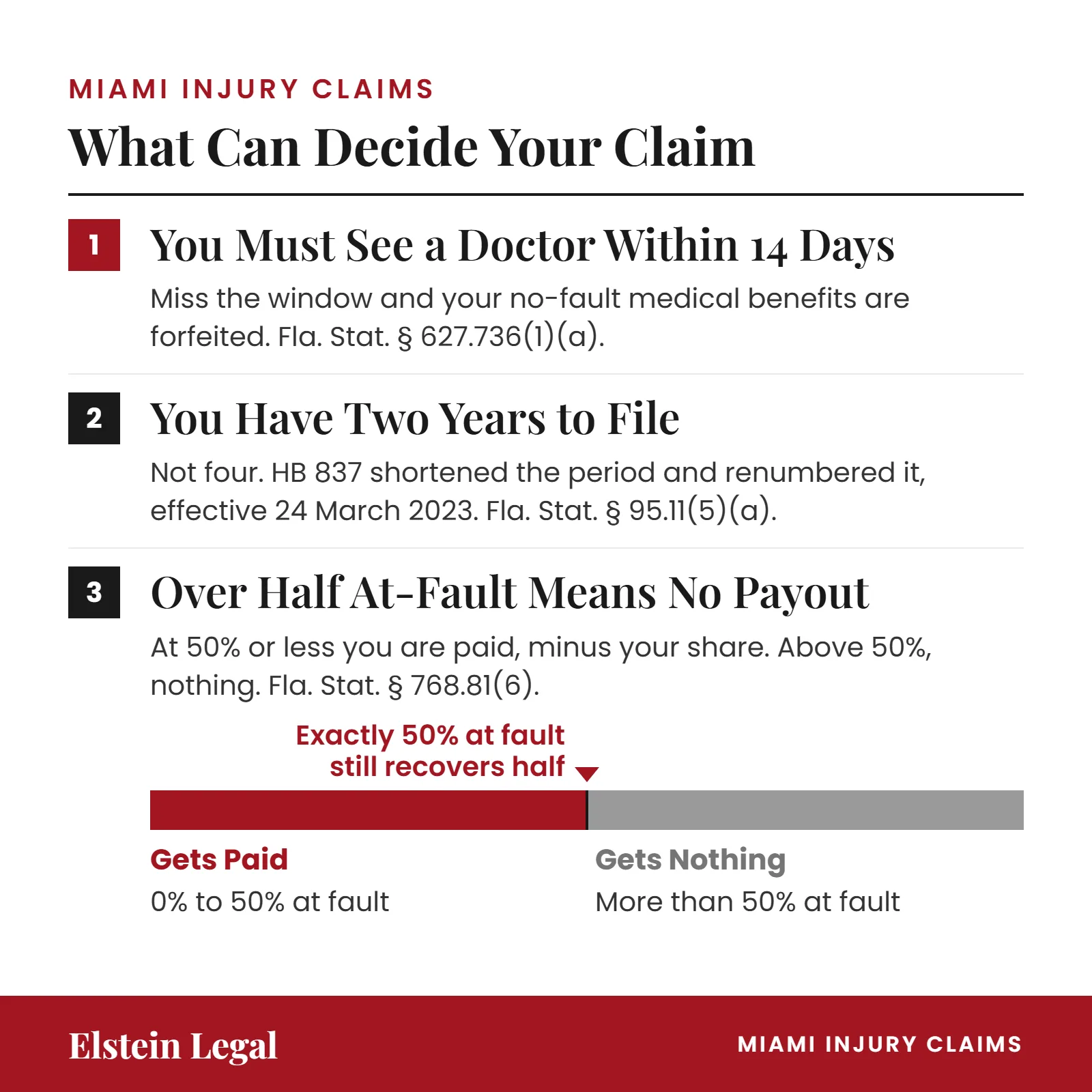
Fourteen days is the deadline that costs people money. Initial medical care must begin within fourteen days of the crash or the benefit is forfeited outright, and forfeited is the correct word. It cannot be argued back. A passenger who walks away from a Lyft crash feeling bruised, declines transport, and sees a doctor three weeks later when the neck pain stops improving has lost it.
That emergency medical condition line is worth a second read as well. Without the finding from a qualified provider, the medical benefit stops at $2,500, which does not cover an ambulance and a scan in Miami-Dade County.
One correction while this is open, because 2026 produced a great deal of writing to the contrary. Personal injury protection was not repealed. The repeal bills, SB 522 and HB 769, died in committee when the session adjourned on 13 March 2026. The minimum, the eighty and sixty percent split and the fourteen day rule are all still in force.
Stepping outside no-fault to pursue the at-fault party for pain and suffering requires meeting the threshold at § 627.737(2), satisfied by any one of four things: significant and permanent loss of an important bodily function; permanent injury within a reasonable degree of medical probability, other than scarring or disfigurement; significant and permanent scarring or disfigurement; or death. Section 627.737 sets no insurance minimums, and any page quoting a coverage figure to it is quoting the wrong statute.
What Are Some Grounds for a Lyft Accident Lawsuit?
A claim after a rideshare crash usually rests on ordinary negligence, and the defendant is not always the person holding the wheel of the car you were in.
- The rideshare driver, where the crash was caused by how that vehicle was driven
- Another motorist, which is the more common situation, since a passenger can be injured by a driver who has nothing to do with the platform
- A commercial vehicle and its operator, where a truck involved in the same crash brings a motor carrier’s own insurance tower into the case alongside the platform’s
- A vehicle owner or an employer, where the vehicle was owned by somebody else or was being used for work at the time
Where the crash happened in a different platform’s vehicle, the coverage structure is set by that platform’s arrangement, and the analysis for an Uber ride instead runs on the same statute with its own detail. The platform-neutral explanation of who pays after a rideshare crash in Florida covers both, and the full set of policies that can respond is laid out in every layer that can respond after a Florida crash.
Damage caused by a defective vehicle component is a different claim on a different clock. Product liability runs four years under § 95.11(3)(d), with a twelve year statute of repose under § 95.031(2)(b), and it must never be blurred into the negligence deadline described below.
Who May Receive Compensation for a Lyft Accident in Florida?
A passenger is not an outsider to Florida’s no-fault scheme. Section 627.736(1) names who personal injury protection reaches, and the list is explicit:
the named insured, relatives residing in the same household unless excluded under s. 627.747, persons operating the insured motor vehicle, passengers in the motor vehicle, and other persons struck by the motor vehicle
Passengers in the motor vehicle is the fourth category, written into the statute. Being in somebody else’s car on a paid trip does not put you outside the system.
Which policy pays first is a separate question, and this page will not invent an order of priority for it. Your own household coverage, the driver’s coverage and the platform’s coverage can all be in the picture, and the sequence depends on the policies rather than on a general rule. Answering it means reading declarations pages.
Whether there is anything to receive at all comes down to a deadline and a percentage.
The deadline is two years, at Fla. Stat. § 95.11(5)(a). It was four years until HB 837 took effect on 24 March 2023, and the same bill renumbered the statute, which is why the subsection is as important as the number. Subsection (3) is the four year one and covers products. Subsection (5) is the two year one and covers negligence. There is no two year subsection (4). The old figure is still in wide circulation, sometimes alongside a link to an archived version of the statute that genuinely used to say it, which makes an outdated answer look authoritative. Check the year on any statute page you are sent.
Fault is measured as a percentage, at Fla. Stat. § 768.81(6). A person found more than 50 percent at fault recovers nothing. At 50 percent or less, the recovery is reduced by their share, so somebody found exactly 50 percent responsible still recovers half. Florida is a modified comparative negligence state rather than a pure one, and the common phrasing that a claimant must be “less than 50 percent” at fault states the rule wrongly. A passenger is rarely assigned much fault, which is one of the few structural advantages of having been in the back seat.
Where a rideshare crash is fatal, the claim is brought by the personal representative of the estate under § 768.20. The spouse, children and parents are beneficiaries under § 768.18(1) and recover through the action, but they do not file it.
Common Injuries in a Lyft Accident
Rear seat passengers take an impact they did not see coming, often without a headrest positioned for them and sometimes without a belt. The injuries follow: concussion and other head trauma, cervical and lumbar spine injury, fractured ribs, wrists and collarbones from bracing, knee and facial injuries from striking the seat in front, and internal injury from the belt itself.
Head and spinal injuries behave differently from the rest. They often present as stiffness and a headache on day one and declare themselves weeks later, which collides directly with the fourteen day rule. A crash producing permanent impairment moves the case somewhere else again. When a crash leaves someone impaired for good the argument stops being about the threshold and starts being about whether the available coverage can reach the cost of a life.
How a Former Insurance Defense Lawyer Handles a Lyft Claim
Brian handles these files personally. There is no team of attorneys here and no case manager standing between you and the person doing the work, which on a rideshare claim matters more than usual, because the early decisions set the ceiling.
The first of those decisions is the tier. Which set of requirements applied depends on what the app recorded at the moment of impact, and that record sits with the platform rather than with you. Asking for it early, in writing, is what stops a carrier’s initial characterization from hardening into the agreed version of events.
After that, someone has to find the coverage. A passenger in a Miami crash may have a household policy, a resident relative’s policy, an at-fault motorist’s policy, a commercial policy and a platform policy all potentially in play. Some get volunteered. Most do not.
Then there is the record itself. Treatment gaps, the recorded statement, the crash report narrative and the documentation supporting an emergency medical condition finding are all being assembled by the other side from the first week. Knowing which side of these claims he used to work is the practical reason this page spends its length on coverage and dates rather than on adjectives.
Where another driver caused the underlying crash, Miami accident attorneys handle the same liability questions without the platform layer on top.
Talk to Brian
Bring what exists. That means the trip record from the app, including the screen showing the ride in progress, the crash report or its number, and anything a hospital gave you. Also bring the name of any insurer that has already called, and the declarations page of every auto policy in your household, including a resident relative’s.
Ahead of all that, see a doctor if you have not, because of the fourteen day rule. And hold off on giving any carrier a recorded statement until you have spoken to someone about how that answer gets used later.
There is no fee to talk and no fee unless there is a recovery. Call (305) 299-2835 or start that conversation with Brian.