

Who Pays After a Florida Crash, Layer by Layer






The first question after a crash is almost always who was at fault. It is rarely the question that decides what happens next.
Once an injury is serious, the damages exceed the coverage, often by a factor of ten or more, and the case stops being an argument about fault and becomes a search for money that actually exists. Liability tends to get resolved. Payment is what gets fought over, and it is settled by documents most people never see: declarations pages, endorsements, excess policies, and coverage sitting on vehicles nobody was driving that day.
What follows sets out those layers in the order they get reached, with the statute behind each one. It is written for the person who has been told the other driver “only had the minimum” and wants to know whether that is the end of the matter. Usually it is not.
Scale is worth stating before the money is. Florida recorded 14,026 incapacitating injuries in 2024 against 3,098 deaths (FLHSMV, 2024). For every person killed on a Florida road that year, roughly four and a half more survived with an incapacitating injury. That classification is the state’s own severity coding rather than a legal standard, and not every incapacitating injury is catastrophic. The group is still the point: survivors outnumber the dead several times over, and each one needs somebody to fund the years that follow.
Why Choose Elstein Legal
Brian Elstein used to work for the insurance companies. He defended personal injury claims before he began bringing them, which means he has read the reserve notes, sat in the adjuster meetings, and watched a carrier decide what a life-altering injury is worth to it.
That background is the reason this page exists. Most injury pages explain fault. Very few explain coverage, and coverage is where a serious claim is won or lost.
Every matter is handled personally by Brian, from one office in South Miami, on a contingency fee. No fees unless we win. Over $50 million recovered. Reach him at (305) 299-2835, days, nights or weekends.
Past results do not guarantee, warrant, or predict future outcomes.
The Five Layers, and the Order They Get Reached
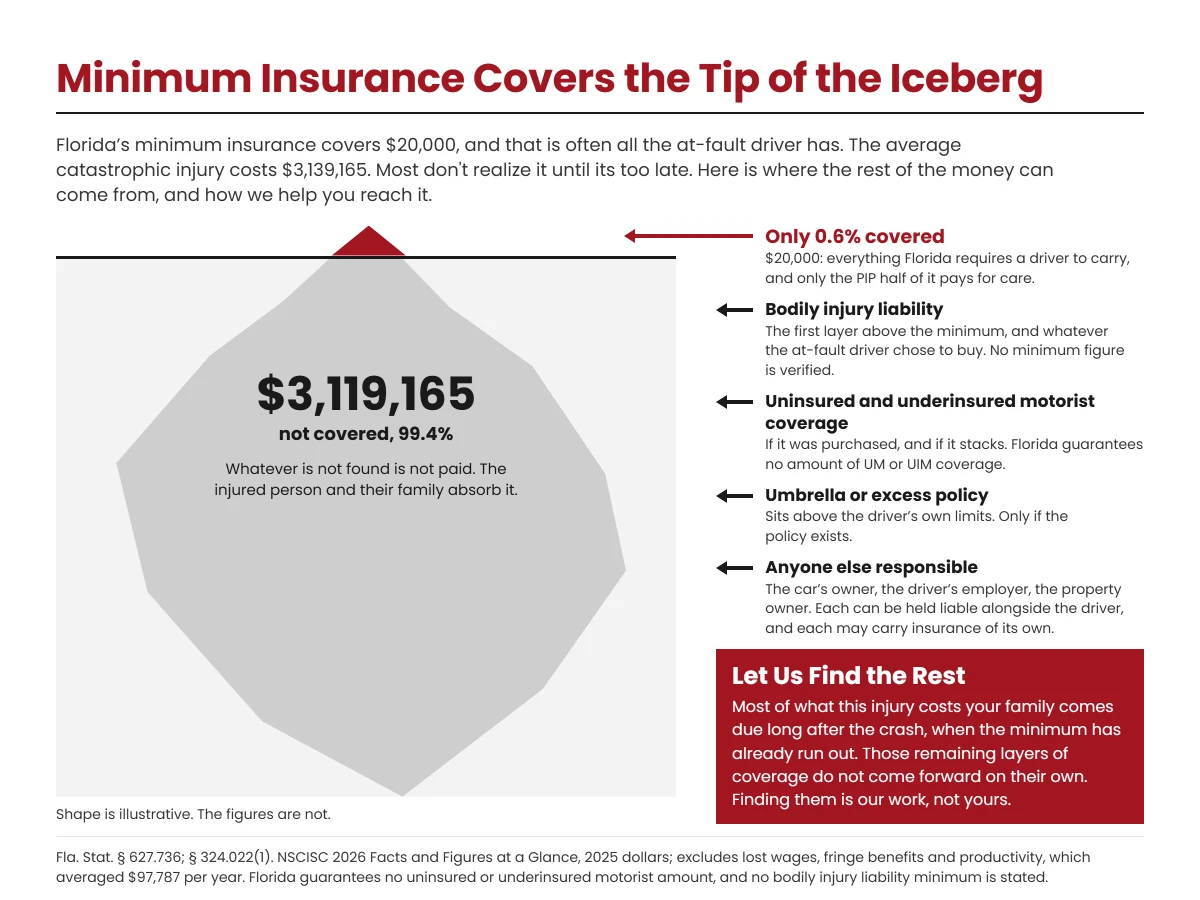
Think of coverage as a stack rather than a single policy. The bottom layer is small, mandatory and quickly gone. Everything above it has to be located, and nothing above it announces itself.
| Layer | What it is | Where it comes from | What it pays |
|---|---|---|---|
| 1 | Personal injury protection | § 627.736. Required of every registered Florida vehicle | $10,000, at 80 percent of medical bills and 60 percent of lost wages |
| 2 | The at-fault driver’s liability policy | § 324.022(1) sets a property damage requirement only | Whatever bodily injury coverage that driver chose to buy, which may be none |
| 3 | Uninsured and underinsured motorist coverage | § 627.727, on your own policy or a resident relative’s | Whatever was purchased. Frequently the largest single layer |
| 4 | Umbrella and excess policies | Sit above a primary policy, personal or commercial | Only reached once the layer beneath is exhausted |
| 5 | Additional and vicariously liable defendants | Employers, vehicle owners, commercial operators, property owners | Their own separate coverage towers |
Layer 1: PIP, and why it runs out first
Florida requires every registered vehicle to carry $10,000 in personal injury protection under Fla. Stat. § 627.736. It pays 80 percent of medical expenses and 60 percent of lost wages, regardless of fault, and it comes with two conditions that catch people out.
The first is the 14-day rule: initial medical care has to be sought within fourteen days of the crash or the benefit is lost. The second is the emergency medical condition finding. Without one from a qualified provider, medical benefits are capped at $2,500 rather than $10,000. PIP only answers a motor vehicle crash, so it does nothing in a premises case, a dog bite, or a claim about medical care. Within that limit it reaches further than the people inside the car: under § 627.736(1) it also covers a pedestrian or a cyclist struck by a motor vehicle.
Ten thousand dollars is a few days of hospital care in a serious case. That is not a criticism of the system, it is simply what the number is, and it is the reason every layer above matters.
Layer 2: What Florida actually requires the other driver to carry
Here is the fact that reframes the whole page, and almost nobody publishes it.
Florida does not require an ordinary driver to carry any bodily injury liability coverage at all.
Fla. Stat. § 324.022(1) requires the ability to respond in damages of $10,000 for property damage in any one crash, which can alternatively be met by a policy carrying at least $30,000 combined property damage and bodily injury. Section 627.733 requires PIP security. Nothing in either provision obliges a private driver to buy coverage that pays for injuring somebody.
The familiar 10/20/10 figures do exist, at § 324.021(7), but they define proof of financial responsibility rather than a purchase requirement. That definition bites afterwards, under § 324.051, when a driver in a reportable crash cannot show coverage and has their licence and registrations suspended. A suspension recovers nothing for the person in the hospital bed. Separately, § 324.023 imposes higher limits for three years on a driver convicted of DUI.
So a driver can obey Florida law to the letter, cause a catastrophic injury, and have nothing that pays for it. That is not an edge case. It is the design of the statute, and it is why the layers above exist.
Layer 3: Uninsured and underinsured motorist coverage
This is usually the most important layer, and it lives on the injured person’s own policy rather than the other driver’s.
Under § 627.727(1), a Florida motor vehicle liability policy that provides bodily injury liability coverage has to include uninsured motorist protection, unless the named insured rejects it or selects lower limits on an approved form. That form spells out what is being given up, and a signature on it is conclusively presumed to be an informed rejection binding on the whole household. One signature, often years before any crash, is why so many people learn after the fact that they have no UM coverage.
Two things follow, and both are worth checking rather than assuming.
- Stacking. A policy can be written non-stacked, in which case coverage on two or more vehicles cannot be added together for one crash. Non-stacked policies carry at least a 20 percent premium reduction. Whether the household’s policies stack is a question answered by the declarations page, never by the adjuster’s summary of it.
- Whose policy. UM on a resident relative’s policy can apply. Households routinely hold more of this coverage than anyone remembers buying.
Hit-and-run is where this layer earns its place in South Florida. Hit-and-run made up 31.7 percent of Miami-Dade crashes in 2024 against 25.7 percent statewide (FLHSMV, 2024, finalized), and the county has stayed above 31 percent every year since 2022. Statewide the figure held at 25.2 percent in 2025 (FLHSMV dashboard, 2025, preliminary). A driver who is never identified cannot be sued, so uninsured motorist coverage is generally the only layer left. That is the practical reason one in three Miami-Dade crashes is a hit-and-run is a coverage statistic rather than a traffic one.
Layer 4: Umbrella and excess
An umbrella or excess policy sits above a primary policy and only responds once the layer beneath it is exhausted. Personal umbrellas are common on households with property, and commercial excess towers are standard on any business large enough to own vehicles or premises.
Neither is ever volunteered. They surface through full declarations pages, through discovery that requires disclosure, and through knowing what to look for. A carrier answering “the policy is $50,000” has answered a narrower question than the one that matters.
Layer 5: Additional and vicariously liable defendants
The last layer is not a policy, it is another defendant, and each one brings its own coverage.
- An employer, where the driver was working at the time.
- A vehicle owner, under Florida’s dangerous instrumentality doctrine, even if they were not driving.
- A commercial operator, including trucking companies, delivery contractors and rideshare platforms.
- A property owner or contractor, where the condition of the place contributed.
Bad faith belongs here too. When a carrier fails to handle a clear claim within its limits, the policy limit can stop being the ceiling. The firm’s own results include a matter where it stopped being the ceiling by a factor of 150.
What a Serious Injury Actually Costs
The stack only makes sense against the number on the other side of it. For spinal cord injury the national baseline comes from the National Spinal Cord Injury Statistical Center, which restates its table every March. These figures are in 2025 dollars.
| Injury level | Lifetime cost, injured at 25 | Lifetime cost, injured at 50 | First year | Each later year |
|---|---|---|---|---|
| High tetraplegia, C1 to C4 | $6,419,617 | $3,528,112 | $1,446,827 | $251,246 |
| Low tetraplegia, C5 to C8 | $4,690,573 | $2,885,122 | $1,045,459 | $154,128 |
| Paraplegia | $3,139,165 | $2,060,139 | $705,131 | $93,409 |
| Motor functional, AIS D | $2,144,693 | $1,513,784 | $472,190 | $57,353 |
One line of small print matters more than the table. NSCISC excludes lost wages, fringe benefits and productivity from every figure above, and puts that loss at an average of $97,787 per year. Lost earning capacity is therefore additional to these numbers rather than inside them, which on a young client is a difference measured in millions.
Set $10,000 of PIP against $3,139,165 for paraplegia at 25 and the arithmetic of a catastrophic claim is visible in one line. The layers are not a technicality. They are the difference between a funded life and an unfunded one, which is why this argument runs through every page about when the injury is permanent and, where someone did not survive, a claim brought by the estate.
The First Offer Is Not What the Claim Is Worth
An opening offer is a number the carrier chose, not a valuation anyone tested. The firm’s published results show what the distance between those two things looks like in practice.
The clearest example is a motorcyclist whose case carried a $15,000 policy limit. The carrier failed to timely tender it. The recovery was $2,250,000, and it came from the carrier’s bad faith rather than from the policy, which is the whole argument of this page compressed into one matter: the policy limit is where the analysis starts, not where it ends.
Another case had been valued by its insurer at $35,000 before Elstein Legal took it over. It resolved for $240,000 in under two months. Elsewhere a $13,780 offer became $100,000 in policy limits, and $145,000 offered before suit became $570,000. Two more were matters where liability had been denied outright and the limits were recovered anyway.
None of that is a promise about any other case. It is evidence that the first number is a negotiating position, and that the work of a serious claim is finding what sits behind it. The full set is published: what carriers offered, and what was actually recovered.
Past results do not guarantee, warrant, or predict future outcomes.
PIP Was Not Repealed
A great deal of material published in 2026 says Florida repealed no-fault and PIP on 1 July 2026. It is wrong, and it is worth correcting here because a coverage page is exactly where somebody arrives already believing it.
PIP is still in force. The 2026 repeal bills, SB 522 and HB 769, died in committee, and the session adjourned sine die on 13 March 2026. Earlier attempts failed the same way: SB 54 was vetoed in 2021, SB 464 died in 2024, and HB 1181 and SB 1256 died in 2025. The $10,000 limit, the 80 and 60 percent split, the $2,500 cap without an emergency medical condition finding, and the 14-day rule all still apply under § 627.736.
Repeal will almost certainly be filed again. Until it passes, anything telling you the 14-day deadline no longer matters is telling you to miss it.
Rideshare Coverage, Stated Correctly
Rideshare is where coverage explanations go wrong most often, including on other law firms’ websites, so this section states what Fla. Stat. § 627.748 actually says.
| Driver status | What the statute requires |
|---|---|
| App on, no passenger matched, § 627.748(7)(b) | $50,000 per person and $100,000 per incident for death and bodily injury, $25,000 property damage, plus PIP and uninsured and underinsured coverage |
| Engaged in a prearranged ride, § 627.748(7)(c) | At least $1 million for death, bodily injury and property damage combined |
Two corrections that matter. The $1 million figure is a combined limit that includes property damage. It is not a million dollars of injury coverage with property damage stacked on top. And no Florida statute provides $1 million in uninsured or underinsured motorist coverage. Both tiers of § 627.748(7) require only uninsured and underinsured vehicle coverage “as required by s. 627.727,” with no dollar figure attached. Uber and Lyft may carry higher limits by contract, which is a fact about their policies rather than about Florida law, and the only way to know is to read the policy in force on the day.
If you were injured in an Uber or in a Lyft crash, the driver’s status at that moment decides which tier applies, and that detail comes out of the platform’s own trip data rather than from the driver’s account of it.
Where Your Claim Is Handled
Coverage is state law and it reads the same everywhere in Florida. What changes by city is where a badly injured person is treated, which decides where the medical record is created and, later, which transfer a carrier will point at when it argues about causation.
- Miami. Ryder Trauma Center at Jackson Memorial is a Level I center, and the city carries both the federal Spinal Cord Injury and Traumatic Brain Injury Model Systems, so a Miami claim that begins at Ryder Trauma Center usually has the most complete record of any in South Florida.
- Miami Beach. There is no trauma center on the island at any level. Hildebrandt Emergency Center at 4300 Alton Road is the only emergency department, which means an injury that has to leave Miami Beach by ambulance starts with a transfer off the island.
- Hialeah. Neither trauma care nor specialty rehabilitation exists inside the city, so a Hialeah case where both the trauma care and the rehabilitation are elsewhere is built from records created in two other places.
- Fort Lauderdale. Broward Health Medical Center on South Andrews Avenue is a Level I trauma center within the city limits, and a Fort Lauderdale claim treated inside the city is the rare one where nothing has to move.
- Pompano Beach. The nearest trauma center is Broward Health North, the only Level II in the county, so a Pompano Beach injury that reaches the county’s only Level II center is treated at a different tier from a Fort Lauderdale one.
- West Palm Beach. St. Mary’s Medical Center on 45th Street is Level I and takes trauma from the part of Palm Beach County north of Southern Boulevard, which is what defines a West Palm Beach claim north of Southern Boulevard.
- Delray Beach. Delray Medical Center is Level I and specialty brain and spinal rehabilitation sits on the same boulevard, so a Delray Beach case where trauma and rehabilitation sit on one boulevard has the shortest path in the region from injury to rehab.
- Boca Raton. There is no trauma center here either, and Palm Beach County Fire Rescue delivers major trauma to Delray Medical Center, so a Boca Raton injury that is treated in Delray Beach involves a transfer before any serious treatment begins.
Deadlines and Fault
Finding the layers takes time, and the clock does not wait for it.
Most Florida negligence claims must be filed within two years, at § 95.11(5)(a). That deadline was four years until HB 837 took effect on 24 March 2023, and the same bill renumbered the statute, so a source citing the old subsection is quoting a provision that no longer says what it once did. Product liability is the exception at four years, under § 95.11(3)(d), with a twelve-year repose at § 95.031(2)(b). Claims against a government entity carry separate presuit notice rules under § 768.28, and no flat period is stated here because that answer is claim-specific.
Fault still prices the recovery even after the coverage is found. Under § 768.81, a person found more than 50 percent at fault recovers nothing, and at 50 percent or less the award is reduced by their share. Note the phrasing, since many sites get it backwards: a plaintiff at exactly 50 percent still recovers, reduced by half. Florida is a modified comparative negligence state rather than a pure one. On a claim worth $4 million, a 30 percent finding removes $1.2 million, which is more than most policies hold.
Where a crash caused the injury, the coverage work and the fault investigation run together, and after a Miami car accident both start in the same week. For how the rest of it unfolds, how a catastrophic claim actually proceeds covers the sequence.
Send Us the Policy
Bring whatever exists: the crash report, the other driver’s insurer, and the declarations page of every policy in the household, including ones that seem irrelevant. If you do not have them, that is normal, and finding them is part of the work.
There is no fee to talk and no fee unless there is a recovery. Call (305) 299-2835 or send us the policy and we will read it. It will be read by the years Brian spent reading these policies for the other side. If you are not yet sure what kind of claim this is, every kind of claim the firm handles is a reasonable place to start, and the rest of this library sits under Florida injury law resources.
Frequently Asked Questions
The other driver had no insurance. Is my claim over?
No. Florida does not require a private driver to carry any bodily injury liability coverage, so an uninsured at-fault driver is common rather than unusual. Your own uninsured and underinsured motorist coverage, and coverage on a resident relative’s policy, is the layer that normally answers. Beyond that, an employer, a vehicle owner or a property owner may be liable alongside the driver, each with separate insurance.
Does Florida require drivers to carry $10,000 in bodily injury coverage?
It does not require any. Section 324.022(1) requires $10,000 for property damage, or a policy carrying at least $30,000 combined property damage and bodily injury, and § 627.733 requires $10,000 in PIP. The 10/20/10 figures that circulate come from § 324.021(7), which defines proof of financial responsibility and applies after a reportable crash, not as a purchase requirement beforehand.
What does stacking mean, and do I have it?
Stacking is adding uninsured motorist coverage across two or more vehicles on one policy for a single crash. A policy can be written non-stacked, in which case the limits cannot be combined, and a non-stacked policy carries at least a 20 percent premium reduction. Whether yours stacks is answered by the declarations page and the endorsements, so send them rather than relying on what an adjuster says the policy holds.
Am I guaranteed $1 million in coverage if I am hurt in an Uber or Lyft?
No, and any page saying so is misreading the statute. The $1 million tier at § 627.748(7)(c) applies while the driver is engaged in a prearranged ride, and it is a combined limit covering death, bodily injury and property damage together. No Florida statute provides $1 million in uninsured or underinsured motorist coverage. The platforms may carry more by contract, which has to be confirmed against the policy in force that day.
Did Florida repeal PIP in 2026?
No. SB 522 and HB 769 died in committee and the 2026 session adjourned sine die on 13 March 2026. PIP, the $10,000 limit, the 80 percent medical and 60 percent wage split, the $2,500 cap without an emergency medical condition finding, and the 14-day treatment deadline are all still in force under § 627.736. Anything telling you otherwise is telling you to miss a deadline.
How do I find out whether an umbrella or excess policy exists?
By asking for it in a form that has to be answered. Carriers disclose the primary policy readily and say nothing about what sits above it. Full declarations pages, discovery directed at excess and umbrella coverage, and identifying every potentially liable party are what surface those layers. This is ordinary work in a serious case, and it is the reason two claims with identical facts can settle at very different numbers.
How long do I have, and what does it cost to ask?
Most Florida negligence claims run two years under § 95.11(5)(a), with product liability at four under § 95.11(3)(d) and separate rules for claims against government entities under § 768.28. Asking costs nothing. The firm works on a contingency fee, so there are no fees unless there is a recovery, and Brian handles matters personally rather than passing them on. He is reachable at (305) 299-2835 at any hour.
Reach Brian Elstein, Miami Personal Injury Lawyer
The consultation is free and there is no fee unless we win. Tell Brian what happened and find out what your case is really worth.
Find out what your case is worth
Free, confidential evaluation. We’ll contact you right away.