


The other driver did not stop. That one fact reorganises the whole claim, because the person who caused the injury is also the person whose insurance was supposed to answer for it.
In Miami-Dade County this is close to routine. Of the 60,000 crashes recorded in the county in 2024, 19,046 were hit-and-runs, which is 31.7 percent against 25.7 percent for Florida as a whole (FLHSMV, 2024). Roughly one crash in three, in the county that already records more crashes than any other in the state.
So the question a hit-and-run victim faces is not really about proving fault. Nobody is arguing that the driver who fled was in the right. The question is which policy pays when there is no at-fault policy to claim against, and the answer is almost always coverage the injured person already owns and has never had a reason to read.
Why Choose Elstein Legal
Brian Elstein defended insurance companies before he started representing the people bringing claims against them. He has read the reserve notes and sat in the adjuster meetings, which is why a page about a hit-and-run on this site spends its time on coverage rather than on blame.
That background is measurable rather than decorative. On one matter a carrier held a $15,000 policy limit and did not timely tender it. The recovery was $2,250,000, and it came from the carrier’s bad faith rather than from the policy.
Every case is handled personally by Brian, from one office in South Miami, on a contingency fee. No fees unless we win. Over $50 million recovered. Call (305) 299-2835 at any hour.
Past results do not guarantee, warrant, or predict future outcomes.
One in Three Miami-Dade Crashes Is a Hit-and-Run
The rate has held. Hit-and-run accounted for 34.3 percent of Miami-Dade County crashes in 2022, 33.4 percent in 2023 and 31.7 percent in 2024, every one of those years finalized by the state. Statewide the share sits lower and just as steady, at 25.2 percent across 2025 and 25.5 percent in the first 211 days of 2026, both preliminary figures from the FLHSMV dashboard and neither of them a Miami-Dade number.
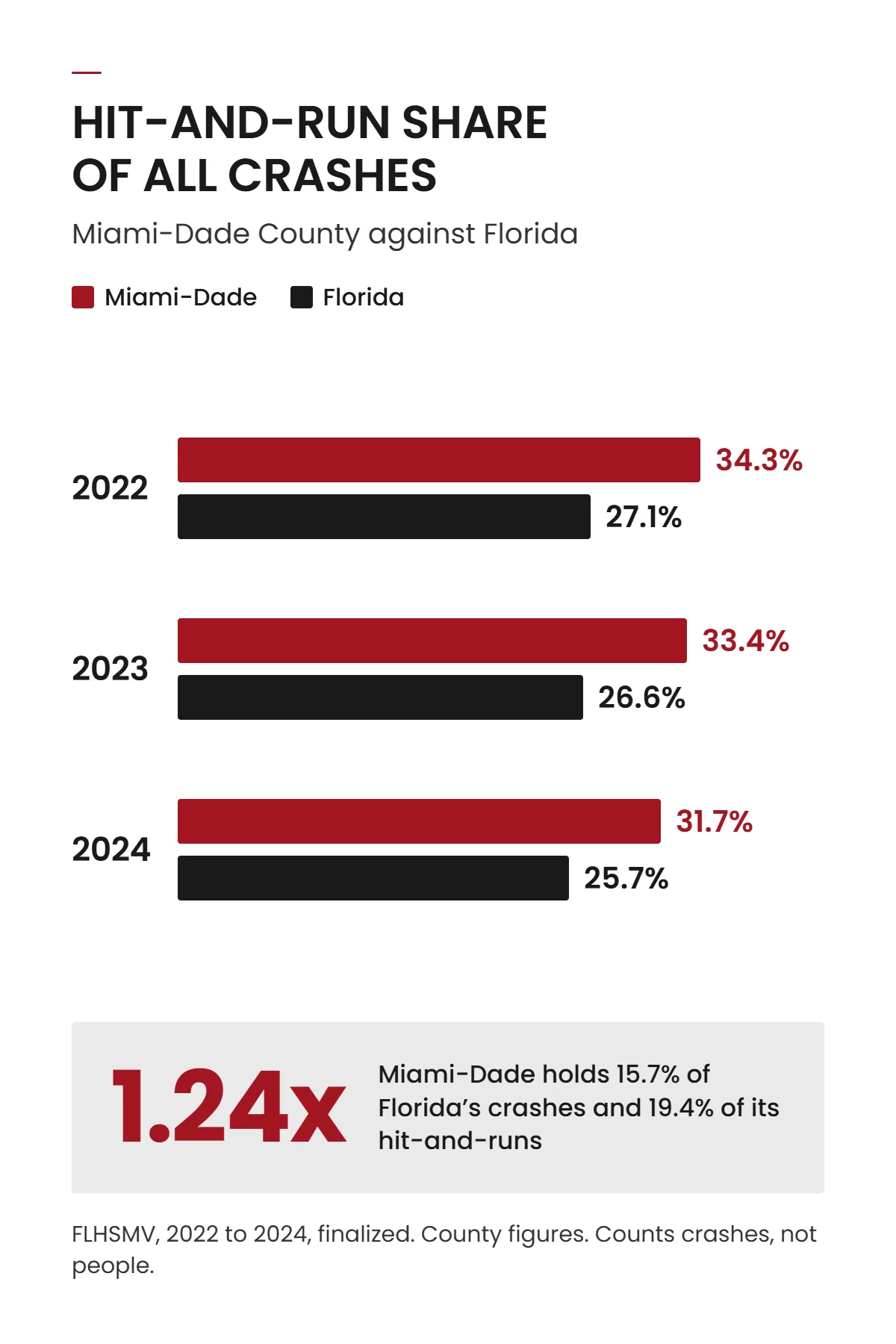
Set against the rest of Florida, the county is carrying more of this than its size explains. Miami-Dade accounts for 15.7 percent of Florida’s crashes but 19.4 percent of its hit-and-runs, which puts the local rate at 1.24 times the state rate.
One detail governs how all of that should be read. These figures count crashes, not people, and they are county figures. No agency publishes hit-and-run data for Miami, Miami Beach or Hialeah separately, so a number attached to a single city is a number somebody made up.
What the pattern tells an injured person is simple enough. A driver leaving the scene in Miami-Dade is not a freak event to be treated as an outlier by an insurer, and it has not been for years.
A Driver Who Leaves Takes the Liability Policy With Them
Every ordinary crash claim runs on the at-fault driver’s bodily injury liability coverage. Remove the driver and that layer disappears, and the loss does not.
Uninsured motorist coverage is what a hit-and-run claim usually runs on instead. It sits on the injured person’s own policy under Fla. Stat. § 627.727, and it exists precisely for the crash where the other side has nothing to pay with. Underinsured motorist coverage does the same job when a driver is identified but carries far less than the injury costs.
Two things about that coverage decide many Miami-Dade cases before a lawyer is ever called.
It has to have been purchased. A Florida insurer must offer uninsured motorist coverage with a motor vehicle liability policy, and the insured can reject it in writing. Plenty of people did, years ago, on a form they no longer remember signing. Whether it was bought, at what limit, and whether the policies in a household stack are questions answered by the declarations pages, never by assumption.
No Florida statute guarantees an amount. There is no automatic $1 million in uninsured or underinsured motorist coverage in this state, whatever a competing page may imply. The limit is whatever was purchased.
Coverage layers stack up in an order worth understanding before an adjuster explains it, and where the money actually comes from sets out that order in full. In a serious case the search widens beyond the obvious policy:
- Uninsured and underinsured motorist coverage on the injured person’s own policy, and on the policy of any resident relative. Whether those limits stack depends on what was bought, and it is checked rather than assumed.
- An umbrella or excess policy sitting above the primary one, which nobody finds unless somebody asks for the declarations pages.
- An employer or vehicle owner who is liable alongside the driver, which becomes live if the driver who fled is later identified.
- Bad faith exposure, which arises when a carrier mishandles a clear claim within its limits and which can stop the policy limit being the ceiling.
There is also a local figure worth holding onto. As of November 2025, an industry estimate put uninsured drivers at about 5.34 percent of Miami-Dade’s roughly 2.44 million registered vehicles, which is in the region of 130,000 motorists. That figure comes from an insurance industry source rather than from a state agency, so treat it as an order of magnitude. It is not published by FLHSMV, which produces no rankings of that kind at all.
What PIP Does, and Where It Stops
Personal injury protection is the one benefit that does not care who caused the crash, which is exactly why it matters after a hit-and-run. It also runs out quickly.
| What PIP does | Detail |
|---|---|
| Pays regardless of fault | No at-fault driver has to be identified for it to respond |
| Carries a $10,000 limit | Fla. Stat. § 627.736 |
| Pays 80 percent of medical expenses and 60 percent of lost income | Both within that same $10,000 |
| Drops to $2,500 without an emergency medical condition finding | A qualified provider has to make the finding for the full $10,000 to be available |
| Requires care within 14 days | Initial treatment has to begin inside two weeks of the crash |
Despite what a great deal of material published in 2026 claims, PIP was not repealed. The 2026 repeal bills died in committee and the session adjourned in March without passing them, so the $10,000 limit and the 14-day rule are both still in force.
Ten thousand dollars covers an emergency department visit and some imaging. It does not cover surgery, and it does not cover the months after. That gap is the whole of the argument on when a hit-and-run leaves someone permanently injured, where the cost of care is measured in decades rather than in bills.
PIP applies to people in a motor vehicle, so the analysis looks different again for people struck while walking and for cyclists hit and left at an intersection. Whether any PIP benefit reaches them depends on the policies in their own household, which is a question to raise in the first week rather than the fifth.
What to Do After a Hit-and-Run
Four things matter, and the first two are close to time-critical.
- Report it to police and get the report number. A hit-and-run claim rests on evidence that the crash happened as described, and the police report is the spine of that record. Most uninsured motorist policies also impose their own reporting conditions, and those conditions run in days rather than months.
- Get medical care inside 14 days. Miss that window and the PIP benefit is gone, whatever the injury turns out to be. It is the single deadline most commonly lost by people who felt able to walk away from the scene.
- Notify your own insurer, and read the declarations pages. Every policy in the household counts, including ones attached to a car that was nowhere near the crash.
- Preserve what disappears. Nearby business and residential cameras usually overwrite within days, and debris and paint transfer are cleared from the roadway within hours. A driver who fled is sometimes identified later, which turns the case back into a Miami car accident claim with a liability policy behind it.
The Deadline, and the Fault Question
Most Florida negligence claims have to be filed within two years, under Fla. Stat. § 95.11(5)(a). That was four years until HB 837 took effect on 24 March 2023, and the same bill renumbered the statute, so a source citing the old subsection is working from superseded text. Right duration, wrong provision, is a common enough error that it is worth checking before relying on any deadline you read online.
A claim against an insurer for uninsured motorist benefits is a contract claim rather than a negligence claim, and it can run on a different clock. Nobody should treat the two-year figure as the outer limit on every step, and nobody should wait to find out which rule applies to their own claim.
Fault still matters even when the other driver is gone. Under Fla. Stat. § 768.81, a person found more than 50 percent at fault recovers nothing, and at 50 percent or less the recovery is reduced by that share. Note the phrasing, because a great many sites get it backwards: a claimant found exactly 50 percent responsible still recovers, reduced by half. Florida is a modified comparative negligence state rather than a pure one. An uninsured motorist carrier arguing that an absent driver was less at fault than its own insured is making the same argument any liability carrier would, and it has more room to make it when the other driver is not there to contradict anything.
Talk to Brian
Bring the police report, the hospital paperwork, and the declarations pages of every auto policy in the household. If you do not have them, that is fine. Finding the coverage is part of the work.
There is no fee to talk and no fee unless there is a recovery. Call (305) 299-2835 or tell us what happened, and the file will be reviewed by the one person handling it, because Brian spent years on the carrier’s side of these files before he started opening them from this side.
Frequently Asked Questions
How common are hit-and-run crashes in Miami-Dade?
Of the 60,000 crashes recorded in Miami-Dade County in 2024, 19,046 were hit-and-runs, which is 31.7 percent against 25.7 percent statewide (FLHSMV, 2024). The share has stayed above 31 percent in the county every year since 2022. These are county figures counting crashes rather than people, and no agency publishes a separate figure for any individual city inside the county.
Who pays if the driver who hit me is never found?
Usually your own uninsured motorist coverage, if it was purchased. There is no at-fault policy to claim against when the driver is not identified, so the recovery comes from coverage you or a resident relative already own. Personal injury protection also pays regardless of fault, up to $10,000 under Fla. Stat. § 627.736, but that is a starting point rather than a settlement.
Does Florida law give me $1 million in uninsured motorist coverage?
No. No Florida statute sets a dollar amount for uninsured or underinsured motorist coverage. Your limit is whatever was purchased on the policy, which is why the declarations pages matter so much. Any page telling you the law guarantees a figure is describing something that does not exist.
What if I rejected uninsured motorist coverage years ago?
Check before assuming it. A Florida insurer must offer the coverage with a motor vehicle liability policy and a rejection has to be in writing, so the paperwork exists somewhere. Other policies in the household may also respond, and an umbrella or excess policy may sit above the primary one. This is worth a proper review rather than a phone call to the adjuster.
I did not go to hospital that day. Have I lost my PIP benefits?
Only if more than 14 days have passed. Fla. Stat. § 627.736 requires initial services and care within 14 days of the crash for personal injury protection benefits to be available. Symptoms from a serious impact often surface after the adrenaline fades, so the safe course is to be seen quickly even if you feel able to walk away.
Was Florida’s PIP system repealed in 2026?
It was not. Repeal bills were filed in the 2026 session and died in committee when the session adjourned in March, which is the same outcome as several previous attempts. The $10,000 limit, the 80 percent medical and 60 percent wage split, and the 14-day rule all remain in force. A number of sites published in 2026 say otherwise and they are wrong.
What does it cost to have Elstein Legal look at a hit-and-run claim?
Nothing up front. The firm works on a contingency fee, so there are no fees unless there is a recovery, and the first conversation is free. Brian handles cases personally rather than passing them to an associate, and he is reachable at (305) 299-2835 at any hour.


