

A driver hit you while you were walking, and the first thing you were told about insurance was probably wrong. Brian Elstein defended insurance companies before he represented injured people. He knows which policy is supposed to respond when a pedestrian is struck, and how quickly that answer expires.






You were walking. That changes the insurance question in a way most people never hear about, and the cost of not hearing about it shows up inside the first two weeks.
Florida runs a no-fault insurance system, and nearly everything written about it describes people sitting inside cars. So a person struck in a crosswalk on Biscayne Boulevard gets told, accurately and uselessly, that their own policy might apply. Nobody mentions the part that decides whether any of it pays. Section 627.736(1) sets out who personal injury protection reaches, and the last category on that list is “other persons struck by the motor vehicle.” A pedestrian is in it. The fourteen day clock on that benefit started at the moment of impact, and it does not pause because you spent the first week of it in a hospital bed.
Fault is the second half of the problem, and it is where a pedestrian claim is really fought. Drivers and their insurers reach for the same three arguments every time: you stepped out, you crossed outside the crosswalk, you were wearing dark clothes. Florida law answers all of that with a right of way statute that runs in both directions, and with a comparative fault rule that converts a percentage into a dollar figure. Both are worth understanding before you talk to anybody’s adjuster.
The statute sections are written out below so you can check them yourself. Where an answer depends on facts nobody can know from a web page, this page says so rather than guessing.
Why Choose Elstein Legal
Brian Elstein used to work for the insurance companies. He defended personal injury claims before he began bringing them, so he has seen how the other side builds a file on a pedestrian case: which gaps in a medical record get flagged, how a delayed first appointment is used later, and what an adjuster is trained to do with a police report that puts you outside the crosswalk.
That is why this page spends its first sections on coverage and deadlines rather than on sympathy. In a pedestrian case the money question is usually settled long before anyone argues about who was careless.
Cases are handled personally by Brian, from one office in South Miami, on a contingency fee. No fees unless we win. Over $50 million recovered. Call (305) 299-2835, days, nights or weekends.
Past results do not guarantee, warrant, or predict future outcomes.
Florida No-Fault Reaches a Person on Foot
Read the statute rather than the summaries. Fla. Stat. § 627.736 requires an insurer to provide personal injury protection to a specific list of people, and subsection (1) names them:
the named insured, relatives residing in the same household unless excluded under s. 627.747, persons operating the insured motor vehicle, passengers in the motor vehicle, and other persons struck by the motor vehicle.
That last clause is the one that matters here. A person on foot is not outside Florida’s no-fault system. They are in the last category of the people it was written to cover.
| Who § 627.736(1) reaches | Applies to a struck pedestrian? |
|---|---|
| The named insured | Yes, if a policy exists in the household |
| Relatives residing in the same household, unless excluded under s. 627.747 | Yes, if a resident relative carries a policy |
| Persons operating the insured motor vehicle | No |
| Passengers in the motor vehicle | No |
| Other persons struck by the motor vehicle | Yes. This is the pedestrian’s route in |
There is a qualification here, and it is the part that usually gets left out. Personal injury protection is bought by a household, and it is the struck person’s own household coverage that responds first. Whether a benefit exists in any particular case is a policy question rather than an automatic yes. If you own a car, you have a policy. If you live with a relative who owns one, that relative’s coverage may reach you. Someone who owns no vehicle and lives in a household with no auto policy may have no personal injury protection route at all.
Nobody should tell you which of those you are without reading the actual declarations pages, and this page will not try. What it will say is that the question is worth answering in the first two weeks rather than the first month, and the fourteen day rule below is why.
One more point, because a great deal of material published in 2026 says otherwise. Personal injury protection was not repealed. The 2026 repeal bills, SB 522 and HB 769, died in committee when the session adjourned on 13 March 2026. The $10,000 minimum, the 80 and 60 percent split and the fourteen day rule are all still in force.
The Fourteen Day Deadline
Initial medical care must begin within fourteen days of the crash, or personal injury protection benefits are forfeited. Not reduced. Forfeited.
The rule lands hardest on pedestrians, because the person hit by a car is the one participant in the event with no vehicle, no insurance card in a glove box and nobody at the scene handing them a claim number. Plenty of struck pedestrians get treated at the roadside, decline transport because nothing appears broken, then see a doctor three weeks later when the neck pain stops improving. By then the benefit is gone and no argument brings it back.
| What personal injury protection pays | Amount |
|---|---|
| Minimum benefit | $10,000 |
| Medical expenses | 80 percent |
| Lost wages | 60 percent |
| Without an emergency medical condition finding | Capped at $2,500 |
| Deadline for initial care | 14 days from the crash |
That emergency medical condition line is worth reading twice. A qualified provider has to make the finding for the full $10,000 to be available. Without it the medical benefit stops at $2,500, which does not cover an ambulance ride and a CT scan in Miami-Dade County.
Two weeks is also short next to the way a serious pedestrian injury actually behaves. Concussions, soft tissue damage and hairline fractures often look like nothing worse than bruising and stiffness on day one. The clock runs anyway. If you were struck by a vehicle and have not been examined, that is the appointment to make today, ahead of any legal question.
Where People Are Struck in Miami-Dade
The streets that come up most often in pedestrian cases here are the ones people already know. Calle Ocho, which is SW 8th Street and carries both the Tamiami Trail and US 41 designations. The Julia Tuttle Causeway. Biscayne Boulevard, US 1. The Brickell corridor. Little Havana, Little Haiti, Liberty City, Midtown Miami and South Miami Beach.
Naming a street is not the same as measuring one, and this page will not pretend otherwise. Florida publishes no crash data below county level, so no honest source ranks one Miami intersection against another. The county is what gets measured, and the county numbers are worth reading.
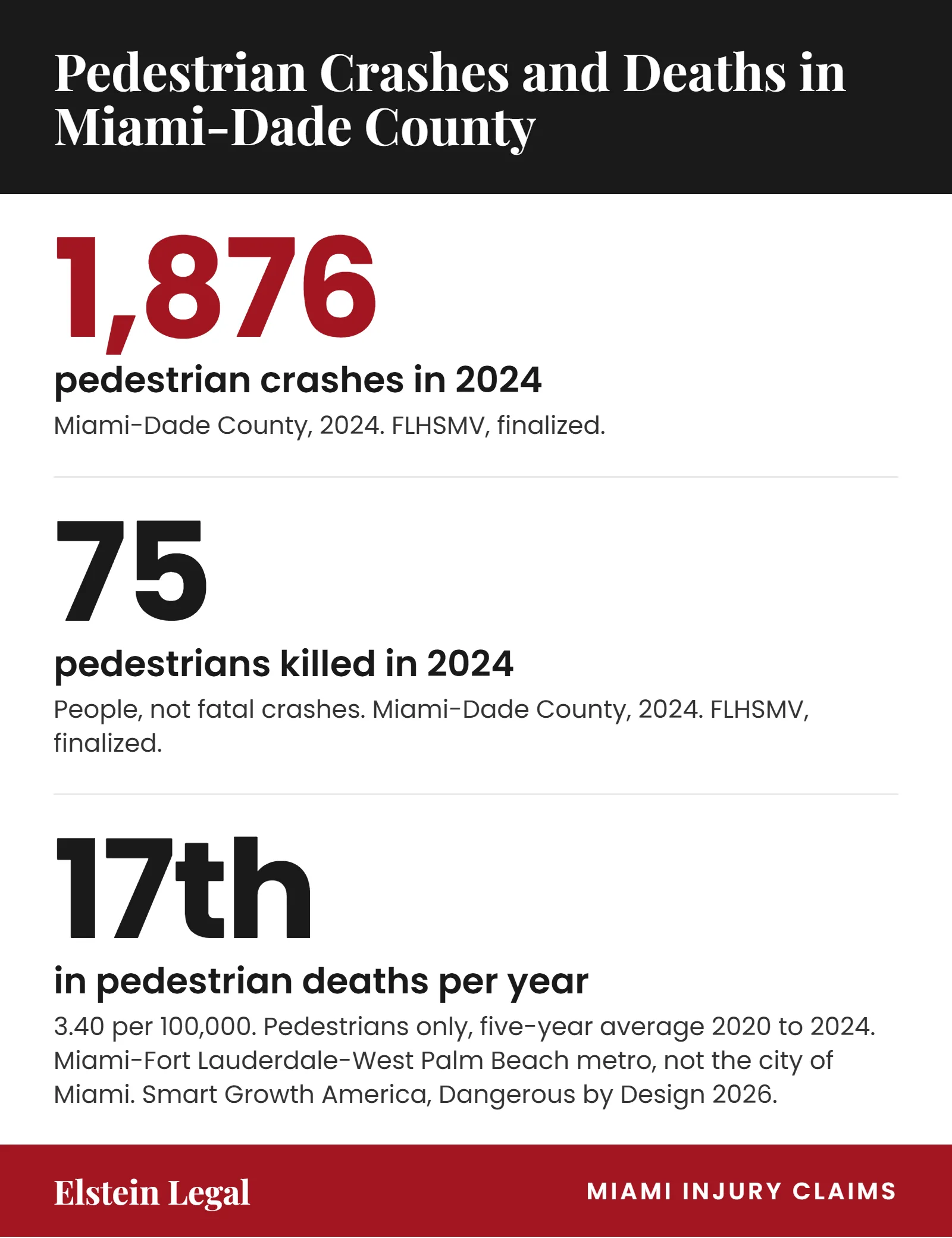
Miami-Dade County recorded 1,876 pedestrian crashes in 2024, and 75 pedestrians were killed (FLHSMV, 2024, finalized). Those 75 are people, not fatal crashes, and the two are different counts.
The sharper number is a share. On the 2025 preliminary county injuries data, Miami-Dade accounts for about 16.9 percent of every pedestrian injury in Florida while carrying 11.2 percent of all traffic injuries in the state. Roughly one in six of Florida’s injured pedestrians is hurt in this county. That is Miami-Dade County data, it counts injuries only, and 2025 remains preliminary.
Nationally, the Miami-Fort Lauderdale-West Palm Beach metro ranks 17th at 3.4 pedestrian deaths per 100,000 people on a five-year 2020 to 2024 average counting pedestrians only (Smart Growth America, Dangerous by Design 2026). That is the metro, not the city.
What the Driver Was Required to Carry
Most people assume a licensed Florida driver has to carry insurance that pays for injuring somebody. The assumption is wrong, and a pedestrian feels that more than most.
| Coverage | What Florida actually requires | Provision |
|---|---|---|
| Personal injury protection | $10,000, security required | § 627.733(1), § 627.736 |
| Property damage liability | $10,000, or a policy carrying at least $30,000 combined property damage and bodily injury | § 324.022(1) |
| Bodily injury liability | Nothing. No purchase requirement exists | No provision mandates it |
Section 324.022(1) requires the ability to respond in damages of $10,000 for damage to property, or in the alternative a policy providing at least $30,000 combined. Neither that section nor § 627.733(1) obliges a private Florida driver to buy coverage that pays for a broken pelvis. A driver can be entirely compliant with Florida law and carry nothing that responds to your hospital bill.
Add the local pattern on top of that. Hit-and-run crashes made up 19,046 of Miami-Dade County’s crashes in 2024, which is 31.7 percent of the county total against 25.7 percent statewide, and the county has stayed above 31 percent every year since 2022 (FLHSMV, 2024, finalized). Nearly a third of crashes here involve a driver who left. A pedestrian struck by a driver who is never identified has no liability policy to claim against at all, which is where uninsured and underinsured motorist coverage stops being an optional extra. That is covered separately in what happens when the driver leaves the scene, and the wider stack is set out in how the coverage layers stack up after a Florida crash.
Recovery in a serious case rarely comes from one place. Four sources are worth checking on every pedestrian file, and the one people forget sits first on the list:
- The struck person’s household personal injury protection, which pays regardless of fault and is subject to the fourteen day rule
- the at-fault driver’s policy, where a driver is identified and carries coverage that responds to a bodily injury
- Uninsured and underinsured motorist coverage on the injured person’s policy or a resident relative’s policy, which is frequently the largest single source in a serious pedestrian case
- An employer or vehicle owner liable alongside the driver, where the vehicle was being used for work or was owned by somebody else
Finding those layers is the work. Elstein Legal has recovered $2,250,000 on a matter where the carrier’s position was a $15,000 policy limit, and $240,000 in under two months on a file the previous handling had valued at $35,000. Neither was a pedestrian case, so read them as evidence of how the firm handles a carrier rather than as a prediction about yours. The full list is at what the firm has recovered.
Past results do not guarantee, warrant, or predict future outcomes.
Rights and Responsibilities of Pedestrians in Miami
Pedestrian right of way in Florida sits at § 316.130, and it runs in both directions. It gives a person on foot protections and it puts duties on them, and a claim is stronger when the person bringing it knows both halves rather than only the flattering one.
What the statute gives a person on foot:
- Drivers must yield to a pedestrian lawfully within a crosswalk on the driver’s half of the roadway, or close enough to it to be in danger
- No vehicle may pass another vehicle that has stopped at a crosswalk to let someone cross
- Drivers owe every pedestrian due care, and must sound the horn where needed and exercise proper caution around a child or an obviously confused or incapacitated person
- Where there is no sidewalk, a person may walk on the shoulder facing oncoming traffic
The duties it places on a person on foot:
- Outside a marked crosswalk or an unmarked intersection crossing, a pedestrian yields to vehicles on the roadway
- Nobody may leave a curb into the path of a vehicle so close that the driver cannot yield
- Crossing between adjacent signalized intersections happens in the crosswalk
- Where a sidewalk exists and can be used, walking in the roadway is not permitted
Read that second list and the adjuster’s playbook is obvious, because every argument they raise comes out of it. None of those duties ends a claim on its own. A driver’s duty of due care survives a pedestrian’s mistake, and Florida prices a mistake as a percentage rather than treating it as disqualification.
Being Blamed for Being There
Florida uses modified comparative fault, at § 768.81(6). The rule is precise, and it is easy to find it stated backwards.
A person found more than 50 percent at fault recovers nothing. At 50 percent or less, the recovery is reduced by their percentage of fault. So a pedestrian found exactly 50 percent responsible still recovers half. The phrase “less than 50 percent” is wrong, and Florida is a modified comparative negligence state rather than a pure one.
Percentages are the whole fight in a pedestrian case, because they convert directly into money.
| Fault assigned to the pedestrian | Effect on a $600,000 claim |
|---|---|
| 0 percent | $600,000 |
| 25 percent | $450,000 |
| 50 percent | $300,000, the last point at which recovery survives |
| 51 percent | Nothing |
Which side of that line a case lands on comes down to evidence that decays fast: signal timing and phasing at the intersection, video from a business, a bus or a doorbell camera that is usually overwritten within days, vehicle event data, the physical scene before it is swept and reopened, and witnesses who were on foot and left no contact details. An insurer starts assembling its version of that record in the first week. A crash report noting that a pedestrian was outside a crosswalk is an opinion recorded at the roadside, not a finding a court has made.
Two Years to File
Most Florida negligence claims must be filed within two years, at Fla. Stat. § 95.11(5)(a).
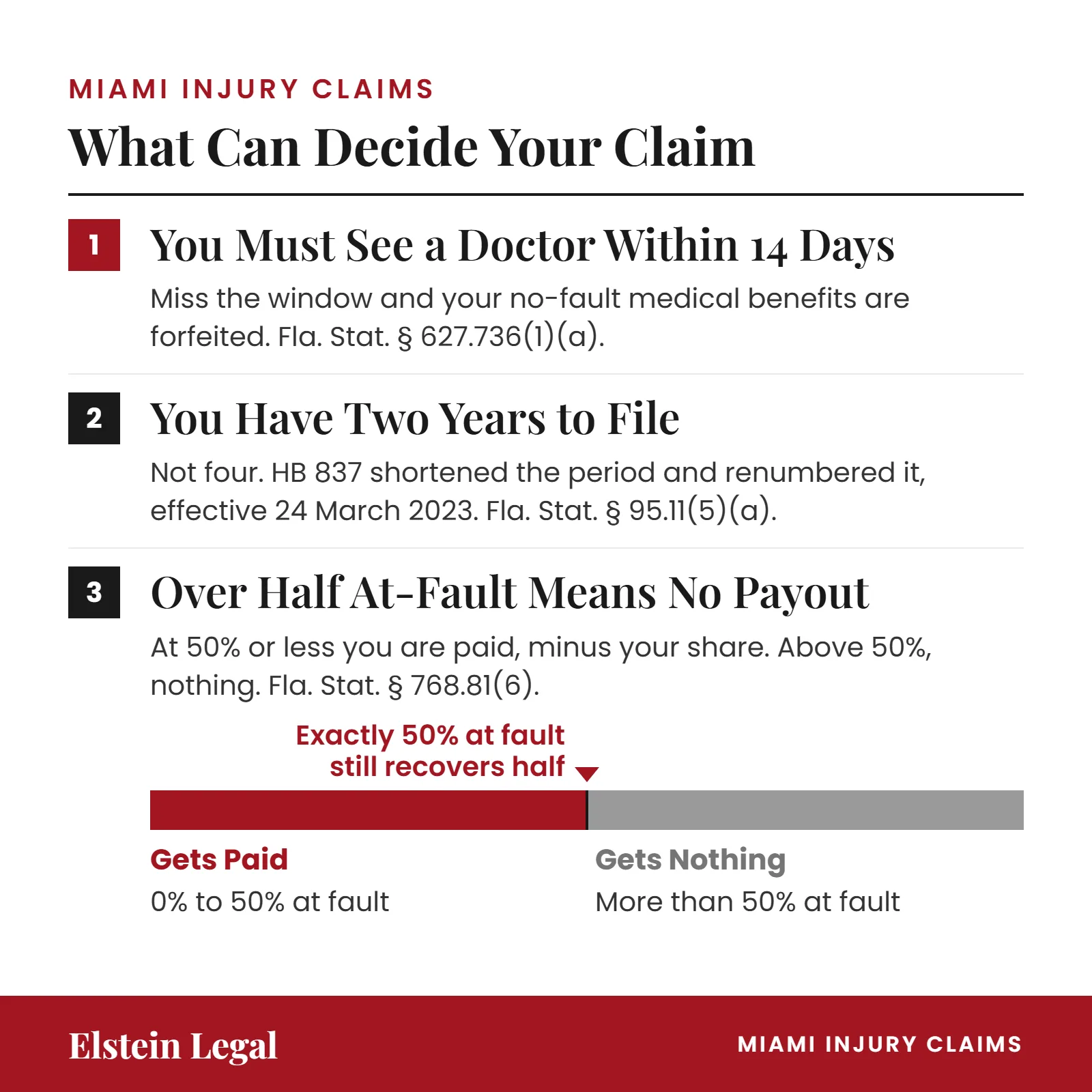
That deadline used to be longer. HB 837 cut it and took effect on 24 March 2023, and the same bill renumbered the statute, which is why the subsection matters as much as the number. Subsection (3) is the four year subsection and covers products. Subsection (5) is the two year one and covers negligence. There is no two year subsection (4).
Plenty of pages still publish the old figure, and some of them link to an archived version of the statute that genuinely used to say it. An outdated citation reads as authoritative precisely because the source is real. Check the year on any statute page you are sent.
| Claim | Deadline | Provision |
|---|---|---|
| General negligence, including a pedestrian struck by a vehicle | Two years | § 95.11(5)(a) |
| Wrongful death | Two years | § 95.11(5)(e) |
| Medical negligence | Two years, with a four year repose | § 95.11(5)(c) |
| Product liability | Four years, with a twelve year repose | § 95.11(3)(d), repose § 95.031(2)(b) |
| Claim against a government entity | Separate presuit notice rules apply. No flat period is stated here | § 768.28 |
So two deadlines run at once after a pedestrian crash, and they are nothing alike in length. Fourteen days decides whether a no-fault benefit pays anything, while two years decides whether a lawsuit can be filed at all. People miss the short one far more often, because nobody sends them a reminder.
Stepping Outside the No-Fault System
No-fault benefits are capped, and they pay regardless of who caused the crash. Pursuing the driver for pain, suffering and the rest of the loss requires clearing the threshold at § 627.737(2), which is met by any one of four things:
- Significant and permanent loss of an important bodily function
- Permanent injury within a reasonable degree of medical probability, other than scarring or disfigurement
- Significant and permanent scarring or disfigurement
- Death
A pedestrian struck by a vehicle usually clears that threshold without much difficulty. Nothing sits between a person and the impact, no metal, no crumple zone, no restraint, which is why the injuries run to fractures, head trauma, degloving and injuries that leave a person dependent on daily care. The threshold argument that eats up an ordinary rear-end case rarely holds a pedestrian case up for long.
One correction while the section is open, because § 627.737 gets mis-cited often. It is the threshold and tort exemption provision. It sets no insurance minimums, so any page that quotes a coverage figure to it is quoting the wrong statute.
When a Pedestrian Does Not Survive
Pedestrian crashes are far likelier to be fatal than an ordinary collision, for the same reason the threshold is easy to meet. Where the person struck does not survive, the case changes shape rather than merely getting larger.
A wrongful death action in Florida is filed by the personal representative of the estate under § 768.20, not by the spouse, by the children or by the parents. Those family members are beneficiaries under § 768.18(1) and they recover through the action, but the personal representative is appointed through probate and is the only person who can bring it. Getting that wrong wastes weeks at exactly the point where a two year deadline is already running, and it is a common mistake. Claims involving a pedestrian who does not survive being struck proceed on that footing.
Related situations sit close by. People are struck on foot by trains as well as by cars, and a claim involving someone struck on the tracks rather than in a crosswalk runs on a different set of rules, particularly where a public transit operator is the defendant. The insurance argument on this page applies just as well to cyclists hit at the same intersections, since § 627.736(1) reaches them through the same clause.
Talk to Brian
Bring whatever exists. The crash report or its number, anything the hospital gave you, the name of the driver’s insurer if you have it, and the declarations page of every auto policy in your household, including a resident relative’s. Most people struck while walking have none of that on day one, and that is normal. Assembling it is the work, not a prerequisite for calling.
Two things are worth doing before you call anyone. See a doctor if you have not, because of the fourteen day rule. And avoid giving the other driver’s insurer a recorded statement about where you were standing until you have spoken to someone about how that answer will be used.
There is no fee to talk and no fee unless there is a recovery. Call (305) 299-2835 or bring the claim to Brian directly. Why the first conversation tends to be about coverage and dates comes down to how an insurer builds its file.