
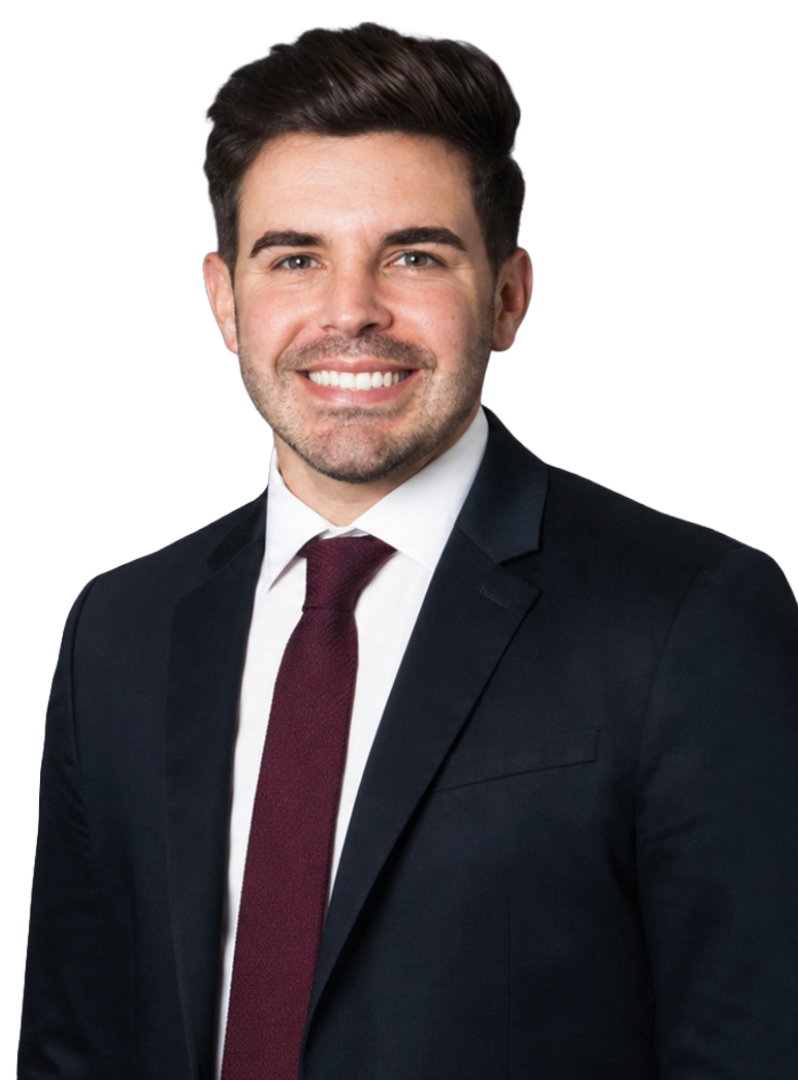
A driver turns across a bike lane and a ride ends in an emergency room. Brian Elstein defended insurance companies before he represented injured people, so he knows how a carrier values a cyclist’s claim and where the coverage that pays for it is actually found. One lawyer, handling the case personally, on a contingency fee.






Most bicycle crashes in Miami end the same way. The rider is on the ground, the driver is standing over them repeating that they never saw the bike, and nobody at the scene says a word about insurance. What you do in the fourteen days after that decides more about the claim than anything either of you says while the traffic is still stopped.
Florida runs a no-fault insurance system, and most people believe it covers drivers and passengers only. The statute is wider than that. Section 627.736(1) requires personal injury protection for the named insured, relatives residing in the same household, the person operating the insured vehicle, passengers in it, and other persons struck by the motor vehicle. A cyclist hit by a car sits in that last category. So a policy may pay 80 percent of medical bills and 60 percent of lost wages regardless of who caused the crash, and it pays none of it unless care begins within two weeks.
Hardly any bicycle page in this market says so. Most state no filing deadline at all, and not one of the competitor pages we checked cited a Florida statute down to the subsection. The section numbers are here because a cyclist who relies on the wrong deadline loses benefits, or loses a whole claim, and usually never finds out why.
Why Choose Elstein Legal
Brian Elstein used to work for the insurance companies. He defended personal injury claims before he started bringing them, which means he has read the other side of a file like yours: what an adjuster flags, what a carrier reserves, and which gap in a treatment record gets used later to argue the injury came from something else.
That is why this page spends its length on coverage, deadlines and fault rather than on adjectives. A bicycle claim is rarely lost on sympathy. It is lost on a missed fourteen-day window, a fault percentage nobody contested, or a policy nobody looked for.
Cases are handled personally by Brian, from one office in South Miami, on a contingency fee. No fees unless we win. Over $50 million recovered. Call (305) 299-2835, days, nights or weekends.
Past results do not guarantee, warrant, or predict future outcomes.
Florida No-Fault Reaches a Cyclist Who Was Struck
The provision that decides this is one sentence long. Under Fla. Stat. § 627.736(1), an insurer must provide personal injury protection to “the named insured, relatives residing in the same household unless excluded under s. 627.747, persons operating the insured motor vehicle, passengers in the motor vehicle, and other persons struck by the motor vehicle.”
Read the last clause slowly. It does not say occupants. Being struck by an insured motor vehicle is itself the qualifying event, which is why a cyclist can be inside a no-fault system they were never driving in.
What the statute does not do is promise that a benefit exists for you. PIP responds through a policy, so everything turns on whether a policy reaches this rider: their own, if they own a registered vehicle, or one belonging to a relative in the same household. A cyclist who owns no car and lives in a household with no auto policy may have no PIP route at all. Both the rule and its limit belong here, and neither answer can honestly be given for a case nobody has read yet. So we pull every declarations page in the household early and read it, instead of guessing in one direction or the other.
Where PIP does respond, these are the terms.
| What PIP does | Detail |
|---|---|
| Minimum benefit | $10,000 per person, § 627.736 |
| Medical expenses | 80 percent |
| Lost wages | 60 percent |
| Without an emergency medical condition finding | Medical benefits capped at $2,500. The full $10,000 requires that finding from a qualified provider |
| Fault | Irrelevant to the benefit. It pays whoever it reaches |
| Deadline | Initial care within 14 days of the crash, or the benefit is forfeited entirely |
The fourteen days are the part that costs people money
A cyclist who walks away sore, waits to see whether the shoulder settles and books an appointment three weeks later has forfeited the PIP benefit outright. None of that is obvious, and no adjuster is going to call and warn you while the clock runs. It is also the omission that shows up most often on bicycle pages from other firms.
Something else needs clearing up too, because it went around widely during 2026. PIP was not repealed. The repeal bills, SB 522 and HB 769, died in committee when the legislative session adjourned on 13 March 2026. The $10,000 minimum, the 80 and 60 percent split, and the fourteen-day rule are all still in force. Any page telling a Florida reader that no-fault ended in 2026 is wrong, and a reader who believes it may skip treatment they are entitled to have paid for.
What the Driver Is Required to Carry, and What They Are Not
What surprises almost every injured cyclist has nothing to do with fault. It is what Florida requires a driver to buy.
Florida requires the owner of a registered vehicle to maintain security under § 627.733(1), meaning PIP. Section 324.022(1) requires the ability to respond in damages of $10,000 for property damage, or alternatively a policy carrying at least $30,000 combined for property damage and bodily injury. Neither section obliges a private Florida driver to buy coverage that pays for injuring a person. The driver who broke your collarbone may be entirely compliant with Florida law and carry nothing that pays for the plate and screws.
The familiar 10/20/10 figures are real, and they are not a purchase mandate. Section 324.021(7) defines those amounts as proof of financial responsibility, which bites after the fact, notably under § 324.051 following a crash reportable under § 316.066(1), when the department suspends a license and registrations unless an exemption applies. Suspending the license of the person who hit you recovers nothing for your medical bills.
Miami-Dade puts a second problem on top of that. The county recorded 19,046 hit-and-run crashes in 2024, which is 31.7 percent of every crash in the county, against 25.7 percent statewide (FLHSMV, 2024, finalized). The share has stayed above 31 percent every year since 2022. If the driver who hits you leaves, there is no liability policy to claim against at all, and the recovery runs through uninsured and underinsured motorist coverage instead. We cover that ground separately, in hit-and-run crashes and the coverage that answers them.
So a bicycle claim is usually built out of layers, not out of one policy, and the order we check them in matters:
- PIP that reaches the struck rider, under § 627.736(1), subject to the fourteen-day rule.
- The at-fault driver’s bodily injury liability coverage, if they bought any. The limits are what they are, which is why this page also explains the driver’s own liability limits in the context of an ordinary crash.
- Uninsured and underinsured motorist coverage on the cyclist’s own policy and on resident relatives’ policies. Whether those layers stack depends on what was bought, so we read the policies instead of assuming.
- Other liable parties, including the vehicle’s owner, or an employer whose driver was working at the time.
- Bad faith exposure, where a carrier mishandles a clear claim inside its limits. That is how a $15,000 policy limit became a $2,250,000 recovery on one of this firm’s matters.
For the full stack in one place, see how the coverage layers stack after a Florida crash.
Past results do not guarantee, warrant, or predict future outcomes.
Bicycle Crashes in Miami-Dade County
Miami-Dade County recorded 1,001 bicycle crashes in 2024, and 20 people were killed in bicycle crashes that year (FLHSMV, 2024, finalized). That second number counts people, not crashes, and legal websites blur those two constantly.
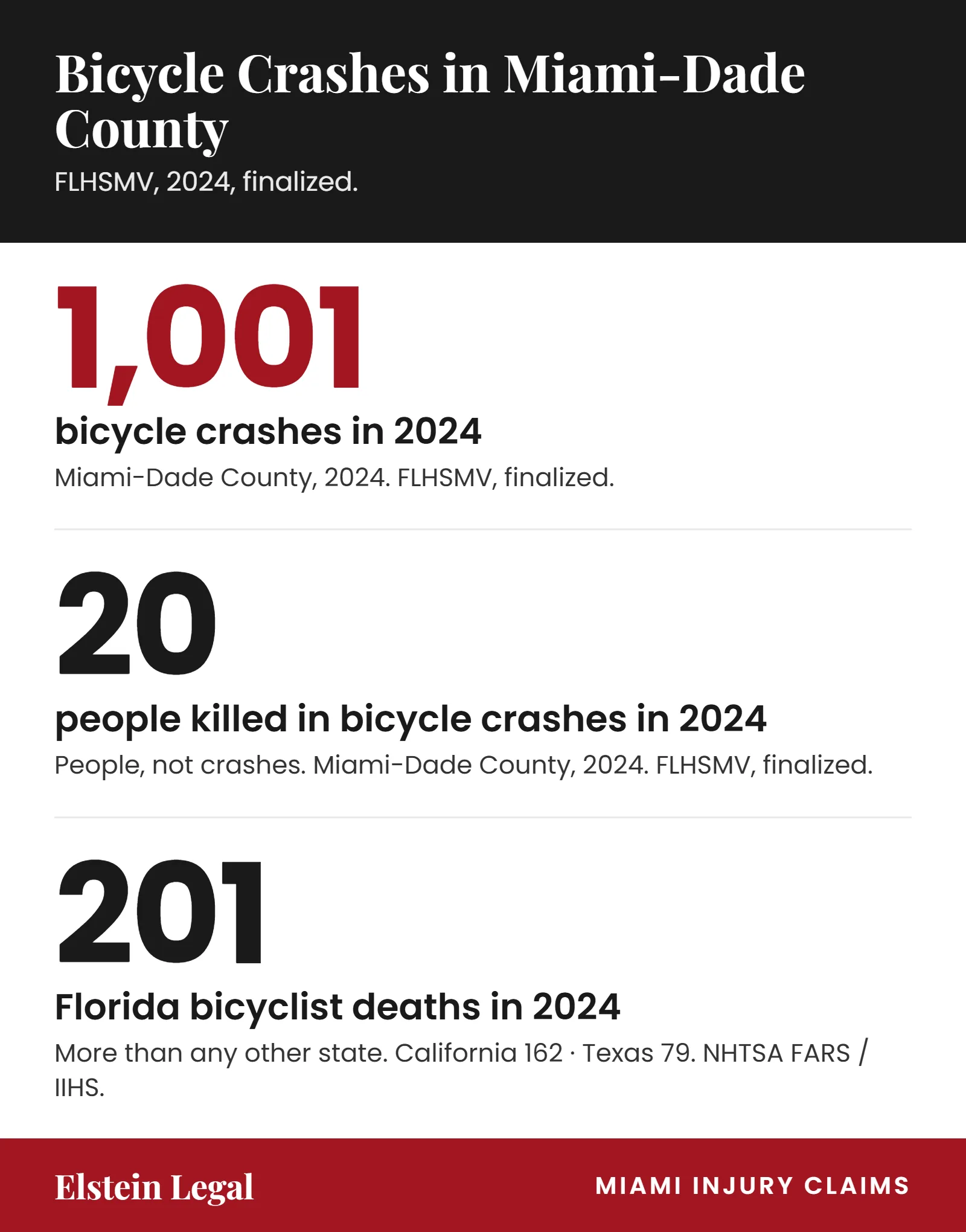
Statewide, the picture is worse than most Floridians assume. Florida recorded 201 bicyclist deaths in 2024, more than any other state, ahead of California at 162 and Texas at 79. That ranking comes from federal fatality data published through NHTSA and compiled by the Insurance Institute for Highway Safety. It is not a Florida agency figure, because FLHSMV publishes no national rankings of any kind.
One ratio, with its labels kept attached. Across Florida in the first 211 days of 2026, from 1 January to 30 July, bicycle crashes ended in a death 1.83 percent of the time against 0.73 percent for crashes generally, roughly two and a half times the ordinary rate. Those are preliminary, statewide, part-year figures from the FLHSMV crash dashboard, and they are used here as all three of those things.
County numbers are county numbers on this page, every time. No agency publishes a bicycle crash count for the city of Miami by itself, and dividing a county figure down to a city would produce a number nobody ever published.
Where People Ride, and What the Law Requires There
Miami is a city people ride in year round, and the riding is concentrated. Cyclists cross the causeways, including the Rickenbacker Causeway out toward Key Biscayne and Crandon Boulevard, along with the MacArthur and Julia Tuttle Causeways. Plenty of that riding happens on Biscayne Boulevard and the neighborhood streets feeding it, among them NE 54th Street in Little Haiti near Morningside Park, and on the corridors running through Brickell and downtown. Over all of it runs the county’s expressway network, I-95, the Dolphin Expressway and the Palmetto Expressway, carrying the traffic that everything else has to cross.
None of that is a ranking by danger. No agency publishes crash counts for individual Miami streets, so any list of “the most common places for a bicycle accident” is somebody’s impression rather than a measurement. The City of Miami adopted an updated Bicycle Master Plan in 2026 to guide the expansion of the bicycle network, with a defined set of priority projects, and the Miami-Dade Transportation Planning Organization runs a bicycle and pedestrian program of its own. Those are the bodies whose documents identify corridors for safety work. Their assessments belong to them, not to us.
For a claim, geography matters less than what the law expects of everyone using that road. That is where most cyclist cases are won and lost.
The Statutes the Defense Will Quote Back at You
Two cyclist-specific statutes decide a great deal of the argument in a Miami bicycle case, and they cut both ways.
The first helps you. Under § 316.083(2) to (3), amended by ch. 2021-180, a driver overtaking a bicycle must pass at a distance of at least three feet. A pass inside that distance is a traffic violation and it is evidence of negligence, which is why we test the driver’s account of how much room they gave against the physical evidence instead of accepting it.
Working against you is the second. Fla. Stat. § 316.2065 requires a bicycle helmet for a rider under 16. It also requires, between sunset and sunrise, a front lamp visible from 500 feet and a rear lamp and a reflector visible from 600 feet. That conjunction is the trap. A rear reflector on its own is not compliant, and plenty of bicycles sold with a reflector and no rear lamp get ridden home from the shop out of compliance, with the owner none the wiser.
None of that is a safety lecture. It is the defense’s toolkit, and it arrives in the file as a percentage. A carrier that can put lighting, a missing helmet or a lane position in front of a jury is not arguing about the driver anymore, it is arguing about the share of the loss you carry. What answers it is evidence. Keep the bicycle itself, photograph its lamps before anything is repaired or replaced, and get the roadway documented while the paint and debris are still on it.
The Injuries, and the Threshold That Stops Mattering
A cyclist has a helmet and a shirt between them and a vehicle that weighs two tons, so the injuries in these cases run to the severe end: head injuries, facial fractures, spinal injuries, clavicle and pelvic fractures, degloving injuries and joint damage that needs surgical repair.
In an ordinary crash claim the argument is whether the injury clears the four-prong threshold at § 627.737(2) and lets the injured person pursue the at-fault driver for pain and suffering. The prongs are these, in the statute’s own terms.
| Prong | § 627.737(2) |
|---|---|
| 1 | Significant and permanent loss of an important bodily function |
| 2 | Permanent injury within a reasonable degree of medical probability, other than scarring or disfigurement |
| 3 | Significant and permanent scarring or disfigurement |
| 4 | Death |
Note that § 627.737 sets no insurance minimums. It is the threshold and tort-exemption statute, nothing else, and it is cited for coverage amounts surprisingly often.
Where a cyclist is left with a permanent deficit, the threshold usually stops being the fight, and the case turns into an argument about what the rest of a life now costs. That is different work, and it is described separately for a brain or spinal injury that changes what they can do for good.
Head injury needs a paragraph of its own, because it is where competitor pages reach for a number that does not exist. There is no authoritative lifetime cost figure for a severe traumatic brain injury. The dollar ranges circulating on law firm websites trace back to no primary source that can be checked, so none appears here. What the CDC does publish is incidence and outcome: 68,663 TBI-related deaths in the United States in 2023, and roughly 214,110 TBI-related hospitalizations in 2020. The lifetime cost of one person’s injury is established case by case, through a life care planner working from that person’s actual deficits, and then priced by an economist.
An evidence rule shapes how medical damages get presented. Under § 768.0427, recoverable past medical damages are limited to amounts actually paid or payable rather than amounts billed, which is why the billing and lien picture has to be built properly and not left to a demand letter.
Two Years to File, and the Fault Rule That Decides the Rest
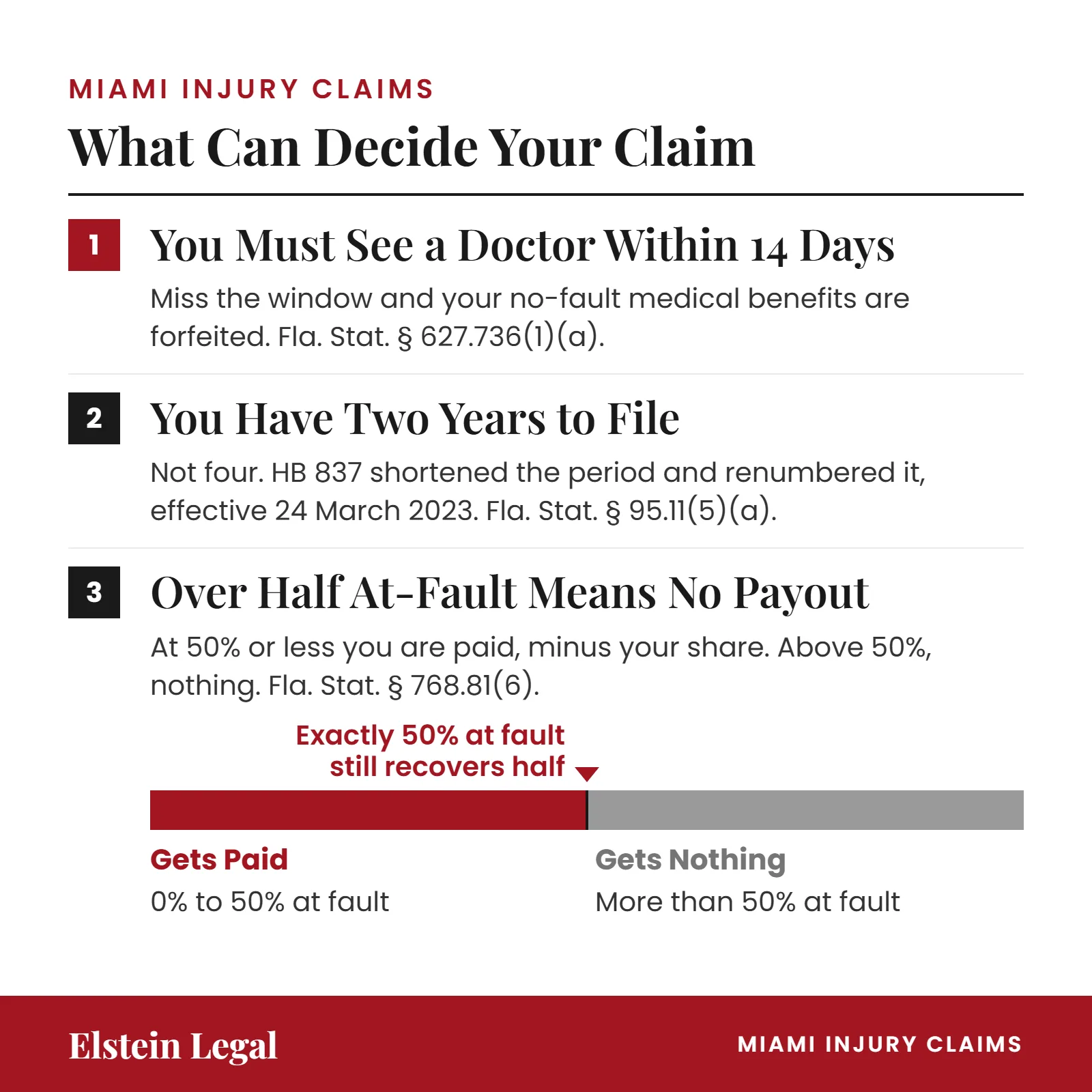
Most Florida negligence claims must be filed within two years, under Fla. Stat. § 95.11(5)(a). It was four years until HB 837, chapter 2023-15, took effect on 24 March 2023, and that bill renumbered the statute as well as shortening it. Subsection (3) is the four-year subsection and subsection (5) is the two-year one. Plenty of published material still cites the old lettering, and a page that gets the duration right while citing a superseded provision is telling you something about how carefully it was written.
There is one exception a cyclist can genuinely land in. If a component failed, a frame, a fork, a brake or a helmet, a claim against the maker of that product runs on four years under § 95.11(3)(d), with a twelve-year statute of repose at § 95.031(2)(b). That is a separate claim with a separate clock, and it does not extend the two years on the claim against the driver.
| The claim | Deadline | Provision |
|---|---|---|
| Negligence by the driver who struck you | Two years | § 95.11(5)(a) |
| A defective bicycle component, helmet or vehicle part | Four years, with a twelve-year repose | § 95.11(3)(d), repose § 95.031(2)(b) |
| Where the rider did not survive | Two years | § 95.11(5)(e) |
| PIP benefits, a separate and much shorter clock | Initial care within 14 days of the crash | § 627.736 |
The rule that matters most in a bicycle case is the one about fault. Under Fla. Stat. § 768.81(6), a person found more than 50 percent at fault recovers nothing. At 50 percent or less, the award is reduced by their share, so someone found exactly 50 percent responsible still recovers half. Read that phrasing carefully, because a large number of websites state the rule backwards and describe a bar that Florida does not have. Florida is a modified comparative negligence state, not a pure one.
Cyclists carry the brunt of this. They get blamed for their own crashes as a matter of routine: they were not in the bike lane, they had no lights, they came off the sidewalk, they were wearing dark clothing. Every one of those assertions is an attempt to move a percentage, and above 50 the percentage stops reducing the claim and ends it. So we collect the fault evidence in the first week, before treatment settles down, and we test what the driver says instead of absorbing it.
Where a rider does not survive, the claim changes shape entirely. It becomes a wrongful death action, and it is brought by the personal representative of the estate under § 768.20, not by the spouse, children or parents, who are beneficiaries under § 768.18(1) rather than filers. A number of Florida firms state that backwards, and it decides who is able to start the case at all. That situation is dealt with separately, for a cyclist killed on the road.
The same drivers and the same intersections, and the same statutory route into PIP, also affect walkers struck in the same crosswalks, which is covered on its own page.
Talk to Brian
Bring whatever exists. The crash report or its number, photographs of the bicycle and the roadway, the name of the driver’s insurer, and the declarations page of every auto policy in your household, because that last item is what determines whether PIP reaches you. If none of it exists yet, that is normal this early. Finding the coverage and assembling the record is the work, not a condition of starting.
This firm has recovered for an injured cyclist before, including a $1,475,000 recovery for a cyclist with a back injury. Past results do not guarantee, warrant, or predict future outcomes.
There is no fee to talk and no fee unless there is a recovery. Call (305) 299-2835 at any hour, or send us what happened on your ride, and the lawyer who would handle it will read it himself. It is worth knowing the years Brian spent on the carrier’s side of the file before deciding who should make the argument for you.