
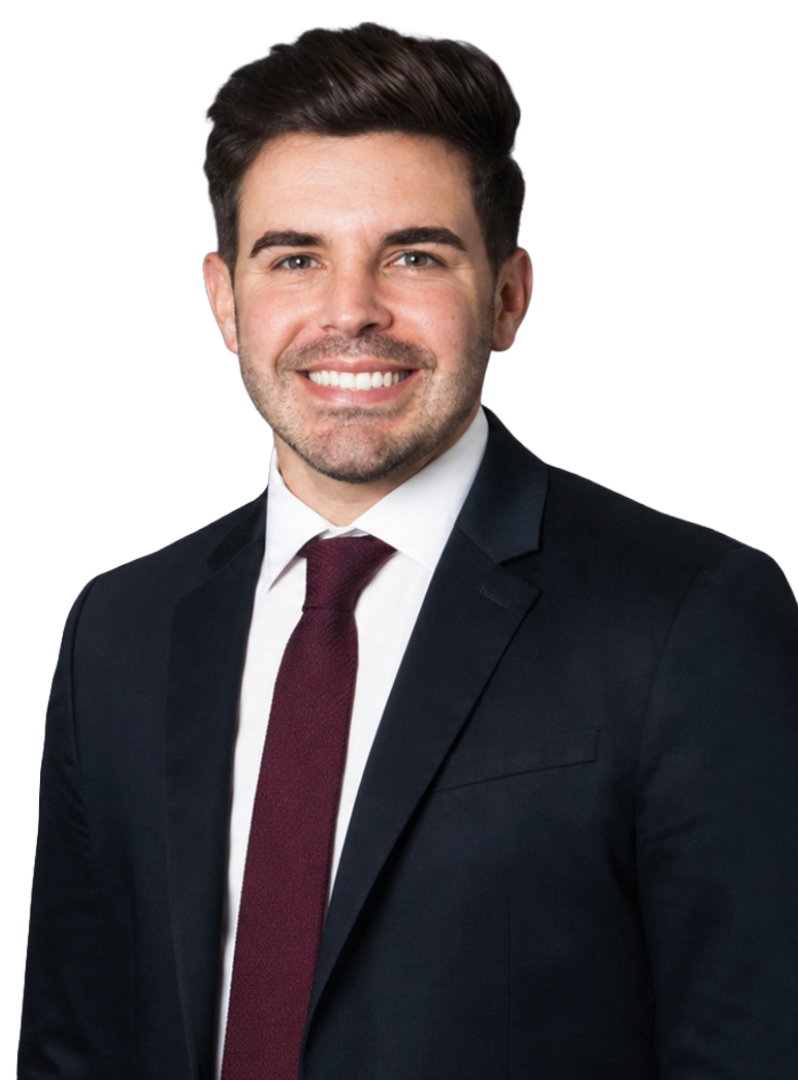
A catastrophic injury turns a legal claim into a funding problem, because the cost of care outruns the insurance long before anyone argues about fault. Brian Elstein defended insurance companies before he represented injured people, so he knows where coverage hides and what it takes to reach it. Every case is handled personally, with no fee unless we win.






A catastrophic injury does not end. The client goes from the crash scene to a Level I trauma bay, then to a rehabilitation unit, then home to a house that no longer fits the body they now have. Somewhere in the first month a family member starts asking what this is going to cost, and nobody can answer, because nobody has counted it yet.
Counting it is the work. A serious Miami injury claim is not won by proving a driver ran a red light. It is won by proving, in numbers an adjuster cannot wave away, what the next forty years of care will cost, and then by finding enough insurance to pay for it. Those are two separate problems, and most of the pages you will read today treat only the first.
Brian Elstein spent the early part of his career on the other side of that arithmetic, defending insurance companies against exactly these claims. He knows what a carrier does when a claim is worth more than the policy covering it, because he used to be the one doing it.
Why Injured Clients in Miami Call Elstein Legal
- A former insurance defense lawyer now represents the injured. Before founding the firm in 2018, Brian defended insurers before he sued them, including high-value personal injury claims. That is the whole reason the coverage analysis on this page exists.
- Your case is handled by Brian, not passed down. Elstein Legal is a solo practice with one office in South Miami. Brian works with his assistant, Leda, and you speak to the lawyer handling your file.
- Over $50 million recovered. The largest published result is a $12.25 million recovery for a paralyzed client, a negligent security shooting.
- 5 out of 5 across more than 120 Google reviews.
- No fees unless we win, and someone answers the phone at nights and on weekends, because catastrophic cases do not keep office hours.
Past results do not guarantee, warrant, or predict future outcomes.
What Makes an Injury Catastrophic in a Florida Claim
No general Florida tort statute defines a catastrophic injury. The definition people quote, at section 440.02(38), belongs to the workers’ compensation chapter and sets no standard for a negligence case. Any page telling you Florida law defines the term for your claim is quoting the wrong body of law.
In practice the word describes an injury that permanently changes what a person can do and earn. The injuries that usually qualify:
- Spinal cord injury producing paraplegia or tetraplegia
- Traumatic brain injury at the moderate to severe end
- Amputation, whether traumatic or surgical after failed limb salvage
- Severe burns over a large surface area or across the hands, face or joints
- Multiple fractures that heal into permanent impairment
- Loss of sight or hearing
- Internal organ damage requiring lifelong management
One legal consequence follows immediately in a crash case. Section 627.737(2) requires a permanent injury within a reasonable degree of medical probability before an injured person can step outside no-fault and pursue the at-fault driver for pain and suffering. On an ordinary claim that threshold is the fight. Here the medical records answer it before anyone opens a file, which frees the entire case to be about damages.
Coverage, Not Liability, Is Usually What Limits a Miami Catastrophic Claim
Read the law firm pages that currently rank ahead of this one and you will find no mention of policy limits, uninsured motorist coverage, stacking, umbrella or excess layers. That silence is strange, because in a catastrophic case the damages almost always exceed the coverage. Liability is often obvious. Finding the money is the case.
Start with what Florida requires a driver to carry.
| Layer | What it does | What it is worth |
|---|---|---|
| PIP, section 627.736 | First-party medical and wage benefits, no fault required | $10,000, paying 80 percent of medical bills and 60 percent of lost wages, capped at $2,500 without an emergency medical condition finding. Treatment must begin within 14 days. Motor vehicle occupants only |
| Property damage liability, section 324.022(1) | Pays for the vehicle, not the person | $10,000, or a policy carrying at least $30,000 combined property damage and bodily injury for one crash |
| Bodily injury liability | The at-fault driver’s coverage for your injuries | Whatever they chose to buy. Florida’s basic financial responsibility requirements do not include it, so a driver can be entirely legal and carry nothing that pays for your care |
| Uninsured and underinsured motorist | Your own policy standing in for a driver who has too little or nothing | Whatever was purchased. No Florida statute guarantees an amount, and any site promising you a fixed figure is wrong |
| Stacking | Multiplies UM limits across vehicles on one policy | Depends on whether stacking was purchased or rejected in writing |
| Umbrella or excess | Sits above the primary policy | Policy specific, and frequently never disclosed until someone asks |
| Additional defendants | Employer, vehicle owner, property owner, contractor, security company | Separate policies with separate limits |

Ten thousand dollars of PIP against a lifetime of attendant care is the practical problem in every one of these cases, and the answer is rarely a single policy. It is usually four or five layers found one at a time, some of which no carrier has an obligation to volunteer.
The firm’s own results prove this argument. In one case the available policy limit was $15,000 and the carrier failed to timely tender it. The recovery was $2,250,000, and it came from the carrier’s bad faith rather than from the policy. In another, the highest offer before Brian took the case over was $35,000, and it resolved for $240,000 in under two months. Neither outcome came from a better argument about who ran the light.
Past results do not guarantee, warrant, or predict future outcomes.
Layered defendants at PortMiami and the airport
Miami produces a category of case where the coverage question is complicated by how many businesses share the same moment. PortMiami moved 1,115,058 TEUs and 9,863,003 total tons of cargo in 2025, and Miami International Airport handled nearly 56 million passengers and 3 million tons of freight in 2024. The airport reports that together the two facilities account for $242.8 billion in economic activity and nearly 1.2 million jobs across Florida, making them the county’s two largest economic engines.
They are also worksites layered with separate employers. A terminal operator, a trucking company, the International Longshoremen’s Association and a warehousing contractor may all touch the same load on the same afternoon, and each may carry its own policy. Similar layering shows up on Brickell and Wynwood construction sites, where the City of Miami’s economic development office names real estate and construction among its key sectors. When a collision with a commercial truck happens inside that structure, identifying every entity with a duty is the difference between one $50,000 policy and several.
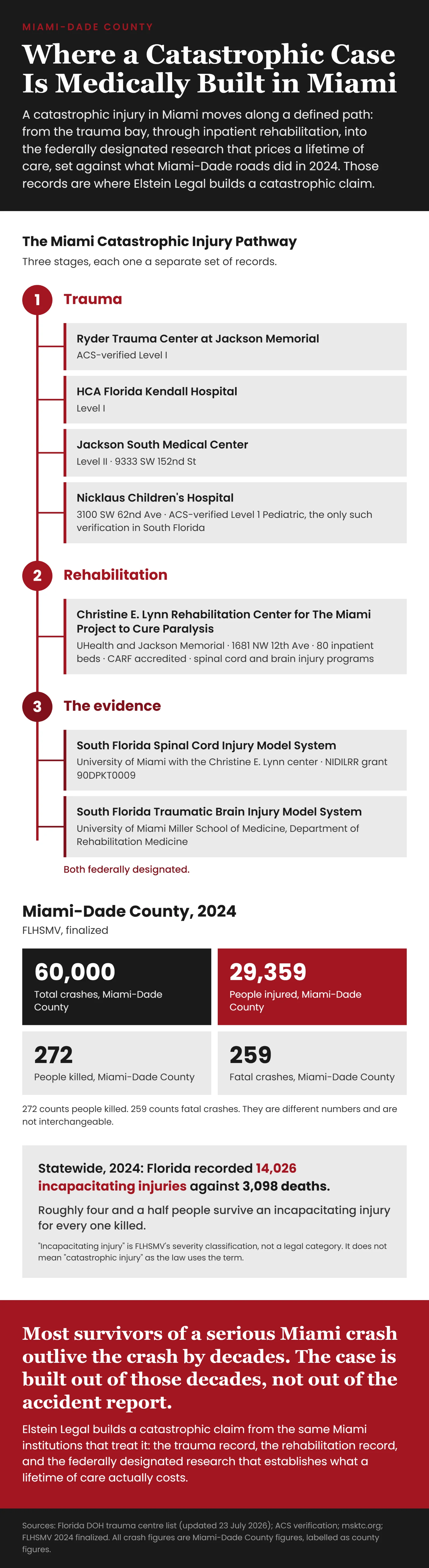
Where a Catastrophic Case Is Medically Built in Miami
This is the part of the argument that only works in this city. A catastrophic claim is priced from medical evidence, and the institutions that produce that evidence are here.
- Ryder Trauma Center at Jackson Memorial is an ACS-verified Level I trauma center and the place most of these cases begin.
- HCA Florida Kendall Hospital also holds Level I status in Miami-Dade County, and Jackson South Medical Center, 9333 SW 152nd Street, is verified at Level II.
- Nicklaus Children’s Hospital, 3100 SW 62nd Avenue, holds the only ACS-verified Level 1 Pediatric Trauma Center designation in South Florida.
- The Christine E. Lynn Rehabilitation Center for The Miami Project to Cure Paralysis, at 1681 NW 12th Avenue, is the UHealth and Jackson Memorial rehabilitation hospital. It runs 80 inpatient beds, holds CARF accreditation, and operates dedicated spinal cord and brain injury programs.
- Both federal Model Systems sit in this city. The South Florida Spinal Cord Injury Model System is a University of Miami programme with the Christine E. Lynn center, funded under NIDILRR grant 90DPKT0009. The South Florida Traumatic Brain Injury Model System runs out of the University of Miami Miller School of Medicine, Department of Rehabilitation Medicine.
That last point does real work in a case. When a life care planner projects forty years of costs, the outcome research underneath those projections comes from federally designated centres, and two of them sit a few miles from where the injury happened.
The county numbers, and what they actually say
Miami-Dade County recorded roughly 60,000 traffic crashes in 2024, with 272 people killed, 259 fatal crashes and 29,359 people injured. Those are FLHSMV figures for a finalized year, and they are county figures rather than city figures. Arithmetic on the same published table puts Miami-Dade at 15.7 percent of Florida’s crash total and about 1.57 times second-place Broward County, which recorded 38,338. FLHSMV publishes the county totals; the share and the ratio are our arithmetic on them.
The number that matters more on this page is a severity figure. Florida recorded 14,026 incapacitating injuries in 2024 against 3,098 deaths. For every person killed on a Florida road that year, roughly four and a half more survived with an incapacitating injury.
Incapacitating injury is FLHSMV’s own severity classification, not a legal category, and not every one of those 14,026 people has a catastrophic claim. What the ratio shows is where the need sits: survivors outnumber the dead several times over, and a survivor needs the money for decades.
High-risk corridors here are familiar to anyone who drives them, including I-95, I-395, I-195, the Palmetto Expressway, the Dolphin Expressway, Biscayne Boulevard, Le Jeune Road and Bird Road. The I-395, SR 836 and I-95 reconstruction is an active $866 million FDOT and Greater Miami Expressway Agency design-build with completion expected in late 2029, so traffic patterns through the middle of the city keep changing for years yet. Most of our clients were hurt in a crash on I-95 or the Dolphin Expressway.
What a Life Care Plan Is, and Who Builds It
Search the competing pages for the phrase and you will not find it. A life care plan is the document that converts a medical condition into a number, and without one a catastrophic claim is a guess.
It is an itemised, year-by-year projection of everything the injury will require for the rest of the client’s life: surgeries and revisions, medication, therapy hours, durable equipment and its replacement cycle, home and vehicle modification, attendant care hours, and the case management to coordinate it. Each line carries a frequency, a duration and a current cost, and an economist reduces the total to present value, because a defendant pays today for care delivered over decades.
Building it takes a certified life care planner working from the treating physicians’ opinions, usually with a physiatrist directing the medical assumptions, a vocational expert quantifying what the client can no longer earn, and an economist handling the discounting. A defense expert will produce a competing plan. The gap between the two is where these cases are fought.
National research gives a sense of scale. The National Spinal Cord Injury Statistical Center publishes lifetime cost estimates by injury level, and these are its 2026 figures, expressed in 2025 dollars.
| Injury level | Lifetime cost, injured at 25 | Lifetime cost, injured at 50 | First year | Each later year |
|---|---|---|---|---|
| High tetraplegia, C1 to C4 | $6,419,617 | $3,528,112 | $1,446,827 | $251,246 |
| Low tetraplegia, C5 to C8 | $4,690,573 | $2,885,122 | $1,045,459 | $154,128 |
| Paraplegia | $3,139,165 | $2,060,139 | $705,131 | $93,409 |
| Motor functional, AIS D | $2,144,693 | $1,513,784 | $472,190 | $57,353 |
One qualification matters more than the totals. NSCISC states plainly that these figures exclude lost wages, fringe benefits and lost productivity, which averaged $97,787 per year. Lost earning capacity is a separate head of damages sitting on top, so a page telling you $6.4 million covers the income has misread the source. Every figure here is national. No Florida-specific or county-specific catastrophic cost data exists.
Traumatic brain injury, and why no honest lifetime figure exists
A range of “$85,000 to $3 million” is quoted for the lifetime cost of a brain injury on plenty of law firm sites, and it traces to no primary source. The only per-person lifetime figure in the literature comes from a 1991 study of 1985 injuries averaged across all severities including fatal ones, which is unusable for a living client, and the National Academies documented the absence of anything better in 2022.
Incidence and outcome data is solid. The CDC recorded 68,663 TBI-related deaths in 2023 and roughly 214,110 TBI-related hospitalizations in 2020. Among inpatient rehabilitation patients aged 16 and over, five years after a moderate to severe brain injury, 22 percent had died and 30 percent had got worse. The honest answer on cost is that it is determined case by case through a life care plan, and a firm quoting you a range has quoted a number nobody published.
Severe burns
Burns have an acute figure and no lifetime one. Hauc and colleagues, writing in the Journal of Burn Care and Research in 2024, put the average total hospital cost per burn patient at $117,794 in 2015 dollars, across an average stay of 10.7 days. No authoritative source publishes a lifetime burn cost, so the reconstructive surgeries, scar management and function loss that follow have to be built case by case. If burns are the injury, our page on severe burns specifically goes further into that claim.
Paralysis and Spinal Cord Injury
Paralysis shows most clearly why the coverage argument comes first. A cervical-level spinal cord injury can require attendant care measured in hours per day for the rest of a life, and the table above shows what that means in money. Roughly 54 new spinal cord injuries occur per million people each year in the United States, about 18,482 annually, and roughly 311,560 people are living with a traumatic spinal cord injury.
The clinical path in Miami is well defined. Acute care after a serious spinal injury averages 18.6 days, followed by an average 36.3 days of inpatient rehabilitation, which for many patients here means the Christine E. Lynn center. Level of injury, completeness, bladder and bowel management, spasticity, pressure injury risk and equipment needs are all established in those two months, before anybody has filed suit.
Which is why the file has to open while the client is still in rehabilitation. An equipment list, a home modification survey and attendant care hours are easier to document contemporaneously than to reconstruct two years later against a defense expert who was not there.
The firm’s largest published result, $12,250,000, was a negligent security shooting that left the client paraplegic. It is the clearest example of what a properly built catastrophic claim can be worth, and it did not involve a car at all. Past results do not guarantee, warrant, or predict future outcomes.
Amputation
Amputation cases split into two kinds that behave differently. Traumatic amputation happens at the scene. Surgical amputation follows a failed limb salvage, sometimes months later, after several operations and a period in which everyone hoped the limb could be kept. The second kind produces a longer and more contested medical record, and it is frequently where the defense argues causation.
The cost research most often cited is MacKenzie and colleagues, 2007, projecting lifetime health care costs after limb loss at $509,275 in 2002 constant dollars against $163,282 for successful reconstruction. Both figures are old and neither is Florida specific, so they anchor an argument rather than settle one.
Prosthesis replacement is where a life care plan is genuinely won or lost, and the professional literature does not agree on the interval:
- Two to five years, per the AMA Journal of Ethics, 2015
- Five years as a Reasonable Useful Life, per Berry 2019, citing Narang 1982
- Seven years for transtibial and ten years for transfemoral devices, per Nair 2008
For a client in their thirties, the difference between a five-year and a ten-year replacement cycle moves the plan total by a large amount across a normal life expectancy. That is a live dispute between qualified professionals rather than a settled fact, and a plan that does not address it will be attacked. Socket changes, component upgrades, residual limb revisions and the therapy that follows each new device move the number again.
What Has to Be Proved, and What Fault Can Take Away
A negligence claim in Florida rests on four elements, and a page that lists three of them has left out the one defendants fight hardest.
| Element | What it means here |
|---|---|
| Duty | The defendant owed the injured person a legal obligation, such as a driver’s duty of reasonable care or a property owner’s duty to keep premises reasonably safe |
| Breach | The defendant failed to meet that obligation. This is the element competitor pages routinely omit, and it is where most defenses live |
| Causation | The breach caused the injury, both in fact and proximately. In catastrophic cases the defense usually concedes the crash and attacks the extent of the harm |
| Damages | Actual loss. Medical costs past and future, lost earning capacity, and the human consequences of a permanent injury |
Then comes the rule that matters more on this page than on any other. Under Fla. Stat. § 768.81, Florida uses modified comparative negligence, not pure. A person found more than 50 percent at fault recovers nothing at all. At 50 percent or less, the award is reduced by their share, which means a plaintiff found exactly 50 percent responsible still recovers half.
Run that against a real number. On a $6,000,000 verdict, a 30 percent fault finding removes $1,800,000. Nothing about the medical evidence changed and nobody argued a different life care plan. One percentage decided by a jury took away more than most personal injury cases are worth in total, which is why fault allocation here deserves the same investigative effort as damages. Scene evidence, vehicle data, surveillance and witness statements all degrade quickly, and by the time a client leaves rehabilitation much of it is gone unless someone preserved it.
One carve-out is worth knowing. Medical negligence claims under chapter 766 keep pure comparative fault, so the 50 percent bar does not apply to them. If the injury came from harm that happened during treatment, that changes the arithmetic, along with the chapter 766 presuit requirements at section 766.106.
The Two-Year Deadline, and the One Exception
Florida cut the deadline for most negligence claims from four years to two, effective 24 March 2023 under HB 837. Many websites still publish the old four-year figure, and some publish the old subsection lettering as well, because HB 837 renumbered the statute at the same time. Do not rely on either.
| Claim | Deadline | Citation |
|---|---|---|
| Negligence, which covers most catastrophic claims | Two years from the injury | Fla. Stat. § 95.11(5)(a) |
| Medical malpractice | Two years, with a four-year statute of repose | § 95.11(5)(c) |
| Wrongful death | Two years | § 95.11(5)(e) |
| Defective product | Four years, with a twelve-year repose | § 95.11(3)(d), § 95.031(2)(b) |
| Claim involving a government entity | Different presuit notice rules and damages limits apply under § 768.28. Do not assume the ordinary rule fits | § 768.28 |
Claims that accrued before 24 March 2023 keep the old four-year window, and a product liability claim genuinely carries four years. Treat everything else on a catastrophic file as a two-year case from the moment the investigation opens.
If suit is filed in Miami-Dade County, it goes to the Eleventh Judicial Circuit. Circuit Civil now sits at the Osvaldo N. Soto Miami-Dade Justice Center, 20 NW 1st Avenue, Miami, Florida 33128, which opened on 10 November 2025 and replaced the 1928 courthouse. A Hialeah District Court operates at 11 E. 6th Street for other matters. Law firm pages across this market still list the old downtown address.
Where This Page Ends and Another Begins
Catastrophic injury is a severity, not a cause, so this page covers the survivor with permanent impairment however it happened. Some neighbouring situations belong elsewhere on this site.
Should the injuries prove fatal, the claim becomes a wrongful death action, and one detail is worth stating correctly because a top-ranking Miami competitor states it wrongly: under section 768.20 the action is brought by the personal representative of the estate, not by the spouse, children or parents, who recover as beneficiaries through the case. Our page on what happens if the injuries prove fatal covers it. Where a motorcycle is involved, PIP never applies, because section 627.732(3) defines a motor vehicle as having four or more wheels, and that changes the coverage map for riders who survive with permanent damage. Pedestrian cases carry their own coverage problem when the driver leaves the scene, which is common here, and those belong with struck while walking. If you are not yet sure which category fits your situation, start with our Miami personal injury overview.
One more accuracy note, because it affects real decisions. Despite what a number of sites published in 2026, PIP was not repealed. The repeal bills died in committee when the session adjourned on 13 March 2026. The $10,000 benefit, the 80 and 60 percent split and the 14-day treatment rule are all still in force, and missing that 14-day window still costs a client their benefits.
Talk to Brian Elstein About What Happened
If someone in your family has a spinal cord injury, an amputation, a brain injury or burns from something another person or business did, the case is about funding the rest of their life. That work starts with reading the policies, identifying every defendant, and getting a life care plan built by people who will hold up under cross-examination.
Elstein Legal is at 7301 SW 57th Court, Suite 570, South Miami. The number is (305) 299-2835, answered at nights and on weekends. There is no fee unless we recover for you. Tell us what happened and we will tell you honestly what we think the claim looks like.