

A permanent spinal cord or brain injury turns a Fort Lauderdale crash into a lifetime of paid care. Brian Elstein spent years defending insurance companies before he began representing injured people, and on a commercial claim that background matters, because the excess coverage above the primary policy is what decides whether the damages get paid.






A catastrophic injury is the kind that does not resolve. The person survives, and then lives with what the injury left behind, whether that is a spinal cord that no longer carries signals below the level of the break or a brain that processes the world differently than it did the day before.
In Fort Lauderdale these injuries come disproportionately from commercial operations. Port Everglades moves cargo, fuel and cruise passengers around the clock. Two airports run their own ground traffic. The marine trades put heavy equipment and heavy vessels in the hands of working crews. When the defendant is a company instead of a private driver, the ceiling on the claim is set somewhere different, and the reason is coverage.
Why Elstein Legal
Brian Elstein defended personal injury claims for insurance companies before he opened this firm. That background is why the first question he asks on a catastrophic file is not what the injury is worth. It is where the money to pay it sits, and whether anyone has looked above the primary policy yet.
The firm’s own results show what that changes. A motorcyclist’s claim came in against a $15,000 policy limit the carrier failed to tender in time, and the recovery was $2,250,000, taken from the carrier’s bad faith rather than from the policy. Another file arrived with a $35,000 offer already on the table and closed at $240,000 in under two months. The largest published result is $12,250,000 for a client left paraplegic by a shooting that negligent security allowed to happen. Over $50 million recovered across published settlements.
Past results do not guarantee, warrant, or predict future outcomes.
Brian handles his cases himself, from one office in South Miami. Call (305) 299-2835 or send us the details.
What makes an injury catastrophic under Florida law
Florida has no general tort definition of catastrophic injury. A statutory definition exists at section 440.02(38), it belongs to the workers’ compensation chapter, and it does not set the standard in a negligence case. Competing pages in this market quote it as though it did.
What the word actually describes is an impairment that is permanent and that changes both what the rest of a person’s life costs and what it can hold:
- Spinal cord injury producing paraplegia or tetraplegia
- Moderate to severe traumatic brain injury
- Traumatic or surgical amputation
- Loss of sight or hearing
- Crush and degloving injuries requiring staged reconstruction
- Internal organ damage that leaves a permanent treatment requirement
Severe burns sit at the edge of this list and are valued differently, through grafting cycles, scar revision and disfigurement, which is why they have their own page on burns and their separate valuation. Where the injured person does not survive, the claim becomes a claim brought by the estate and the law changes with it. This page is about the survivor.
The defendant’s identity changes the ceiling
The economy around Fort Lauderdale is unusually commercial for a coastal city its size, and that shows up in who ends up on the other side of a serious injury claim.
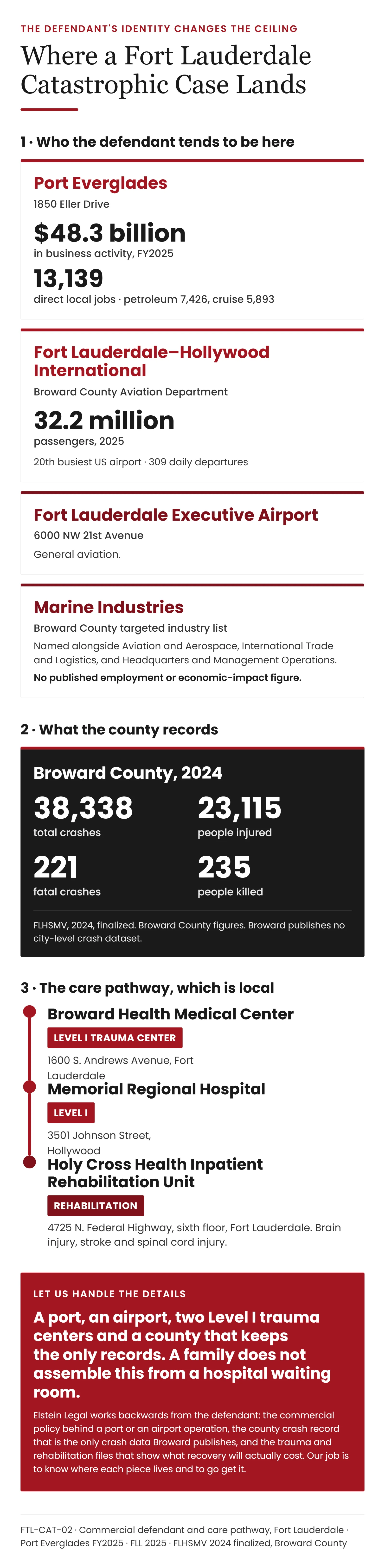
Port Everglades, at 1850 Eller Drive, generated more than $48.3 billion in business activity in fiscal year 2025 and supports 13,139 direct local jobs, with petroleum accounting for 7,426 of them and cruise operations 5,893. Cargo, fuel and passenger operations run in the same footprint, so yard tractors, tank trucks and pedestrian crowds share ground.
Fort Lauderdale-Hollywood International Airport handled 32.2 million passengers in 2025, making it the 20th busiest airport in the country, with 309 daily departures under the Broward County Aviation Department. General aviation runs out of Fort Lauderdale Executive Airport at 6000 NW 21st Avenue. Broward County’s targeted industry list names Marine Industries, Aviation and Aerospace, International Trade and Logistics, and Headquarters and Management Operations.
Traffic feeds all of it. FDOT describes I-95 at Broward Boulevard as the main entryway to the downtown central business district and as a ten-lane facility, four general purpose lanes plus one special use lane in each direction. Serious injuries here arise from a crash where Broward Boulevard meets I-95, from port and freight truck collisions, from motorcyclists left permanently injured and from injuries on the water. Each of those causes can produce the same outcome, and each can put a company on the defense side.
Where the money comes from when the damages exceed the policy
Most of what is written about Florida crash claims stops at the $10,000 problem. Personal Injury Protection under section 627.736 pays 80 percent of medical bills and 60 percent of lost wages up to $10,000, drops to a $2,500 cap without an emergency medical condition finding, and requires care to begin within 14 days. PIP applies to motor vehicle occupants and to nobody else, so a fall at a terminal or an injury on a vessel never touches it. Against a life care plan running into seven figures, $10,000 is not a source of recovery. It is a receipt.

A commercial defendant inverts that problem. Companies buy differently than individuals do, and a claim that would be capped against a private driver may sit under several layers of coverage at once.
| Layer | What it holds | Where it stops |
|---|---|---|
| PIP, § 627.736 | $10,000, 80 percent of medicals and 60 percent of wages, $2,500 without an EMC finding | Motor vehicle occupants only, and exhausted in days |
| Property damage liability, § 324.022(1) | $10,000, or a policy carrying at least $30,000 combined property damage and bodily injury for any one crash | Property, not people |
| The at-fault party’s bodily injury liability | Whatever the policy was written for | Usually the first number the adjuster quotes |
| Your own uninsured and underinsured motorist coverage, § 627.727 | Whatever you bought, and whether it stacks depends on the policy | Often never checked by the injured person |
| A commercial defendant’s primary general liability or commercial auto policy | Written to a business exposure, not a personal one | The layer most claims are settled inside |
| Umbrella or excess above the primary | Attaches once the primary is exhausted | Only reached if someone identifies it and pleads to it |
| Additional and vicariously liable defendants | A contractor, a vessel owner, an employer, a property owner | Only if the relationships are pulled apart early |
Finding the excess tower is the work. It rarely announces itself: the primary carrier answers, offers inside its own limits, and has no obligation to explain what sits above it. Pulling apart the corporate relationships behind an operation, the contracts between them and the policies that follow those contracts is what moves a claim from the primary layer to the layer that can pay for thirty years of attendant care. That is the part of the file Brian was on the other side of for years. It is also the part the firm’s own results speak to: the motorcyclist’s claim above was written against a $15,000 policy limit and recovered $2,250,000, because the money was never in the policy. Past results do not guarantee, warrant, or predict future outcomes.
What a lifetime of care actually costs
Very few competing pages in this market put a number on any of this. The published research does. The National Spinal Cord Injury Statistical Center estimates lifetime cost by level of injury and restates the table annually. These are the 2026 edition figures, expressed in 2025 dollars.
| Injury level | Lifetime cost, injured at 25 | Lifetime cost, injured at 50 | First year | Each later year |
|---|---|---|---|---|
| High tetraplegia, C1 to C4 | $6,419,617 | $3,528,112 | $1,446,827 | $251,246 |
| Low tetraplegia, C5 to C8 | $4,690,573 | $2,885,122 | $1,045,459 | $154,128 |
| Paraplegia | $3,139,165 | $2,060,139 | $705,131 | $93,409 |
| Motor functional, AIS D | $2,144,693 | $1,513,784 | $472,190 | $57,353 |
Source: NSCISC 2026 Facts and Figures at a Glance, data through August 2025.
Read the footnote before using those numbers, because it changes the arithmetic. NSCISC states that these figures exclude lost wages, fringe benefits and productivity, which averaged $97,787 per year. Lost earning capacity is a separate head of damages that adds to the care cost rather than sitting inside it. Anyone quoting $6.4 million as an all-in figure for a high tetraplegia case has misread the source.
Brain injury, where the honest answer is the stronger one
Brain injury works differently. No credible lifetime cost figure exists for traumatic brain injury. The range that circulates on marketing sites traces back to no primary source, and the National Academies documented the gap in 2022. What is published is incidence and outcome: the CDC recorded 68,663 TBI-related deaths in 2023 and roughly 214,110 TBI-related hospitalizations in 2020, and among inpatient rehabilitation patients aged 16 and over, five years after a moderate to severe TBI, 22 percent had died and 30 percent had declined further. A brain injury claim is valued through a life care plan built for that person, not from a table.
Amputation and severe burns
Amputation has one traceable projection, from MacKenzie and colleagues: $509,275 in projected lifetime health care cost, in 2002 constant dollars, against $163,282 for limb reconstruction. Prosthesis replacement intervals are disputed in the literature, running from two to five years in one analysis to five years as a reasonable useful life in another and to seven years transtibial and ten transfemoral in a third, so a life care plan has to pick a defensible interval and hold it. For severe burns only an acute figure exists, an average total hospital cost of $117,794 per patient in 2015 dollars across an average stay of 10.7 days.
None of this research is Florida-specific and none of it can be localized to Broward County. It is national data and should be read that way.
Who builds the number
A life care plan is a costed document, not an estimate. A physiatrist sets the medical baseline. A certified life care planner prices every recurring item across the person’s remaining life expectancy, from surgical revisions and attendant care hours to equipment replacement cycles, home and vehicle modification and transportation. A vocational expert measures lost earning capacity and an economist reduces the result to present value. Insurers retain the same specialists, which is why the plan has to be built to survive one.
The care pathway here is local
Fort Lauderdale differs from several of the other cities this firm serves, where the nearest trauma center is a county away.
Broward Health Medical Center, at 1600 S. Andrews Avenue, is a Level I trauma center inside the city. Memorial Regional Hospital at 3501 Johnson Street in Hollywood is the county’s second Level I. For the rehabilitation phase, the Holy Cross Health Inpatient Rehabilitation Unit at 4725 N. Federal Highway, sixth floor, treats brain injury, stroke and spinal cord injury.
Those first weeks matter to the claim, because they set the record. Nationally the average acute hospital stay after a spinal cord injury runs 18.6 days and the average inpatient rehabilitation stay 36.3 days, and roughly 311,560 people in the United States are living with a traumatic spinal cord injury. The documentation generated in that window is what a life care plan is later built on, which is why the medical file and the legal file should start moving together.
Broward County, by the numbers
Broward County publishes no city-level crash dataset, so every figure below is a county figure and is labelled as one. No Fort Lauderdale crash number is stated on this page, because estimating one from a county total would be invention.
| Broward County, 2024 | Figure |
|---|---|
| Total crashes | 38,338 |
| People injured | 23,115 |
| Fatal crashes | 221 |
| People killed | 235 |
FLHSMV, 2024, finalized data. Broward’s crash volume is second only to Miami-Dade among Florida counties.
Statewide in the same year, FLHSMV recorded 14,026 incapacitating injuries against 3,098 deaths in Florida. For every person killed on a Florida road that year, roughly four and a half more survived with an incapacitating injury. Incapacitating injury is FLHSMV’s own severity classification rather than a legal category, and not every one of them is catastrophic. What the ratio shows is where the pressure falls: survivors outnumber deaths several times over, each arrives with a cost measured in decades, and the coverage written to meet it was sized to minimums. Volume is not the constraint on these claims. Coverage is.
The Florida law that governs a catastrophic claim
Two years to file. A negligence claim accruing on or after March 24, 2023 must be filed within two years under Fla. Stat. § 95.11(5)(a). HB 837 cut the deadline from four years and renumbered the statute at the same time, so pages still listing four years, and pages citing the old subsection (4), are working from superseded text. Product liability is the exception at four years under § 95.11(3)(d), with a repose period at § 95.031(2)(b). Claims against a government entity carry separate notice requirements under § 768.28 and need to be assessed on their own facts rather than against a flat deadline.
Comparative fault decides more here than anywhere else. Under Fla. Stat. § 768.81(6), a plaintiff found more than 50 percent at fault recovers nothing. At 50 percent or less the award is reduced by the percentage of fault, so a plaintiff found exactly 50 percent responsible still recovers, halved. Florida is a modified comparative fault state, not a pure one. On a claim valued in the millions, a 30 percent finding is a seven-figure event, which is why the defense invests in it and why the liability investigation cannot be treated as settled just because the injury is severe. Medical negligence claims under chapter 766 are the carve-out and keep pure comparative fault.
The tort threshold is already met. On an ordinary crash claim the fight is whether the injury clears the four-prong threshold at § 627.737(2) and opens the door to pain and suffering damages. A permanent, life-altering impairment clears it on its face, so the argument moves straight to value. Note that § 627.737 sets no coverage minimums; the property damage minimum lives at § 324.022(1).
Where the cause is medical. An injury caused in the course of treatment triggers chapter 766 presuit, including the notice of intent and 90-day investigation period at § 766.106 and a verified written expert opinion. That is injuries caused in care, and it runs on a different clock. Where a death follows medical negligence, section 768.21(8) remains in effect and restricts which survivors may recover non-economic damages.
If the injured person dies. The action is brought by the personal representative of the estate under § 768.20, not by the spouse, children or parents, who are beneficiaries under § 768.18(1). More than one competing page in South Florida states this incorrectly.
Where a Broward catastrophic case is heard
Broward County sits in the 17th Judicial Circuit. Circuit civil matters are filed at the Broward County Central Courthouse, 201 SE 6th Street, Fort Lauderdale FL 33301. The regional courthouses at Deerfield Beach, Plantation and Hollywood are staffed by county court judges and are listed among the 17th Judicial Circuit court locations.
Talk to Brian directly
A catastrophic claim is decided early, by who identifies the defendants and the coverage above them before the record hardens. Brian takes these calls himself, including nights and weekends, and there is no fee unless the firm recovers for you. Read about the years Brian spent defending carriers, look through our Fort Lauderdale injury overview if you are not yet sure what kind of claim this is, or call (305) 299-2835.