

A spinal cord injury, a severe brain injury or an amputation turns a medical file into a lifetime budget, and the policy on the car that caused it almost never covers that total. Brian Elstein defended insurance companies before he represented the injured, and he knows where the coverage that pays for decades of care is actually found.






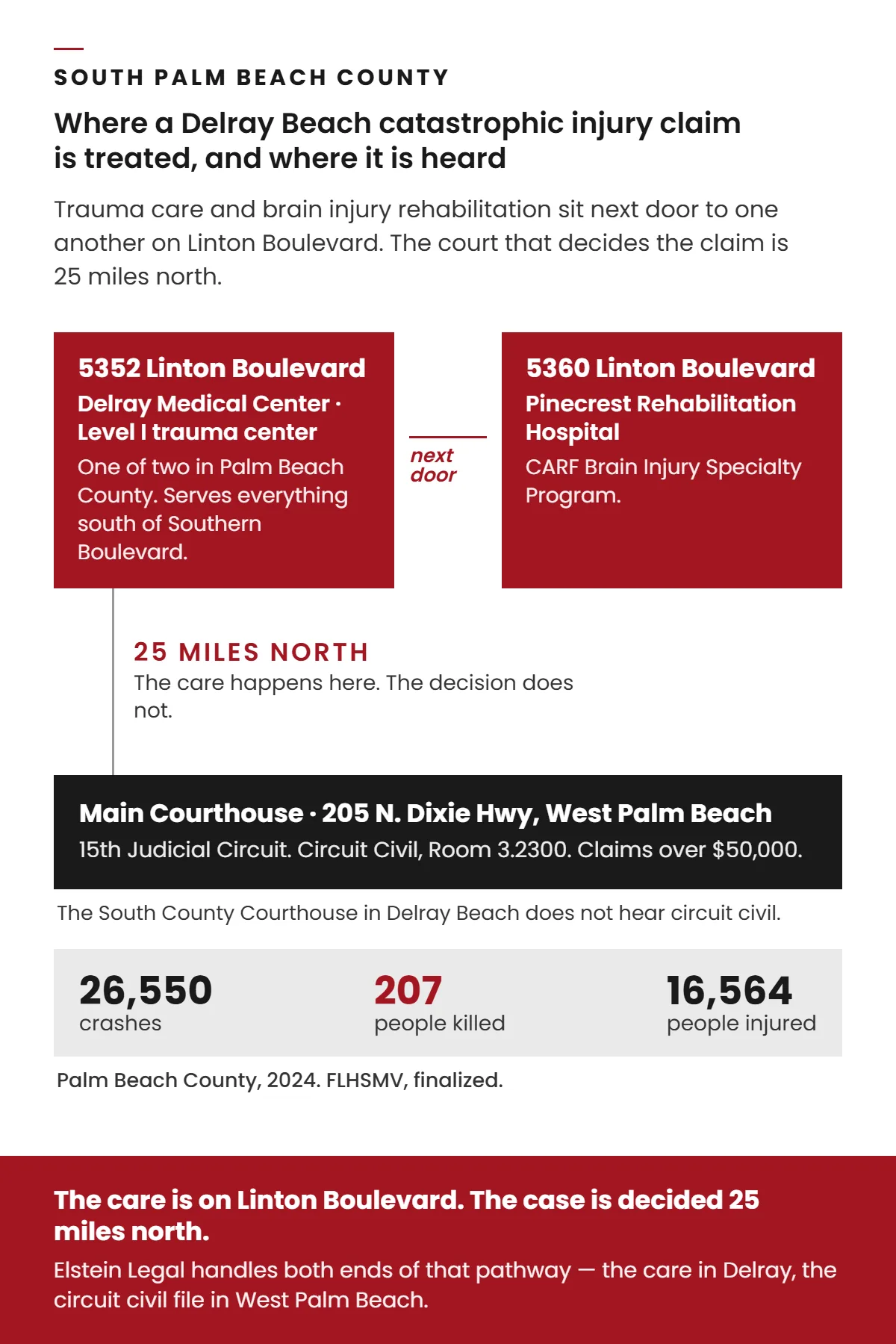
Two buildings on Linton Boulevard decide most of what happens after a catastrophic injury in south Palm Beach County, and they are next door to each other.
Delray Medical Center, at 5352 Linton Boulevard, is a state-designated Level I trauma center, one of only two in Palm Beach County. Palm Beach County Fire Rescue delivers major trauma from everything south of Southern Boulevard here, by ground or by Trauma Hawk. Pinecrest Rehabilitation Hospital sits at 5360 Linton Boulevard, a few hundred feet away, and holds three-year CARF accreditations for its Brain Injury Specialty Program, its Stroke Specialty Program and its general inpatient rehabilitation programme, first earned in 2011.
Acute trauma care and specialty brain injury rehabilitation at adjacent street numbers is unusual anywhere. For an injured person it means the hardest handoff in the whole process happens across a car park. For a claim, it means something more specific.
One thing does not stay in Delray Beach. The lawsuit leaves. The South County Courthouse on West Atlantic Avenue handles a long list of matters and circuit civil is not among them, so a serious injury claim from this city is filed twenty-five miles north in West Palm Beach.
Why Choose Elstein Legal
Brian Elstein used to work for the insurance companies. He defended personal injury claims before he began bringing them, which means he has seen how a carrier sets a reserve, what its adjusters look for in a treatment history, and how it decides what a permanent injury is worth to it.
On a catastrophic claim that background changes where the work goes. Liability is usually the easier half. The harder half is finding enough coverage to pay for a life, and that is what this page spends most of its words on.
Every case is handled personally by Brian, from one office in South Miami, on a contingency fee. No fees unless we win. Over $50 million recovered. Call (305) 299-2835 at any hour, including nights and weekends.
Past results do not guarantee, warrant, or predict future outcomes.
What the Word Catastrophic Actually Covers
Florida has no general tort definition of catastrophic injury. The definition that appears on a good many law firm websites comes out of the workers’ compensation chapter, and it does not create a category in an injury lawsuit. Be wary of any page telling you the legislature has settled this. It has not.
Used honestly, the word describes a permanent, life-altering impairment: the point where the medical record stops describing recovery and starts describing management. In practice that means:
- Spinal cord injury with paralysis, tetraplegia or paraplegia
- Moderate to severe traumatic brain injury
- Amputation, whether traumatic or surgical
- Severe burns over a large surface area
- Loss of sight, or orthopaedic damage that never returns to baseline
None of those is defined by how it happened. A brain injury from a rear-end collision on I-95 and one from a fall on a construction site are the same injury with the same lifetime cost.
Severity is also why the legal footing shifts. In an ordinary crash claim the argument is whether the injury clears the four-prong threshold at § 627.737(2) and escapes Florida’s no-fault system. When the injury is catastrophic, that threshold is met rather than argued, and the case moves straight onto the ground a carrier would rather avoid.
Scale is worth stating plainly. Florida recorded 14,026 incapacitating injuries in 2024 against 3,098 deaths (FLHSMV, 2024). Roughly four and a half people survived an incapacitating injury for every person killed on a Florida road that year. Read that classification carefully, because incapacitating injury is the state’s own severity coding rather than a legal standard, and not every incapacitating injury is catastrophic. Notice what follows from that: the code is assigned by an officer at the scene, on the day, before anyone knows what will be permanent. Whether a case is worth six figures or eight is settled months later, in a rehabilitation record.
The Pathway on Linton Boulevard
Palm Beach County recorded 26,550 crashes in 2024, with 207 people killed and 16,564 people injured (FLHSMV, 2024, finalized). Those are county figures. No published crash count exists for Delray Beach on its own, and dividing a county number down to a city would be inventing one.
What is specific to this city is the route a serious injury takes through it. Trauma resuscitation happens at 5352 Linton Boulevard. Inpatient brain injury rehabilitation happens at 5360. Pinecrest describes itself as the only state-designated brain and spinal cord injury rehabilitation program in Palm Beach County, a claim that rests on the hospital’s own account rather than a published state roster, so treat it as the hospital’s description.
Then the case goes north. Circuit civil for the 15th Judicial Circuit sits at the Main Courthouse, 205 N. Dixie Highway in West Palm Beach, Room 3.2300, which is where claims over $50,000 are heard. Every catastrophic claim is over $50,000.
So the medical file is built on one boulevard and the file is tried in another city. Both halves are worth knowing before anyone signs anything.
Why an Unbroken Medical Record Is Worth Money
Carriers rarely attack a catastrophic injury head on, because denying that a spinal cord injury happened is not a strategy. What an adjuster looks for instead is daylight in the record.
| Where an adjuster looks for daylight | What the gap is used to argue |
|---|---|
| Delay between the injury and first treatment | The injury was not that serious, or something else caused it |
| Weeks between acute discharge and a rehabilitation bed | The deficit developed at home rather than in the crash |
| A change of facility, city or county mid-recovery | New baselines, taken by clinicians who never saw the patient before |
| Appointments missed during a long wait for admission | Non-compliance limited the recovery, so the defendant should not pay for it |
None of that has to be true to be useful to the other side. It only has to be arguable.
Distance usually creates the gap. Across most of South Florida, a person injured badly enough to need specialty rehabilitation is transferred out of the hospital that saved them, often out of the city. Delray Beach is the exception, because the two facilities are neighbours. That guarantees neither a fast admission nor that every patient goes next door. It does mean geography is not the obstacle, and when the handoff happens quickly the documentary trail runs continuously from the trauma bay into the rehabilitation programme.
CARF accreditation is the second thing worth understanding rather than name-dropping. CARF is an independent nonprofit accreditor of health and human services programmes, and a facility applies to it voluntarily. Three years is the longest term it awards. A Brain Injury Specialty Program designation is narrower than general rehabilitation accreditation, because the programme is surveyed against standards written specifically for brain injury, covering clinical staffing, outcome measurement and follow-up. Standardised functional measures, recorded at intervals by a programme surveyed against published criteria, are considerably harder for a defence expert to wave away than a narrative progress note.
Records built that way become the evidence for what the next forty years will cost. Records with holes in them become an argument about causation.
The Coverage Is the Case
Here is the arithmetic that decides most catastrophic claims, and it barely touches the question of who ran the light.
Florida requires $10,000 of personal injury protection under § 627.736. PIP pays 80 percent of medical expenses and 60 percent of lost wages, and it is capped at $2,500 unless a qualified provider makes an emergency medical condition finding. Treatment has to begin within 14 days of the crash or the benefit is lost. Despite a great deal published in 2026 to the contrary, PIP was not repealed. It also applies only to occupants of motor vehicles, so it does nothing in a premises case, a dog bite, or a claim about medical care.
Now the part almost nobody states. Florida does not require an ordinary driver to carry any bodily injury liability coverage at all. Section 324.022(1) requires the ability to pay $10,000 for property damage, or a policy carrying at least $30,000 combined for property damage and bodily injury. Nothing in the financial responsibility scheme obliges a private driver to buy coverage that pays for someone else’s injuries. The familiar 10/20/10 figures are a definition of proof of financial responsibility, which is demanded after the fact, and suspending the at-fault driver’s licence afterwards recovers nothing for the person in the rehabilitation unit.
Set a $10,000 PIP benefit and a legally compliant policy against a first-year cost of care above $1 million, which is what national spinal cord injury data shows at the severe end, and the gap is the whole case.

Closing it means finding every layer rather than accepting the first one offered:
- Uninsured and underinsured motorist coverage, on the injured person’s own policy and on the policies of resident relatives. This is frequently the largest single source of recovery in a serious crash. Whether coverage stacks depends on what was purchased, which is checked rather than assumed.
- Umbrella and excess policies, which sit above a primary policy and which nobody finds unless somebody asks for every declarations page in the household.
- Additional and vicariously liable defendants: an employer whose driver was working, a vehicle owner under Florida’s dangerous instrumentality doctrine, a property owner, a contractor.
- Bad faith exposure, which arises when a carrier mishandles a clear claim within its limits, and which can stop the policy limit being the ceiling.
Elstein Legal’s own results are the evidence for that last point.
| What the insurer put on the claim | What was recovered |
|---|---|
| A $15,000 policy limit the carrier failed to tender in time | $2,250,000, through the carrier’s bad faith rather than the policy |
| $35,000, the best offer before Elstein Legal took the case over | $240,000, in under two months |
| $20,000, the highest offer | $150,000 |
| $145,000 offered before suit | $570,000 |
The firm’s largest published recovery is itself a catastrophic injury matter. A negligent security shooting that left the client paraplegic resolved for $12,250,000.
Past results do not guarantee, warrant, or predict future outcomes.
Brain Injury, and the Number Nobody Can Give You
Brain injury is the injury this pathway is built around, because the CARF Brain Injury Specialty Program sits next to the trauma centre. It is also where most published guidance stops being reliable.
⚠️ There is no authoritative lifetime cost figure for traumatic brain injury, and this page will not print one. A dollar range circulates widely across legal marketing pages and it traces to no primary source. The only traceable per-person lifetime estimate averages across all severities, including fatal cases, from injuries that occurred in 1985, which makes it unusable. The National Academies documented the gap in 2022. Any page quoting a confident lifetime brain injury figure is quoting something nobody published.
What the CDC does publish is incidence and outcome, and the outcome data is the part that matters for valuing a claim. There were 68,663 TBI-related deaths in 2023 and roughly 214,110 TBI-related hospitalizations in 2020. Among inpatient rehabilitation patients aged 16 and over, five years after a moderate to severe traumatic brain injury, 22 percent had died, 30 percent had declined further, 22 percent were unchanged and 26 percent had improved.
Sit with the second figure. Five years on, more than half of that group is dead or worse than they were at discharge. A settlement built on the assumption that someone plateaus and then holds steady is built on the less likely outcome. That is the case for pricing a brain injury through a life care plan rather than a national average.
What a Life Care Plan Prices
A life care plan is a costed, itemised projection of everything an injury will require for as long as the person lives: surgery, equipment, attendant care hours, home and vehicle modification, medication, and replacement of devices as they wear out. A certified life care planner prepares it and an economist prices it. In a catastrophic case it is the document that converts an argument about suffering into a number a defendant has to answer.
For spinal cord injury a national baseline does exist. The National Spinal Cord Injury Statistical Center restates these figures each March, and the ones below are in 2025 dollars.
| Injury level | Lifetime cost, injured at 25 | Lifetime cost, injured at 50 | First year | Each later year |
|---|---|---|---|---|
| High tetraplegia, C1 to C4 | $6,419,617 | $3,528,112 | $1,446,827 | $251,246 |
| Low tetraplegia, C5 to C8 | $4,690,573 | $2,885,122 | $1,045,459 | $154,128 |
| Paraplegia | $3,139,165 | $2,060,139 | $705,131 | $93,409 |
| Motor functional, AIS D | $2,144,693 | $1,513,784 | $472,190 | $57,353 |
One footnote is worth more than the table. NSCISC excludes lost wages, fringe benefits and productivity from every figure above, and puts that loss at an average of $97,787 per year. Lost earning capacity is therefore additional to those totals rather than contained in them, which on a young client is a distinction worth millions. Average acute hospital stay runs 18.6 days and average inpatient rehabilitation 36.3 days, against roughly 311,560 people in the United States living with traumatic spinal cord injury.
Other injuries have partial data and it should be presented as partial. For amputation, MacKenzie and colleagues projected lifetime health care costs of $509,275 in 2002 constant dollars, against $163,282 for limb reconstruction, and prosthesis replacement intervals are genuinely contested: two to five years in one account, five years as a stated reasonable useful life in another, seven years transtibial and ten transfemoral in a third. Picking one of those would be inventing precision. Severe burns have only an acute figure, an average total hospital cost of $117,794 per patient in 2015 dollars across a 10.7 day stay, with no lifetime figure published anywhere authoritative. Where the burn is the claim rather than one injury among several, serious burns are handled on their own terms.
All of these are national. No Palm Beach County equivalent exists, which is why the demand number should be the one a planner prices for this person, in this market.
Fault, and What a Percentage Costs
Comparative fault matters more here than on any other page, because the same percentage applied to a larger number destroys a larger sum.
Under Fla. Stat. § 768.81, a person found more than 50 percent at fault recovers nothing. At 50 percent or less, the award is reduced by that share. Read the phrasing carefully, because a great many sites get it backwards: a plaintiff found exactly 50 percent at fault still recovers, reduced by half. Florida is a modified comparative negligence state, not a pure one.
| Share of fault assigned to you | What remains of a $4,000,000 claim |
|---|---|
| 0 percent | $4,000,000 |
| 15 percent | $3,400,000 |
| 30 percent | $2,800,000 |
| 50 percent | $2,000,000 |
| 51 percent | Nothing |
Fifteen points of fault on that claim is $600,000. One point past fifty is everything. Which is why fault evidence gets gathered in the first weeks rather than once treatment settles down. Vehicle data is overwritten, scene conditions change, video is recycled on a retention schedule, and witnesses stop remembering, while the carrier begins building its version in the first week.
Medical negligence is the exception. Chapter 766 requires presuit notice and an investigation period under § 766.106 before suit, and medical negligence claims keep pure comparative fault rather than the 50 percent bar. Where the harm came from treatment rather than an event, injury arising from medical care sets out how that runs.
Deadlines follow the cause, because catastrophic injury is a severity rather than a cause of action. Most negligence claims must be filed within two years, at Fla. Stat. § 95.11(5)(a). That was four years until HB 837 took effect on 24 March 2023, and the same bill renumbered the section, which is why the subsection matters as much as the count. Material published since then still cites the superseded lettering.
- Negligence: two years, § 95.11(5)(a)
- Medical negligence: two years, with a four-year repose, § 95.11(5)(c), and a presuit process that has to run first
- Death: two years, § 95.11(5)(e), brought by the personal representative of the estate under § 768.20, not by the spouse, children or parents, who are beneficiaries rather than filers
- Product liability: four years, § 95.11(3)(d), with a twelve-year repose at § 95.031(2)(b)
Which row applies is often the first question, not the last. Where the injury proved fatal, when the estate brings the claim explains how that action works. Where a crash caused it, the underlying claim may begin as a crash on Atlantic Avenue or I-95, as one of the commercial truck collisions moving through the corridor, or as a case involving motorcyclists who survive the crash with permanent damage.
Talk to Brian
Bring whatever exists: the crash report, hospital and rehabilitation paperwork, the other driver’s insurer, and the declarations page of every policy in the household. If none of it is to hand, locating coverage is part of the work.
Nothing is charged for the conversation, and nothing at all unless there is a recovery. Call (305) 299-2835 or start with a free case evaluation, and it will be read by Brian’s time on the defense side. If the category of claim is still unclear, our Delray Beach personal injury overview is a better starting point.