

An impact with a loaded tractor trailer leaves injuries a car crash rarely produces, and the records that prove how it happened sit on systems the trucking company controls. Brian Elstein defended insurance companies before he represented injured people. He knows which records exist after a commercial crash and how fast they disappear.






Most people call a lawyer about a truck crash weeks or months afterward. They wait because the hospital comes first, or because two years sounds like plenty of time. In an ordinary car case that pause costs nothing. The crash report is filed, the photographs sit on a phone, and the medical records accumulate on their own.
A commercial vehicle claim does not behave that way. The material that proves what happened is not sitting in a public file. It is inside systems the trucking company owns and operates: the electronic log that recorded the driver’s hours, the telematics and engine control module data that recorded speed and braking in the seconds before impact, the camera footage if a camera was fitted, the file the carrier keeps on that driver’s qualifications and testing, the maintenance and inspection history of that tractor and that trailer, and the dispatch and load paperwork for the trip.
Those records exist because federal rules require the industry to create them. They also move on ordinary business cycles, so data gets overwritten and footage loops. Nobody has to destroy anything for the decisive evidence in your case to stop being available.
So the deadline that governs a truck claim on paper is not the deadline that decides it. Florida gives you two years to file. The window for proving how the crash happened can close much sooner, and nothing announces when it does.
Why Choose Elstein Legal
Brian Elstein used to work for the insurance companies. He defended personal injury claims before he began bringing them, so he has seen the other side of a commercial file: what a carrier’s counsel asks for first, which records get preserved once a demand lands, and which gaps in a medical chart an adjuster is trained to look for.
That background is why this page is about records and defendants rather than about how sorry we are that this happened. In a truck case, liability is frequently obvious and the fight is over proof and coverage.
Cases are handled personally by Brian, from one office in South Miami, on a contingency fee. No fees unless we win. Over $50 million recovered. Call (305) 299-2835, days, nights or weekends. You can read the years Brian spent on the carrier’s side of the file, and what the firm has actually recovered.
Past results do not guarantee, warrant, or predict future outcomes.
The Records That Decide a Truck Claim Belong to the Other Side
Put a car crash and a truck crash beside each other and the important difference is who holds the evidence, not the size of the vehicles.
After an ordinary two-vehicle collision, the proof is largely neutral and durable. A crash report exists. Both drivers photographed the scene. Medical records are created by the treating hospital and stay there. Nothing about that set of material depends on the goodwill of the person who hit you.
In a commercial crash, the most useful facts live in the defendant’s own systems. A serious case usually turns on the questions below, and on who keeps the answers.
| The question | Where the answer lives | Who controls it |
|---|---|---|
| How long had the driver been working, and when did the last break end? | The electronic logging record for that driver and that vehicle | The motor carrier |
| How fast was the truck traveling, and did the driver brake? | Telematics and engine control module output | The carrier, or its telematics vendor |
| What did the driver see, and what did the road look like? | Onboard camera footage, where a camera was fitted | The carrier |
| Was this driver qualified to be in that seat? | The driver qualification file, including licensing, medical certification and testing records | The carrier |
| Had the brakes, tires or coupling been inspected and repaired? | Maintenance and inspection records for the tractor and separately for the trailer | The carrier, the owner, or a maintenance contractor |
| Was the trailer loaded correctly, and by whom? | Dispatch instructions, the bill of lading and loading documents | The carrier, the shipper, the broker |
Federal law governs driving time, record keeping and vehicle inspection for interstate commercial carriers, which is why this evidence exists at all. A carrier’s own paperwork is often the strongest thing an injured person has, as long as somebody demands it in time.
Two of those questions come up often enough to have their own page here. A crash caused by a driver who was too tired to be behind the wheel runs on the driving-time and log records. A crash caused by a truck the carrier never properly maintained runs on the inspection and repair history. Both are worth reading if that is what happened to you.
None of it arrives by itself. A hospital sends its records when you request them. A trucking company sends nothing it has not been formally asked to keep.
The Evidence Expires Before the Claim Does
Preservation is the first act in a truck case, and it happens before anyone has decided whether to sue. A written demand goes to the carrier, its insurer and any other party that may hold data, identifying what must be kept and putting them on notice that it is relevant to a claim. Once that letter lands, ordinary overwriting stops being ordinary and becomes a decision the other side has to defend.
The sequence matters more than the speed of any single step. Identify who holds what, demand that they keep it, and only then ask what it says.
Reverse that and the answer to the last question may no longer exist. Someone who waits three months to make a call can still be comfortably inside Florida’s two-year filing window and already outside the window in which the case could have been proved. That gap is why the first conversation is worth having early, even if you are certain you do not want a lawsuit.
Nothing about a preservation demand commits you to litigation. It preserves the option of proving what happened, which is a different thing, and it costs you nothing to ask for.
What to Do in the First Week
Most of what matters in the first week is medical. A few practical steps sit alongside that.
- Get examined, and do it inside 14 days. Florida’s no-fault benefits carry a hard 14-day deadline for seeking initial care. Miss it and the benefit is gone regardless of how badly you were hurt.
- Photograph the vehicles before they are moved or repaired. Include the trailer, the company markings, and the license plates of both the tractor and the trailer, which are frequently registered to different owners.
- Write down what you remember while it is fresh. Weather, lane position, what the truck did, whether you heard brakes.
- Keep the crash report number. It is how every later record request is indexed.
- Say nothing recorded to the other side’s adjuster. A recorded statement taken in week one, before anyone knows the extent of an injury, is used later to argue the injury was minor.
- Ask a lawyer to send a preservation demand. It has an expiry date attached to it, and it is the one thing on this list you cannot do later.
Insurers for large carriers often have an investigator at a serious crash scene within hours, sometimes before the injured person has left the emergency department. That is not misconduct. It is a well-resourced party doing exactly what it should do. The imbalance is only a problem when one side is collecting evidence and the other side is waiting to feel better first.
A Truck Crash Has More Defendants Than a Car Crash
In a two-car collision, the analysis usually stops at the other driver and the policy behind them. A commercial crash routinely involves several parties, each responsible on its own footing.
| Party | Why they may be responsible |
|---|---|
| The driver | Their own negligence in operating the vehicle |
| The motor carrier | Responsibility for the conduct of a driver in its service, and for how it hired, trained, scheduled and supervised that driver |
| A separate owner of the tractor or the trailer | Ownership and control of a vehicle can sit with a party that is not the carrier and not the driver |
| A maintenance contractor | Work performed, or not performed, on brakes, tires, lighting or coupling components |
| A shipper or the party that loaded the trailer | How the cargo was loaded, secured and weighted, where shifting or overloading contributed |
| A broker who arranged the load | The arrangement of the movement itself, depending on what that party did and controlled |
Identifying every one of them early is not a way of casting a wide net. Each party holds a different set of records, and each carries its own insurance. Miss a party and you have missed both.
Some crashes go further than negligence. Where a tire, a brake assembly or a coupling failed rather than being neglected, the claim against the component’s manufacturer is a defective tire, brake or coupling matter, and it runs on a different and longer deadline than the negligence claim does. The table below sets that out.
A Commercial Policy Is Built in Layers
A private driver’s auto policy is usually a single document with a single limit. Commercial insurance is normally arranged differently, with a primary policy and further coverage sitting above it, and with more than one policy potentially responding to the same crash depending on which party is liable and in what capacity.
The first offer you receive may come from one layer of a structure that has more than one. Identifying every liable party is a financial question as much as a legal one, because each party brings its own coverage into the case.
Florida’s requirements for ordinary drivers are worth knowing as a contrast. State law obliges a private driver to carry personal injury protection and to answer for property damage. It does not require that driver to buy bodily injury liability coverage at all. A commercial carrier’s obligations are not the same, which is one of the few situations in Florida injury law where being hit by a larger vehicle can mean more coverage rather than less.
How these layers fit together, including uninsured and underinsured motorist coverage on your own policy, is set out at length in how the coverage layers stack up after a Florida crash rather than repeated here.
The Two Deadlines, and the Fault Rule That Decides What Is Left
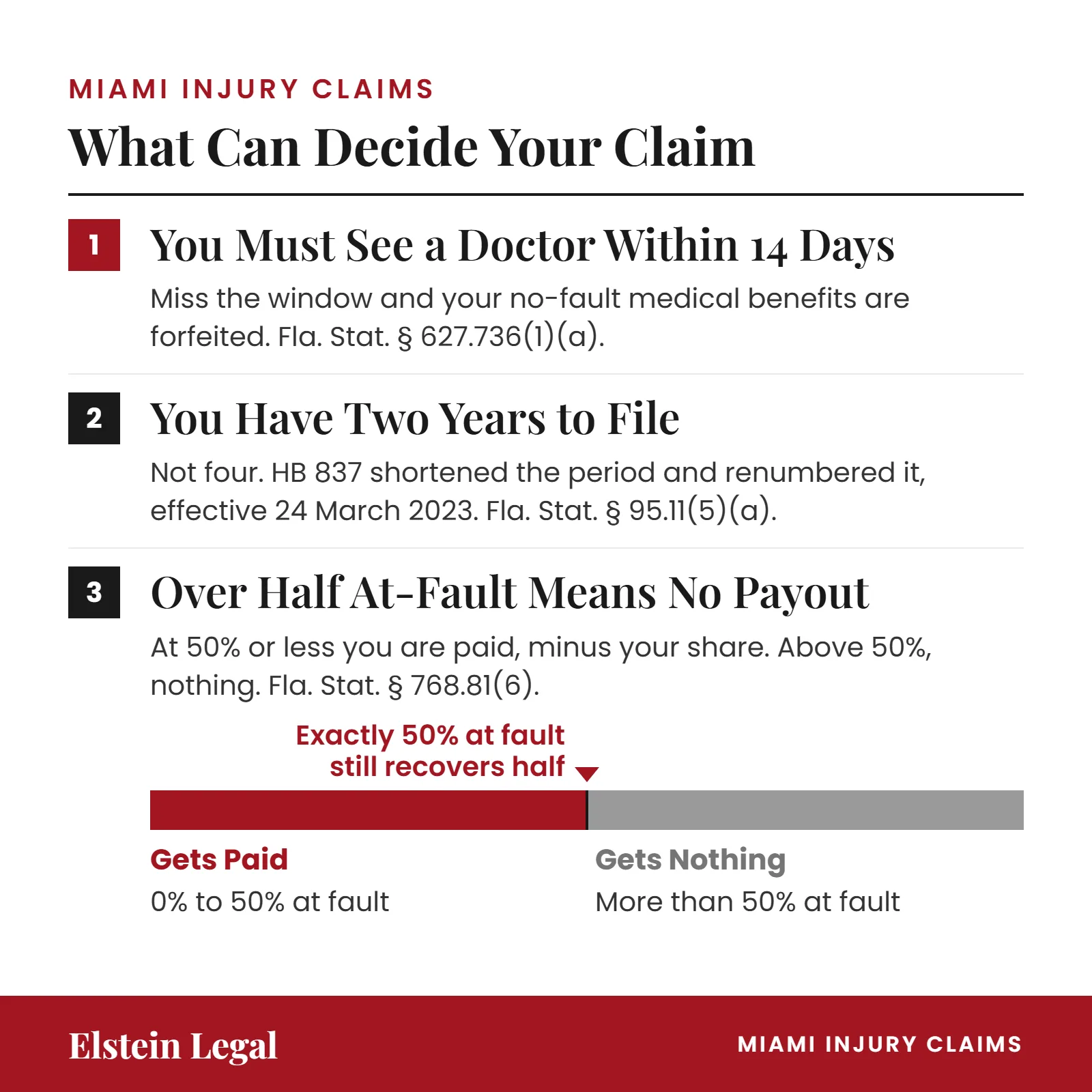
Florida negligence claims must be filed within two years, under Fla. Stat. § 95.11(5)(a). The period was four years until HB 837 took effect on 24 March 2023, and the same bill renumbered the statute, so the subsection is now as easy to get wrong as the number. Pages published since then still list four years, and others give the correct duration under the superseded lettering. Neither is a reason to trust what you read somewhere else.
| Type of claim arising from a truck crash | Deadline | Provision |
|---|---|---|
| Negligence against the driver, carrier, owner, contractor, shipper or broker | Two years | § 95.11(5)(a) |
| Wrongful death | Two years | § 95.11(5)(e) |
| A defective component, such as a tire, brake or coupling | Four years, with a twelve-year repose | § 95.11(3)(d), repose § 95.031(2)(b) |
The four-year row is a genuine exception, and it belongs only to a product claim. If your case is that a driver was tired, a carrier scheduled badly, a trailer was loaded wrong or a truck was not maintained, the answer is two years.
Fault is the other rule that decides the size of a recovery, and it is the one most often stated backwards. Under Fla. Stat. § 768.81, at subsection (6), a person found more than 50 percent at fault recovers nothing. At 50 percent or less, the award is reduced by their share.
| Your share of the fault | What you recover |
|---|---|
| 0 percent | Your full damages |
| 20 percent | 80 percent of your damages |
| 50 percent | Half. A person found exactly 50 percent responsible still recovers |
| More than 50 percent | Nothing. Recovery is barred entirely under § 768.81(6) |
Florida is a modified comparative negligence state, not a pure one, and it has been since March 2023. The bar sits above 50 percent rather than at it, so copy telling you that you must be under half at fault is wrong in the one direction that matters to somebody sitting at exactly half.
Fault percentages are argued from evidence, which is where this page started. Lane position, speed, braking and the driver’s hours are all questions the truck’s own data answers. When that data is gone, the argument runs on recollection instead, and recollection is where a well-prepared defendant does its best work.
Billing is the other thing that shapes what a claim is worth. Under § 768.0427, recoverable past medical damages are limited to amounts actually paid or payable rather than amounts billed, which is a reason to have somebody looking at the bills early rather than after treatment ends.
PIP, the 14-Day Rule and the Injury Threshold
If you were in a car when a truck hit you, Florida’s no-fault system still applies to you, and it applies first.
Personal injury protection under Fla. Stat. § 627.736 provides a $10,000 minimum benefit, paying 80 percent of medical expenses and 60 percent of lost wages, capped at $2,500 unless a qualified provider makes an emergency medical condition finding. Care must begin within 14 days of the crash. Plenty of material published in 2026 says otherwise, but PIP was not repealed. The repeal bills died in committee when the legislative session adjourned on 13 March 2026, and the 14-day rule is still in force.
PIP is also nowhere near enough for the injuries a commercial vehicle produces, which is why the threshold question matters. To pursue the at-fault parties for pain and suffering rather than being confined to no-fault benefits, an injury must meet one of four prongs at Fla. Stat. § 627.737(2):
- Significant and permanent loss of an important bodily function
- Permanent injury within a reasonable degree of medical probability, other than scarring or disfigurement
- Significant and permanent scarring or disfigurement
- Death
On an ordinary crash claim, whether the threshold is met is frequently the whole fight. After an impact with a loaded commercial vehicle it is usually met without argument, which moves the case onto ground a carrier would rather not be on, namely what the injury will cost over a lifetime.
This framework leaves one vehicle out. A motorcycle is not a motor vehicle for no-fault purposes, so a rider beside a trailer has no PIP benefit at all and depends on liability coverage from the outset.
Where the Trucks Run, and Where the Case Ends Up
Freight in Miami-Dade moves on a small number of roads, and two of them carry most of it. The Palmetto Expressway, signed SR-826, and the Dolphin Expressway, signed SR-836, are the corridors where a passenger vehicle is most likely to be sharing a lane with an articulated truck at speed. I-95 carries the north and south volume, Biscayne Boulevard, signed US-1, carries surface commercial traffic, and the MacArthur Causeway carries its own mix across the county.
Where the crash happens on that network changes almost nothing legally. Where the patient goes, and where the case is filed, are both worth knowing.
| Stage | Where | Detail |
|---|---|---|
| Trauma care | Ryder Trauma Center at Jackson Memorial | Level I, ACS verified. The county’s primary destination for major trauma |
| Other trauma capacity | HCA Florida Kendall Hospital, Jackson South Medical Center, HCA Florida Aventura Hospital | Level I at Kendall, Level II at Jackson South and Aventura |
| Injured children | Nicklaus Children’s Hospital | ACS-verified Level 1 Pediatric, the only such verification in South Florida |
| Filing the lawsuit | 11th Judicial Circuit, Osvaldo N. Soto Miami-Dade Justice Center, 20 NW 1st Avenue, Miami, Florida 33128 | Circuit Civil is heard in this building, which opened in November 2025 and replaced the older downtown courthouse |
That last row is a small thing with real consequences. Material written before late 2025 sends readers to an address where civil cases are no longer filed, and some of it is still online.
Why a Truck Crash Injures People Differently
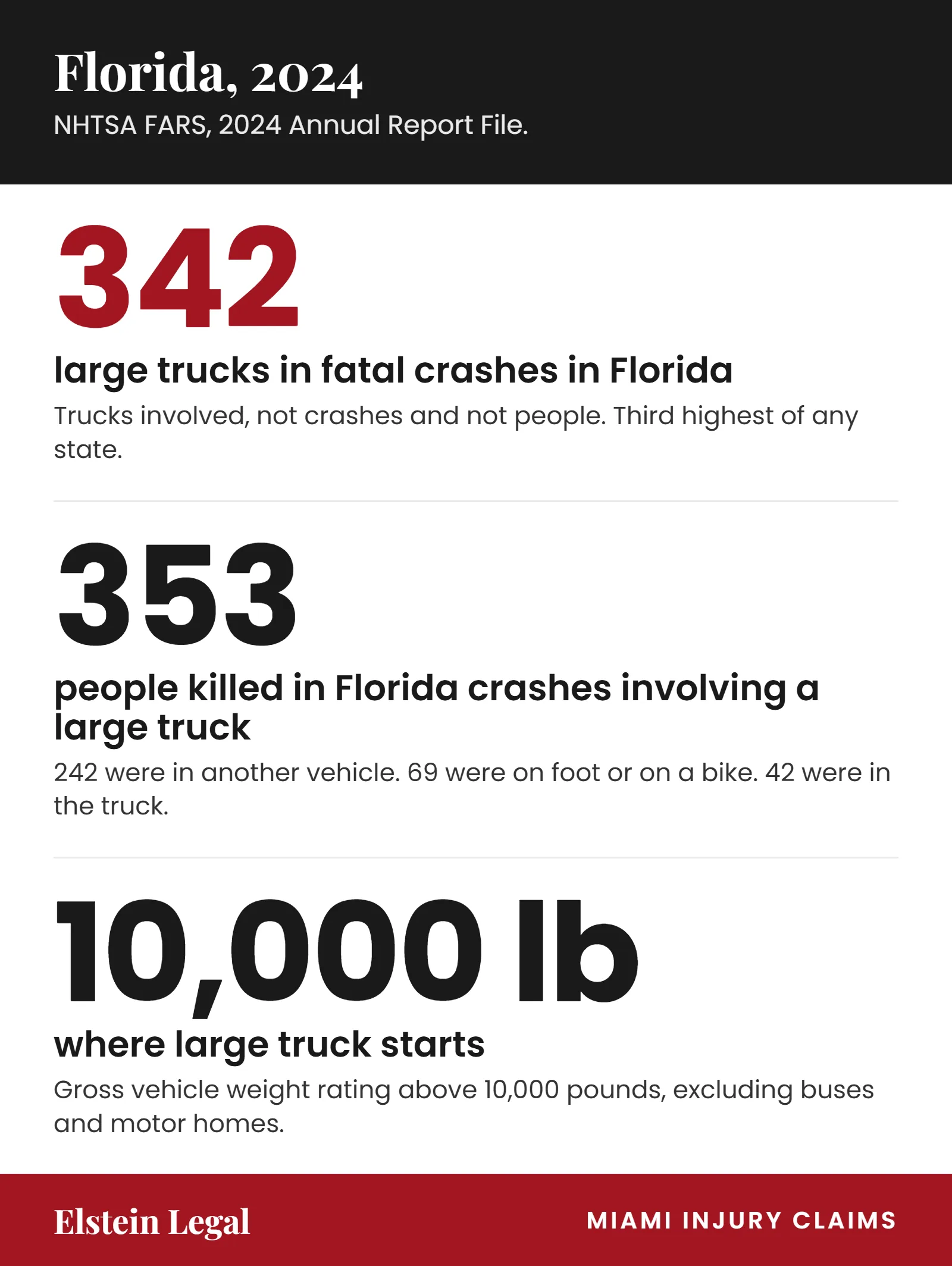
Physics does most of the work here. A loaded tractor trailer can weigh many times what the vehicle it strikes weighs, and the energy in that collision is not distributed evenly between them. The smaller vehicle absorbs most of it. Underride, where a car goes beneath a trailer, and jackknife and rollover events produce injury patterns that two cars colliding do not.
That changes the claim itself. Injuries are more often permanent, which is why the threshold question above is usually settled before it is asked. The case becomes a claim about a survivor who never regains what the crash took rather than a claim about recovery. Fatal outcomes are also proportionately more common, so a truck case is more likely than most to become a claim brought by an estate rather than by the injured person.
Where a crash is fatal, the action is filed by the personal representative of the decedent’s estate, appointed through probate, and not by the spouse, children or parents, who are beneficiaries rather than filers. That gets stated backwards often, and it determines who is able to start the case at all. The firm handles that claim when the crash kills the smaller vehicle’s occupants.
Cargo can make it worse still. Fuel and flammable freight put burns into a case that otherwise would not carry them, and a tanker fire or a fuel-fed burn is treated separately because the medicine, the evidence and the damages all differ.
What the Process Actually Looks Like
The stages below are typical ranges rather than commitments, and they overlap in practice. Any individual case can move faster or take much longer depending on the injuries, the number of parties and whether the carrier’s records arrive without a fight.
| Stage | Typical range | What is happening |
|---|---|---|
| Case evaluation | 1 to 2 weeks | Reviewing the crash report, identifying the parties, sending the preservation demand |
| Investigation | 1 to 3 months | Obtaining logs, telematics, driver and maintenance files, locating every policy |
| Negotiation | 2 to 6 months | Demand and response, once the medical picture is stable enough to value |
| Discovery, if suit is filed | 6 to 12 months | Depositions, document production, expert work |
| Mediation | 1 to 2 days | A structured settlement conference, required in most circuit civil cases |
| Trial preparation | 1 to 2 weeks of concentrated work | Exhibits, witnesses, motions |
No range on that table is a promise about your case, and none of it is a reason to delay the first step, which is the only one with a clock attached.
Talk to Brian
Bring whatever exists. The crash report or its number, hospital paperwork, photographs of both vehicles, the name of the trucking company and anything printed on the trailer, plus the declarations page of every auto policy in your household. If you have none of it, that is normal at this stage and it is not a prerequisite for calling.
There is no fee to talk and no fee unless there is a recovery. Call (305) 299-2835 at any hour, or send the details of the crash and Brian will read it himself.
The preservation demand is the step that gets harder every week you wait, and the filing deadline is not the deadline that will decide your case.