

You were in an Uber when it was hit, or an Uber hit you, and everyone has an opinion about whose insurance pays. Brian Elstein defended insurance companies before he represented injured people. What decides the answer is the driver’s app status at the moment of impact, and that single fact moves the available coverage by a factor of twenty.






Most people want to know whether they can sue Uber. That question eats the first week and settles very little.
The one that decides how much coverage exists is narrower: what was the app doing at the moment of impact? Florida’s rideshare statute builds the insurance in tiers, and the tier is set by the driver’s status when the vehicles met. A driver who had not opened the app is an ordinary motorist. Logged on and waiting for a ping, that driver sits under one set of limits. Carrying you on a trip already accepted, the same driver sits under a limit twenty times larger for the same collision.
Nothing about the crash itself changes that. Same intersection, same impact, same injuries, and the insurance standing behind them moves depending on whether a driver tapped a button a few seconds earlier. That is why the trip record matters more than the police report on the insurance question, and why “it was an Uber” is not an answer by itself.
What follows is the tier structure with its statute sections, the coverage figure that is easy to state loosely, and the deadlines that decide whether any of it reaches you. Where the answer depends on a policy nobody can read from a web page, this page says so instead of guessing.
Why Choose Elstein Legal
Brian Elstein used to work for the insurance companies. He defended personal injury claims before he began bringing them, which means he learned how a carrier reads a rideshare file: which trip records it will ask for, how it uses a gap between the crash and the first medical appointment, and how quickly a coverage question turns into a coverage denial.
That experience is the reason this page opens with policies rather than with sympathy. In a rideshare case the argument about who was careless is often settled long after the argument about which policy responds.
Cases are handled personally by Brian, from one office in South Miami, on a contingency fee. No fees unless we win. Over $50 million recovered. Call (305) 299-2835, days, nights or weekends.
Past results do not guarantee, warrant, or predict future outcomes.
Which Policy Responds Is Decided by the App
Florida regulates rideshare insurance at Fla. Stat. § 627.748, and subsection (7) is where the coverage requirements live. It describes three positions a driver can be in, and each one carries a different answer.
| Driver status at impact | What the statute requires | Provision |
|---|---|---|
| App off. Not logged on, not working | Whatever the driver bought privately. Nothing more | No rideshare provision applies |
| App on, no ride accepted. Logged on and waiting | $50,000 per person and $100,000 per incident for death and bodily injury, $25,000 property damage, plus personal injury protection and uninsured and underinsured coverage as required by law | § 627.748(7)(b) |
| Engaged in a prearranged ride. Trip accepted, through drop-off | At least $1 million for death, bodily injury and property damage combined, plus personal injury protection and uninsured and underinsured coverage as required by law | § 627.748(7)(c) |
Read the middle row against the bottom row. The per incident figure moves from $100,000 to $1 million on nothing more than whether a driver had accepted a trip. A passenger is almost always in the bottom tier, because a passenger in the car means a trip was accepted. Someone hit by an Uber, rather than riding in one, may be in any of the three.
The top row is the one that catches people out. When the app is off, the driver is a private motorist and there is no rideshare coverage at all. That matters more in Florida than it would elsewhere, because Florida does not require a private driver to buy any coverage that pays for injuring somebody. Section 324.022(1) requires the ability to respond in damages of $10,000 for property damage, or a policy carrying at least $30,000 combined property damage and bodily injury. Neither that section nor § 627.733(1) obliges a driver to carry bodily injury liability coverage. A driver can be entirely lawful and carry nothing that responds to a broken wrist, which is the situation covered on the page about the driver’s personal policy.
Establishing which tier applies is evidence work rather than argument. The platform holds the trip data: when the driver logged on, when the request was accepted, where the vehicle was at each point. A driver’s memory of it is not that record, and an adjuster rarely volunteers the record early.
What Up To $1 Million Actually Means
One sentence on the current version of this page is worth keeping word for word, because it is more careful than almost anything published on the subject in Florida: once a trip has been accepted and throughout the trip, Uber provides up to $1 million in third-party accident liability.
Every part of that sentence is doing real work. It says “up to” rather than naming a flat amount, and it calls the coverage third-party liability, which is what the platform buys to answer claims made against its drivers. It also states the period, which is the app-status trigger described above.
What the sentence leaves out is the word that changes what a reader expects. The $1 million is combined. Section 627.748(7)(c) requires at least $1 million for death, bodily injury and property damage together, not $1 million reserved for injuries with vehicle damage handled somewhere else. A claimant told there is “a $1 million policy” reasonably hears a million dollars available for their broken bones. The statute does not say that. It sets a floor on a combined limit, and what any individual claim recovers out of it depends on the injuries, the fault picture, how many people were hurt in the same crash, and what the policy in force that day actually says.
A second correction matters just as much. No Florida statute provides $1 million in uninsured or underinsured motorist coverage. Both tiers of § 627.748(7) require only uninsured and underinsured vehicle coverage “as required by s. 627.727,” with no dollar figure attached. Uber may carry higher uninsured motorist limits by contract, which is a fact about a commercial policy that can change without notice rather than a protection Florida law gives you. Anyone who tells you the law promises an injured rideshare passenger a million dollars of uninsured motorist coverage is describing something that does not exist.
If the full stack of policies interests you, including how these tiers sit alongside your own coverage, that is set out in what sits behind a Florida crash claim, layer by layer. The platform-neutral version of the tier question, covering both companies at once, is who pays after a rideshare crash in Florida.
No-Fault Reaches a Passenger
Florida is a no-fault state, and rideshare passengers are inside the no-fault system rather than outside it. Fla. Stat. § 627.736 sets out who personal injury protection reaches, and subsection (1) names the categories:
the named insured, relatives residing in the same household unless excluded under s. 627.747, persons operating the insured motor vehicle, passengers in the motor vehicle, and other persons struck by the motor vehicle.
Passengers appear expressly on that list. Being in a car you do not own, driven by somebody you had never met, does not put you outside the scheme.
Which policy pays first is a different question, and this page is not going to answer it with a rule that sounds tidy and might be wrong for your claim. Personal injury protection is bought by households and by vehicle owners, and a rideshare crash can involve your own policy, a resident relative’s policy, the driver’s policy and the platform’s coverage at the same time. Priority between them turns on the policy language in force on the day. Anyone who gives you an order of payment without reading the declarations pages is guessing.
Personal injury protection was not repealed, whatever you have read this year. The 2026 repeal bills, SB 522 and HB 769, died in committee when the session adjourned on 13 March 2026. The $10,000 minimum, the 80 and 60 percent split, the $2,500 cap without an emergency medical condition finding and the fourteen day rule are all still in force.
| What personal injury protection pays | Amount |
|---|---|
| Minimum benefit | $10,000 |
| Medical expenses | 80 percent |
| Lost wages | 60 percent |
| Without an emergency medical condition finding | Capped at $2,500 |
| Deadline for initial care | 14 days from the crash |
The Fourteen Day Deadline
Initial medical care has to begin within fourteen days of the crash, or personal injury protection benefits are forfeited. Not reduced by a percentage, forfeited.
Rideshare passengers miss this deadline more often than drivers do, and the reason is just how these crashes go. You get out of a damaged car on a street you were passing through. Whoever hit you swaps details with the driver, not with you. You go home, report the trip in the app and wait to see how you feel. By the time the stiffness stops improving, three weeks have passed and no argument recovers the benefit.
The emergency medical condition line in the table matters here too. A qualified provider has to make the finding before the full $10,000 is available. Without it, the medical benefit stops at $2,500, which does not cover an ambulance ride and a scan in Miami-Dade County.
Missing the fourteen days does not end a claim against whoever caused the crash. It removes the layer that pays medical bills regardless of fault while everything else is still being argued about, and that layer is usually the only money moving in the first two months.
A Crash Inside Miami-Dade County
Miami-Dade County recorded 60,000 crashes in 2024 (FLHSMV, 2024, finalized). That is the county, not the city, and it is the pool a rideshare crash in Miami comes out of.

It is not a rideshare figure, and this page will not turn it into one. No agency publishes rideshare crash counts by county, so any percentage, share or “thousands of them” attached to that 60,000 would be invented. What the number tells you honestly is the scale of the roads you were on.
Paid trips are how a lot of people move here, through the Brickell corridor, out along the Dolphin Expressway, across the MacArthur Causeway late at night. The law that applies on those roads is the same law that applies on any Florida road, and it does not change because the trip was booked in an app. What changes is the number of insurance policies in the picture and the number of parties with a reason to describe the crash their own way.
Florida publishes no crash data below county level. Any page that tells you which Miami street is the most dangerous for rideshare passengers is telling you something no dataset supports.
What To Do if You Are Injured in an Uber Accident in Miami
The trip record is the piece of evidence that is easy to preserve today and awkward to reconstruct later.
- Screenshot the ride in the app while it is still in your history: the driver, the vehicle, the times and the route
- Get the crash report number at the scene, and the names of the other drivers and any witnesses
- Report the crash through the app as a passenger, keeping the confirmation
- See a doctor, for the reason set out above, and mention every symptom rather than only the worst one
- Photograph the vehicles and the scene before anything is moved, including the interior if you were riding
- Say nothing recorded to any insurer until you understand which policy is being asked to respond and why
Uber’s own claims process may open quickly and seem helpful, and it is run by representatives whose job is to value the claim. Nothing requires you to give a recorded account of your injuries in the first week, and little is gained by doing it before anyone has read your medical records.
Being Assigned a Share of the Blame
Florida uses modified comparative fault at § 768.81(6), and the rule is an easy one to state backwards.
A person found more than 50 percent at fault recovers nothing. At 50 percent or less, the recovery is reduced by their share, so a claimant found exactly 50 percent responsible still recovers half. Putting the bar the other way around, as though anyone at half fault were shut out, gets it wrong. Florida is a modified comparative negligence state rather than a pure one.
Passengers are rarely assigned any meaningful share of the blame, not having been the one steering or choosing the lane. Seat belt use can come up. So can conduct inside the vehicle. Neither is a common outcome.
Where the rule bites in rideshare cases is between the drivers. Two carriers arguing over which of them pays are arguing about percentages, and every point moved between them changes what the eventual recovery looks like. That fight happens above the passenger’s head, and it is one of the reasons a passenger claim that looks straightforward can sit still for months.
Two Years to File
Most Florida negligence claims must be filed within two years, at Fla. Stat. § 95.11(5)(a).
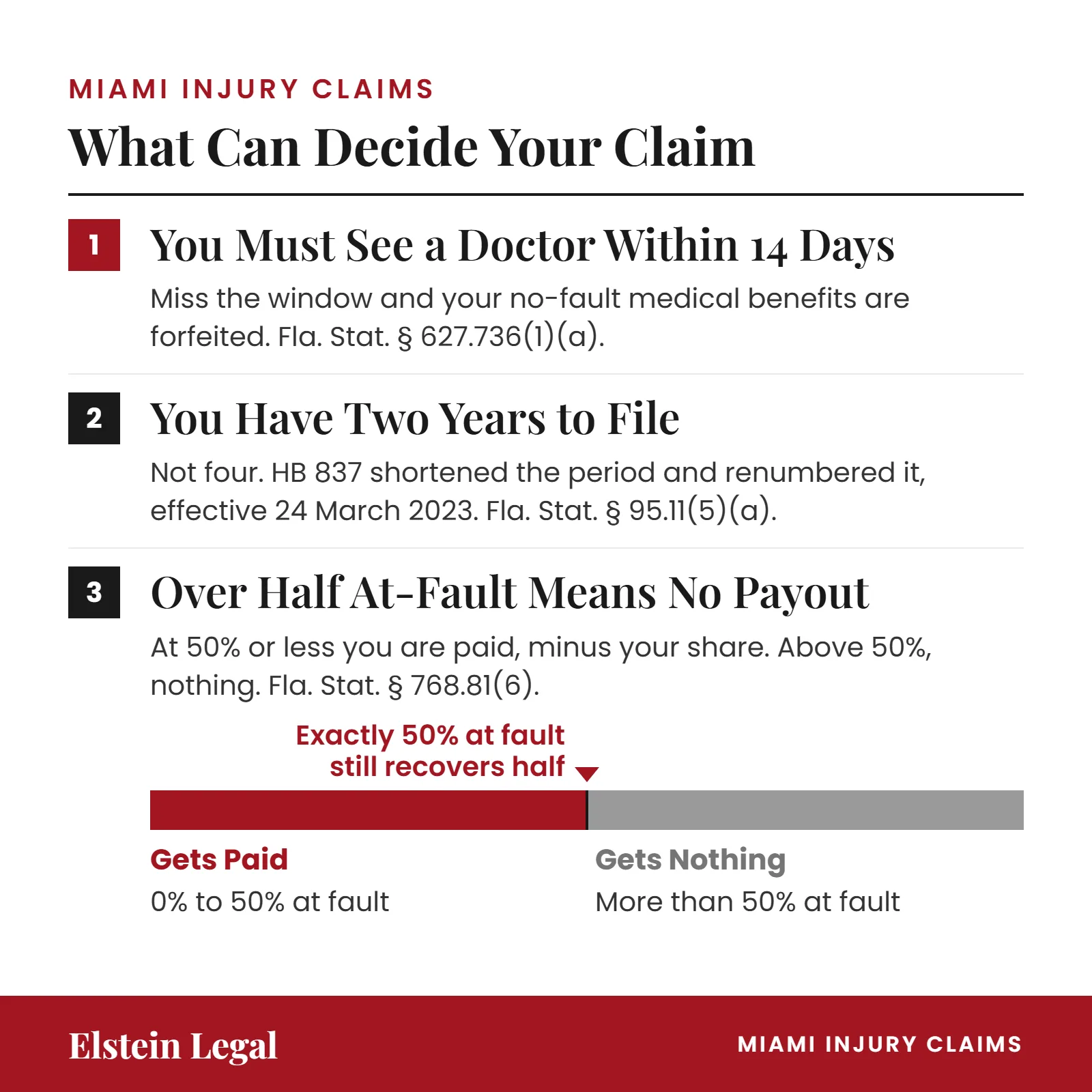
That deadline was four years until recently. HB 837 cut it, effective 24 March 2023, and the same bill renumbered the statute, which is why the subsection matters as much as the number. Subsection (3) is the four year subsection and covers products. Subsection (5) is the two year one and covers negligence. There is no two year subsection (4).
| Claim | Deadline | Provision |
|---|---|---|
| Negligence, including a rideshare crash | Two years | § 95.11(5)(a) |
| Wrongful death | Two years | § 95.11(5)(e) |
| Product liability, such as a defective vehicle part | Four years, with a twelve year repose | § 95.11(3)(d), repose § 95.031(2)(b) |
The old four year figure is still in wide circulation, and some of the pages carrying it link to an archived version of the statute that genuinely used to say it. An outdated citation reads as authoritative precisely because the source is real. Check the year on any statute page you are sent, including the ones on this site.
Those clocks run at once after a rideshare crash, and they do different jobs. Fourteen days decides whether a no-fault benefit pays anything. Two years decides whether a lawsuit can be filed at all.
Why Hire a Miami Uber Accident Lawyer?
Most of these claims never become a lawsuit. They become a negotiation between an injured passenger and a carrier that handles rideshare claims all day, and the difference between a fair outcome and a poor one is usually made before anyone drafts a complaint. Filing suit is what happens when a carrier will not move. In the 11th Judicial Circuit, a Miami-Dade circuit civil case is filed at the Osvaldo N. Soto Miami-Dade Justice Center, 20 NW 1st Avenue, Miami, which opened on 10 November 2025.
What a lawyer is doing in the months before that point is mostly coverage work: pinning the driver’s app status to the second using the platform’s own trip data, and finding every policy that could respond, including your own household coverage. It also means reading the platform policy in force on the day of the crash rather than the summary published on a website, and building a medical record that answers the causation argument before anyone makes it.
Elstein Legal has recovered $100,000 in policy limits on a claim a carrier had valued at $13,780, $240,000 in under two months on a file the previous handling had valued at $35,000, and $2,250,000 in bad faith where the carrier’s position was a $15,000 policy limit. The published settlement list contains no rideshare matter, so read those as evidence of how the firm handles an insurer rather than as a prediction about your claim. The full list is at the settlements the firm has published.
Past results do not guarantee, warrant, or predict future outcomes.
Severity changes the shape of the work rather than the law. A claim brought for a passenger left with damage that does not reverse runs on the same tiers with far more attention to what the combined limit leaves uncovered. A passenger hit by a commercial truck in the same collision faces two insurance towers rather than one. And the same crash in a Lyft runs on the same statute with a different platform policy behind it.
Reach Brian Elstein
Bring whatever exists. The crash report or its number, the ride confirmation from the app, anything the hospital gave you, and the declarations page of every auto policy in your household including a resident relative’s. Most passengers have none of that on day one, which is normal. Assembling it is the work rather than a condition of starting.
Before you call anyone, see a doctor if you have not, because of the fourteen day rule. And hold off on giving any insurer a recorded statement until you know which tier of § 627.748(7) is being argued about, since that is the question your answers will be measured against.
There is no fee to talk and no fee unless there is a recovery. Call (305) 299-2835 or speak to Brian directly. Why the first conversation tends to be about policies and dates rather than about pain is explained by the years Brian spent on the insurer’s side.