

A crush injury, an amputation or a severe brain injury changes what the rest of a life costs, and the policy behind it is rarely written for that. Brian Elstein defended insurance companies before he represented injured people. He knows how a carrier values a claim this size, and where the coverage that funds long-term care is actually found.






The first call usually comes from somebody other than the injured person. A husband, a sister, a shift supervisor. Someone is in a trauma bay, the words being used are spinal cord or brain injury or amputation, and the question being asked is not yet a legal one. It is where the patient is being taken next.
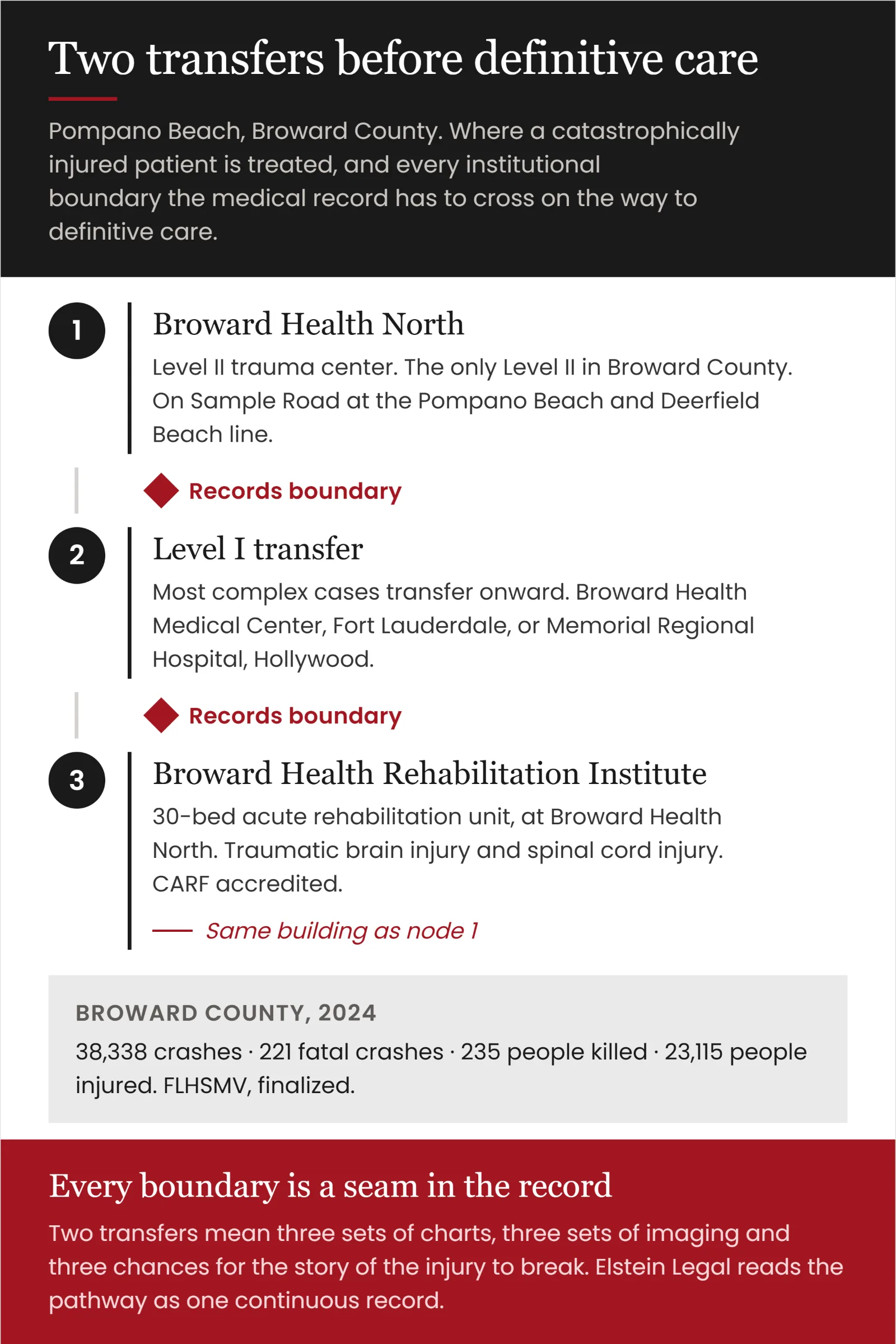
In Pompano Beach that question has an unusual answer, and it shapes the claim that follows. The nearest trauma center is Broward Health North, which is a Level II, the only Level II in Broward County. Broward County’s trauma plan routes Pompano Beach and northern Broward there, and it also provides that the most complex cases move onward to a Level I. So a catastrophically injured patient from this city can be moved twice before reaching definitive care, and then moved back again for rehabilitation.
There is genuine good news buried in that. The acute rehabilitation unit sits at the same hospital the patient started in, which is unusual, and which makes the later part of the record continuous. The earlier part is what gets fragmented.
None of this criticises the care. It describes where the paperwork lives, and in a claim worth millions the paperwork is what the other side reads.
Why Choose Elstein Legal
Brian Elstein used to work for the insurance companies. He defended personal injury claims before he began bringing them, which means he has seen how a file is built on the other side: what gets flagged, what gets reserved, and which gaps in a medical record an adjuster is trained to find.
That background is why this page spends more time on coverage and records than on who was at fault. In a catastrophic case the damages run past the policy almost immediately, and the work is locating everything that can pay.
Cases are handled personally by Brian, from one office in South Miami, on a contingency fee. No fees unless we win. Over $50 million recovered. Call (305) 299-2835, days, nights or weekends.
Past results do not guarantee, warrant, or predict future outcomes.
What Makes an Injury Catastrophic
Florida has no general tort definition of a catastrophic injury. The statutory definition that circulates online sits in the workers’ compensation chapter and creates no category in an injury lawsuit, so be wary of any page that tells you the legislature has defined this for you. It has not.
Used honestly, the word describes a permanent, life-altering impairment. It is the point where the medical record stops describing recovery and starts describing management. The injuries that usually reach it include:
- Spinal cord injury with paralysis, whether tetraplegia or paraplegia
- Moderate to severe traumatic brain injury
- Amputation of a limb, traumatic or surgical
- Crush injuries with permanent loss of function
- Severe burns across a large surface area
- Blindness, or multiple orthopaedic injuries that never return to baseline
None of those is defined by how it happened. Any of them can come from a crash, a fall from height, a machine, a fire or a failure of medical care, which is what separates this page from the ones organised around a cause.
That severity point carries one immediate legal consequence. In an ordinary crash claim the fight is over whether the injury clears the four-prong threshold at § 627.737(2) and escapes Florida’s no-fault system. When the injury is catastrophic, the threshold is met rather than argued, and the case moves onto the ground the carrier would rather avoid, which is what the next several decades cost.
Statewide, this group is larger than most people assume. Florida recorded 14,026 incapacitating injuries in 2024 against 3,098 deaths (FLHSMV, 2024). Roughly four and a half people survived with an incapacitating injury for every person killed on a Florida road that year. Incapacitating injury is the state’s own severity coding rather than a legal standard, and not every incapacitating injury is catastrophic.
Read for what it does show, the figure says something specific about a city like this one. It counts an outcome and not a mechanism, so those people are spread across every way a body can be badly hurt. Where the economy runs on warehousing, distribution and manufacturing, the mechanisms that dominate are not the ones a car accident page describes.
The Two Transfers Before Definitive Care
Broward Health North sits on Sample Road at the Pompano Beach and Deerfield Beach line. It is a Level II trauma center, the only one in Broward County, and it is staffed to receive serious trauma. Broward County’s trauma plan assigns this city and northern Broward to it, and provides that the most complex cases transfer onward to a Level I, meaning Broward Health Medical Center in Fort Lauderdale or Memorial Regional Hospital in Hollywood.
That is the system operating the way it was designed to operate. A family should not read it as a failure, because it is not one.
What it does is place institutional boundaries in the middle of a medical record. A patient can be received and stabilised at one hospital, treated definitively at a second, then returned to the acute rehabilitation unit back at the first. The chart has to be reassembled from more than one building.
Every seam is a place a carrier can later argue that the deficit came from something other than the event. A gap in the notes during transport. Two hospitals coding the same finding differently. A day when no neurological exam was documented because the patient was in an ambulance. Ordering that record properly, from every institution rather than only the one that discharged the patient, is early work rather than something to do when treatment settles down.
Where the Claim Itself Is Filed
The medicine moves around. The lawsuit does not.
| Stage | Where it happens | Detail |
|---|---|---|
| Trauma care | Broward Health North, Sample Road at the Pompano Beach and Deerfield Beach line | Level II, the only Level II in Broward County. Receives Pompano Beach and northern Broward under the county trauma plan |
| Most complex cases | Broward Health Medical Center, Fort Lauderdale, or Memorial Regional Hospital, Hollywood | Level I. The county trauma plan provides for onward transfer |
| Rehabilitation | Broward Health Rehabilitation Institute, at Broward Health North | 30-bed acute rehabilitation unit, treating traumatic brain injury and spinal cord injury. CARF accredited for its comprehensive programme and its stroke specialty programme |
| Filing the lawsuit | 17th Judicial Circuit, Broward County Central Courthouse, 201 SE 6th Street, Fort Lauderdale | Circuit civil is heard downtown. The nearest branch, North Regional Courthouse at 1600 W. Hillsboro Blvd in Deerfield Beach, uses county court judges |
One detail in that table is easy to misread. Broward is the 17th Judicial Circuit for court purposes and Trauma Service Area 18 for trauma purposes, two numbers that sit beside each other in a serious case and refer to entirely different systems.
The rehabilitation row is the one that helps you. A 30-bed acute rehabilitation unit inside the same hospital that received the patient means the second half of the record is written by one institution, in one place, with one set of conventions. Cases where the rehabilitation happens out of town lose that.
The Injuries Pompano’s Economy Produces
Pompano Beach is Broward County’s largest industrial, warehouse and distribution submarket, with more than 28 million square feet of industrial space. The city names manufacturing, marine, tourism and entertainment as its lead industries. Two Amazon distribution centers operate here, along with Precision Metal Industries and Point Blank Enterprises, both defense contractors. Pompano Beach Air Park adds another layer: city-owned, 650 acres, three runways, more than 200 based aircraft, and roughly 2,597 jobs with over 145,000 operations a year, per a 2022 FDOT study.
An economy shaped like that produces a particular set of catastrophic injuries. Crush injuries and amputations from machinery and material handling equipment. Falls from height. Forklift strikes. Collisions involving commercial vehicles far heavier than the cars around them.
Those mechanisms matter for a reason unconnected to sympathy. The parties behind them carry commercial insurance rather than personal auto policies, and a commercial policy is a different financial object. Higher primary limits, an umbrella or excess layer sitting above it, and frequently more than one liable party attached to it.
An injury at work can still produce a claim against somebody who is not your employer: the driver of a delivery vehicle, a contractor on the same site, a property owner who controlled the premises, or the manufacturer of a machine that failed. Those are third-party liability claims, and they are what this page is about.
Roads carry the rest, at a volume worth stating precisely. Broward County recorded 38,338 crashes in 2024, 221 of them fatal, killing 235 people and injuring 23,115 (FLHSMV, 2024, finalized). Those are county figures and they are used here as county figures. Broward publishes no city-level crash dataset, so no Pompano Beach number exists, and dividing the county total down to the city would produce a figure no agency has ever published.
Atlantic Boulevard is state road SR 814, currently subject to FDOT roadway improvements and an Intracoastal Waterway bridge project, and the city confirms an at-grade rail crossing on the South Florida Rail Corridor where it meets Atlantic Boulevard. Sample Road runs the northern edge of the city, past the trauma center itself. Serious injuries arise from crashes on Atlantic Boulevard and Sample Road, from distribution and freight vehicles moving through those corridors, from warehouse and property injuries, from thermal and chemical burns where fire or chemistry was involved, and from crashes involving riders who lose a limb or the use of one because there was nothing around them.
The Coverage Problem Is the Case
Here is the arithmetic that decides most catastrophic claims, and it is barely connected to who was at fault.
Florida requires a driver to carry $10,000 in personal injury protection under § 627.736. PIP pays 80 percent of medical expenses and 60 percent of lost wages, capped at $2,500 unless a qualified provider makes an emergency medical condition finding, and it carries the 14-day rule, so treatment must begin within two weeks of a crash for the benefit to survive. Despite a great deal of material published in 2026 saying otherwise, PIP was not repealed. It applies to occupants of motor vehicles, so it does nothing at all in a premises case, a machinery injury or a claim about medical care.
Now the part almost nobody publishes. Florida does not require an ordinary driver to carry any bodily injury liability coverage at all. Section 324.022(1) requires the ability to respond in damages of $10,000 for property damage, or alternatively a policy carrying at least $30,000 combined for property damage and bodily injury. Nothing obliges a private driver to buy coverage that pays for injuring someone. A driver can be entirely compliant with the statute and still have nothing behind them that pays a hospital bill, and suspending that person’s licence afterwards recovers nothing for the injured.
Set that against a first-year cost of care above $1 million, which is what the national spinal cord injury data shows for the most severe injuries, and the gap is the whole case.

Closing it means finding every layer rather than accepting the first one offered:
- Uninsured and underinsured motorist coverage on the injured person’s policy and on resident relatives’ policies, which is often the largest single source of recovery in a serious crash. Whether those policies stack depends on what was actually purchased, so it gets checked rather than assumed.
- Commercial auto and commercial general liability policies, which is where the Pompano cases frequently land, and which usually sit below an umbrella or excess layer that nobody finds unless somebody asks for the declarations pages.
- Additional and vicariously liable defendants, including an employer whose driver was working, a vehicle owner under Florida’s dangerous instrumentality doctrine, a property owner, a contractor, or an equipment manufacturer.
- Bad faith exposure, which arises when a carrier fails to handle a clear claim within its limits, and which can stop the policy limit being the ceiling.
The firm’s own results are the argument for doing this work rather than settling into the first number offered.
| What the insurer said the claim was worth | What was recovered |
|---|---|
| $15,000 policy limit, which the carrier did not timely tender | $2,250,000, through the carrier’s bad faith rather than the policy |
| $35,000, the highest offer before Elstein Legal took the case over | $240,000, in under two months |
| $20,000, the highest offer | $150,000 |
| $13,780 offered | $100,000, the full policy limits |
| Under $100,000 offered globally before suit | $500,000 |
Elstein Legal’s largest published recovery is itself a catastrophic injury case. A negligent security shooting that left the client paraplegic resolved for $12,250,000.
Past results do not guarantee, warrant, or predict future outcomes.
What Lifetime Care Costs
A catastrophic claim is valued through a life care plan, a costed, itemised projection of everything the injury will require for as long as the person lives. Surgery and equipment, attendant care hours, home and vehicle modification, medication, and replacement of devices that wear out. A certified life care planner prepares it and an economist prices it, and it turns an argument about suffering into a figure a defendant has to answer.
For spinal cord injury the national baseline comes from the National Spinal Cord Injury Statistical Center, which restates its whole table every March. The figures below are in 2025 dollars.
| Injury level | Lifetime cost, injured at 25 | Lifetime cost, injured at 50 | First year | Each later year |
|---|---|---|---|---|
| High tetraplegia, C1 to C4 | $6,419,617 | $3,528,112 | $1,446,827 | $251,246 |
| Low tetraplegia, C5 to C8 | $4,690,573 | $2,885,122 | $1,045,459 | $154,128 |
| Paraplegia | $3,139,165 | $2,060,139 | $705,131 | $93,409 |
| Motor functional, AIS D | $2,144,693 | $1,513,784 | $472,190 | $57,353 |
A line of small print under that table matters more than the table. NSCISC excludes lost wages, fringe benefits and productivity from those totals, and puts that loss at an average of $97,787 per year. Lost earning capacity is additional to the figures above rather than contained in them, which on a young client is a distinction worth millions. Average acute hospital stay runs 18.6 days and average inpatient rehabilitation 36.3 days, and roughly 311,560 people in the United States are living with traumatic spinal cord injury.
Amputation
Given what this city’s industry produces, amputation deserves more than a passing mention, and the literature on it is more honest than the marketing.
MacKenzie and colleagues projected the lifetime health care cost of amputation at $509,275 in 2002 constant dollars, against $163,282 for limb reconstruction. Carry that dollar year every time the figure is used, because a 2002 constant-dollar projection is not a 2026 price.
Prosthesis replacement is where published opinion genuinely diverges, and no single interval can honestly be presented as the answer:
| Source | Replacement interval |
|---|---|
| AMA Journal of Ethics, 2015 | Two to five years |
| Berry 2019, citing Narang 1982 | Five years, as Reasonable Useful Life |
| Nair 2008 | Seven years transtibial, ten years transfemoral |
That spread is not a rounding problem. Across a forty-year life expectancy, replacing a device every three years rather than every ten is the difference between roughly thirteen prostheses and four, before any allowance for componentry, socket changes, weight change or activity level. Presenting one of those numbers as settled would manufacture a precision that does not exist. Pricing it for one person, through a life care plan, is the only defensible route.
Brain injury, and one figure nobody should publish
⚠️ No authoritative lifetime cost estimate for severe traumatic brain injury exists. The dollar range that circulates on law firm websites traces back to no primary source, and the National Academies documented the gap in 2022. What the CDC does publish is incidence and outcome: 68,663 TBI-related deaths in 2023, roughly 214,110 TBI-related hospitalizations in 2020, and among inpatient rehabilitation patients aged 16 and over, five years after a moderate to severe injury, 22 percent had died and 30 percent had declined further. The cost is therefore established case by case through a life care plan. Any single national lifetime figure for brain injury should be treated with suspicion, including a flattering one.
Severe burns sit in a similar position, with only an acute figure published: an average total hospital cost of $117,794 per patient in 2015 dollars across a 10.7 day stay, and no lifetime figure in any authoritative source.
Every number in this section is national. No Florida or Broward County equivalent exists, and nobody should invent one. The figure that ends up in a demand letter is the one a life care planner prices for this person, in this market.
Deadlines and Fault
Most Florida negligence claims must be filed within two years, at Fla. Stat. § 95.11(5)(a). That was four years until HB 837 took effect on 24 March 2023, and the same bill renumbered the statute, which is why the subsection matters as much as the number. Plenty of material published since then still cites the old lettering. Right duration, wrong provision.
A catastrophic injury is a severity rather than a cause, so the deadline follows whatever produced it.
| Type of claim | Deadline | Provision |
|---|---|---|
| General negligence | Two years | § 95.11(5)(a) |
| Medical negligence | Two years, with a four-year repose | § 95.11(5)(c) |
| Wrongful death | Two years | § 95.11(5)(e) |
| Product liability, including defective machinery | Four years, with a twelve-year repose | § 95.11(3)(d), repose § 95.031(2)(b) |
| Claim against a government entity | Separate presuit notice rules. No flat period stated here | § 768.28 |
Waiting to discover which row applies is the one mistake with no remedy.
Comparative fault deserves more attention here than on any other page. Under Fla. Stat. § 768.81, a person found more than 50 percent at fault recovers nothing. At 50 percent or less, the award is reduced by their share. Read the phrasing carefully, because a large number of websites state it backwards: a plaintiff found exactly 50 percent responsible still recovers, reduced by half. Florida is a modified comparative negligence state, not a pure one.
Scale is what makes this the decisive issue on a catastrophic claim. On a case valued at $4 million, a 30 percent fault finding removes $1.2 million, more than most claims are worth in total. Whether a machine guard had been removed, or whether someone was standing where they were entitled to stand, becomes an argument worth seven figures. Physical evidence, vehicle data, site conditions and video degrade quickly, and the other side starts collecting its version in the first week.
Medical negligence runs on different rules. Chapter 766 requires presuit notice and an investigation period under § 766.106 before suit, and those claims keep pure comparative fault rather than the 50 percent bar. Where an injury proved fatal, the claim becomes a wrongful death action brought by the personal representative of the estate under § 768.20, not by the spouse, children or parents, who are beneficiaries under § 768.18(1) rather than filers. A surprising number of Florida law firm websites state that backwards, and it decides who is able to start the case at all. Claims where the injury proved fatal proceed on that footing.
Talk to Brian
Bring whatever exists: the incident or crash report, hospital paperwork from every facility involved, the name of the other side’s insurer, and the declarations page of every policy in the household. If you have none of it, that is normal at this stage. Locating coverage and assembling records is the work, not a prerequisite for starting.
There is no fee to talk and no fee unless there is a recovery. Call (305) 299-2835 or talk to us about the claim, and it will be read by how the other side builds its file. If you are not yet certain what kind of claim this is, our Pompano Beach injury overview is the place to begin.