







A Lyft ride is supposed to end with you safely at your door. When a crash on I-95 or Okeechobee Boulevard changes that, you are left with hospital bills and lost income while your claim runs through more than one insurance company at once. A rideshare wreck is not an ordinary car-accident case. Which policy covers you depends on what the Lyft app was doing at the exact moment of impact, and the carriers know how to turn that detail against you. Elstein Legal handles West Palm Beach Lyft injury claims personally, and this page explains how the coverage and the law actually work so you can make decisions from a position of knowledge.
Why Injured Lyft Riders in West Palm Beach Choose Elstein Legal
Before Brian Elstein represented injured people, he worked the other side of these cases. He spent years as an insurance-defense attorney, defending carriers and putting a dollar value on injury claims exactly like yours. That background is the reason to call him. He already knows the scripts adjusters read from and the low first number they hope you accept before you understand what your case is worth.
Now that same experience works for you instead of against you. You can read more about Brian Elstein and the career that sets this firm apart from the plaintiff-only shops advertising on every billboard in the county.
What that means on a Lyft case:
- Brian handles your case himself. It is not passed down to a junior associate or a paralegal you never meet.
- Contingency representation. You owe no attorney’s fee unless the firm recovers money for you.
- Reachable 24/7, including nights and weekends, because a crash does not wait for business hours.
- An insider’s read on how rideshare insurers value and defend these specific claims, learned from the inside.
Most firms can promise to work hard. Very few can tell you, from experience, precisely how the company on the other side builds its file and where its offer is soft.
How Lyft’s Insurance Coverage Works After a West Palm Beach Crash
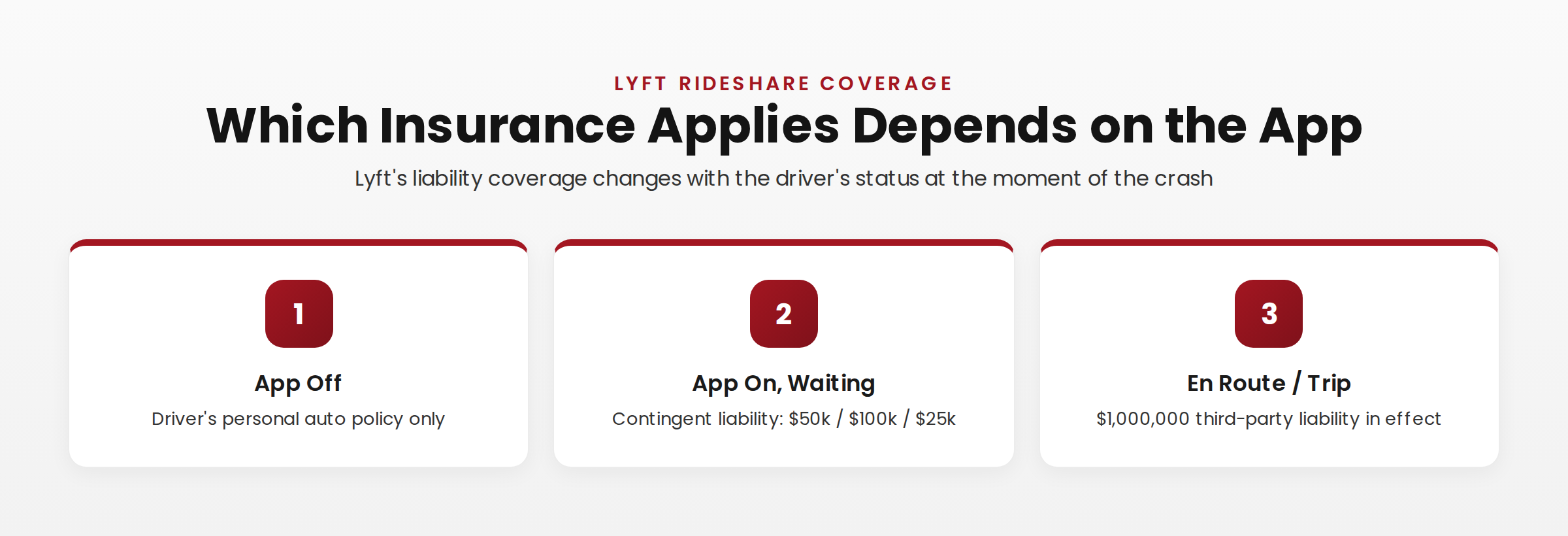
Rideshare claims rise or fall on one question: what was the Lyft app doing when the crash happened? Florida ties the available insurance to the driver’s app status, so the same driver can carry very different coverage from one minute to the next. This is where most claimants quietly lose money, and where an insider’s view earns its keep.
| Lyft app status at the moment of the crash | Insurance that typically applies |
|---|---|
| App off (driver not logged in) | The driver’s personal auto policy only |
| App on, waiting for a ride request | Lyft’s contingent liability coverage (lower limits) |
| En route to a pickup, or a passenger in the car | Lyft’s $1,000,000 commercial liability coverage |
The headline number is the $1,000,000 policy that applies once a driver is on the way to a rider or has a passenger aboard. If you were riding in the Lyft when it crashed, that coverage is usually in play. When the driver was only logged in and waiting for a request, Lyft’s contingent coverage carries much lower limits, and the personal auto insurer often tries to deny the claim outright by pointing to the app.
Sorting out which policy responds, then stacking every source of coverage available to you, is a core part of the work. If another vehicle caused the wreck, that driver’s policy matters too, and so does your own uninsured or underinsured motorist coverage if the at-fault driver was uninsured. Palm Beach County has a high share of uninsured motorists, so UM/UIM coverage is often the difference between a real recovery and an empty judgment. The same layered analysis applies no matter which platform booked the trip. If your crash involved a different service, our Uber accident page walks through that carrier’s tiers in the same detail.
A word on the word “contingent.” When a Lyft driver is logged in but has not yet accepted a ride, the platform’s coverage is limited and secondary, meaning the driver’s personal insurer is expected to respond first. Many personal auto policies exclude commercial or rideshare use, so that insurer frequently denies the claim, and the injured person gets bounced between two carriers that each point at the other. Untangling that standoff quickly, before deadlines pass or records go cold, is exactly the kind of problem an insurance-side background prepares Brian to solve. He knows which coverage the carrier is contractually on the hook for and how to force the issue.
What to Do After a Lyft Accident in West Palm Beach
The hours and days after a crash shape the claim more than most people realize. A short, practical checklist protects your health and your case at the same time.
- Get medical care within 14 days. Florida’s no-fault system (explained below) ties your benefits to prompt treatment, so do not tough it out.
- Report the crash inside the Lyft app, and save the trip receipt plus the screen showing your ride.
- Photograph the vehicles and the scene, then capture the app screen and any visible injuries.
- Collect the name and insurance information for every driver involved.
- Say nothing on the record to any insurance adjuster before you talk to a lawyer. Recorded statements exist to shrink claims.
- Call a West Palm Beach Lyft accident lawyer while the evidence is fresh.
Because a Lyft crash is still a motor-vehicle collision at its core, the same crash mechanics and injury patterns behind an ordinary car accident apply to your claim as well. What changes is the number of insurers in the room and the size of the policy behind the at-fault driver. That extra coverage is good news, but it also means more lawyers on the other side working to keep the payout small.
Florida Injury Law, Stated Correctly
Competitor pages get these points wrong constantly, and a wrong deadline or a repealed-PIP myth can cost you real money. Here is what actually governs a West Palm Beach Lyft claim in 2026.

Your deadline is two years. For negligence injury claims that accrue on or after March 24, 2023, Florida gives you two years to file, under Fla. Stat. § 95.11(5)(a). HB 837 cut the old four-year window down to two. Many sites still list four years, so do not rely on them.
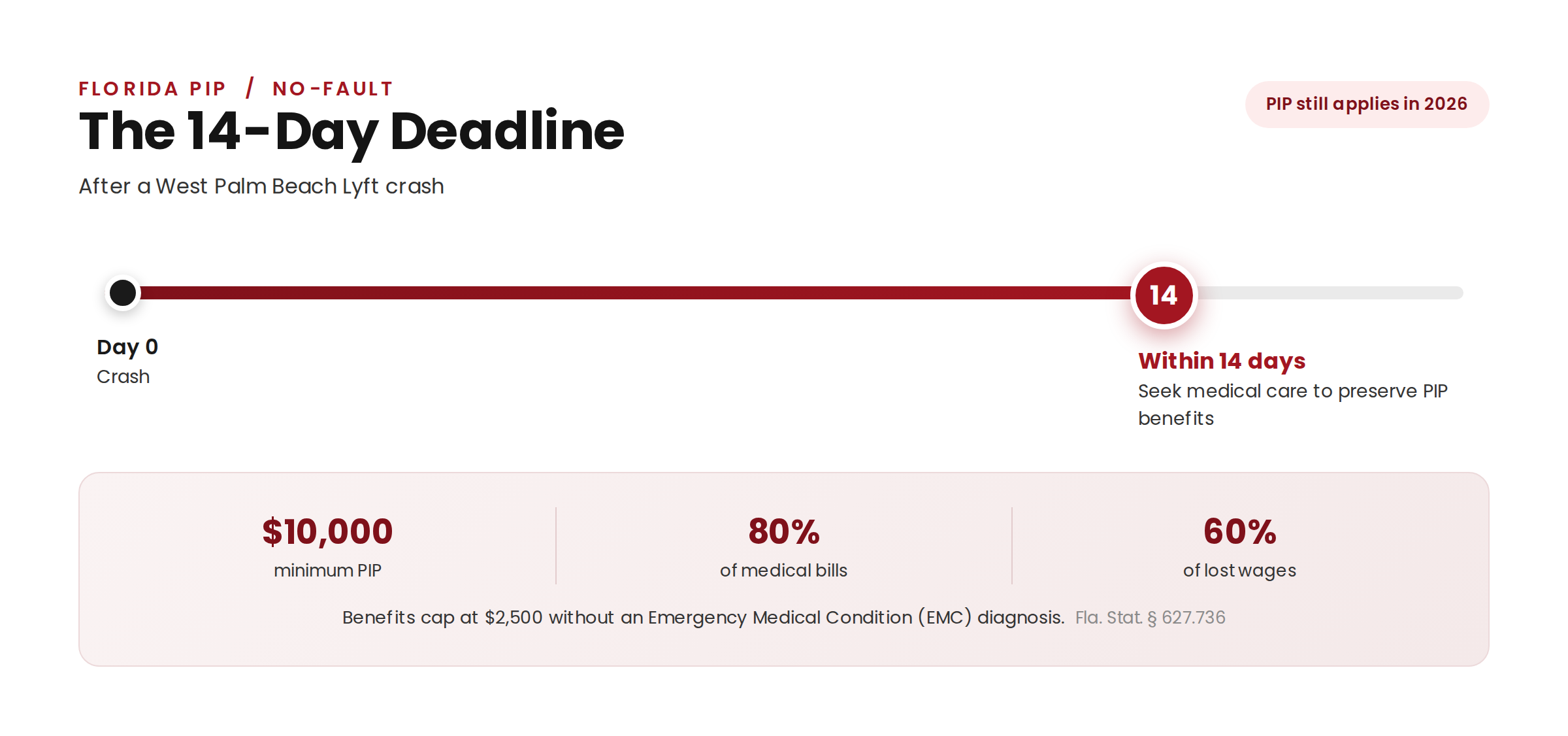
No-fault PIP still applies, and it was not repealed. Every Florida driver carries at least $10,000 in Personal Injury Protection under Fla. Stat. § 627.736. PIP pays 80 percent of your medical expenses and 60 percent of lost wages, though benefits are capped at $2,500 unless a doctor certifies an emergency medical condition. Despite what many 2026 articles claim, Florida did not end no-fault. The repeal bills, SB 522 and HB 769, died in committee when the legislative session closed in March 2026.
The 14-day rule. PIP only pays if you seek initial medical care within 14 days of the crash. Miss that window and you can lose the benefit entirely.
Getting past no-fault: the serious-injury threshold. To pursue the at-fault party for pain and suffering, your injury must meet one of four prongs under Fla. Stat. § 627.737(2):
- Significant and permanent loss of an important bodily function.
- A permanent injury within a reasonable degree of medical probability, other than scarring or disfigurement.
- Significant and permanent scarring or disfigurement.
- Death.
Shared fault: the 50 percent bar. Under § 768.81, a person found more than 50 percent at fault recovers nothing. At 50 percent or less, your recovery is reduced by your share of the blame. Rideshare insurers routinely try to push fault onto injured riders to trigger this rule, which is one more reason to have someone who knows their playbook.
Stating the law correctly is not just a safety measure here. When a firm gets the deadline and the PIP rules right while larger competitors publish outdated figures, that accuracy tells you something about the care your file will get.
Who Pays, and What Your Lyft Claim Is Worth
Because Brian valued injury claims for insurers, he reads a Lyft file the way the other side will. Adjusters do not start from what your case is worth. They start from what they can defend paying, then work up only as far as the pressure forces them. Knowing the gap between those two numbers is how you avoid settling short.
The heaviest of these losses come when the injury never resolves. A spinal cord or traumatic brain injury that does not heal changes who earns, who drives, and who does the caring in a household.
What you can actually recover after a West Palm Beach Lyft crash falls into two categories.
| Type of damages | What it can include |
|---|---|
| Economic | Past and future medical bills, lost wages, reduced earning capacity, out-of-pocket costs |
| Non-economic | Physical pain, mental anguish, permanent impairment, loss of enjoyment of life |
One 2023 change matters to the medical piece. Under Florida’s current evidence rules, recoverable past medical expenses are tied to amounts actually paid or payable, not the inflated sticker price a hospital first bills. The value of any specific case depends on your injuries and the coverage available to pay for them, so treat every figure as case-specific until it has been evaluated. A soft-tissue claim and a permanent-injury claim sit far apart, and the $1,000,000 rideshare policy only helps if your injuries and your proof reach that far.
PIP shapes the early bills no matter who was at fault. Your own auto insurer pays first under no-fault, so as a passenger you may open a PIP claim on your own policy or a household member’s, even though you were riding in someone else’s car. Getting the emergency medical condition designation from a treating doctor unlocks the full $10,000 rather than the reduced $2,500 tier, which is why the first medical visit is worth taking seriously. Brian coordinates your PIP with the rideshare and UM/UIM policies so the sources work together instead of leaving gaps.
Why Palm Beach County Lyft Cases Are Different
West Palm Beach sits in one of Florida’s busiest crash counties, and rideshare traffic only adds to the load. Seasonal visitors and late-night trips home from Clematis Street put more Lyft vehicles on roads like I-95 and Okeechobee Boulevard at exactly the hours crashes spike.
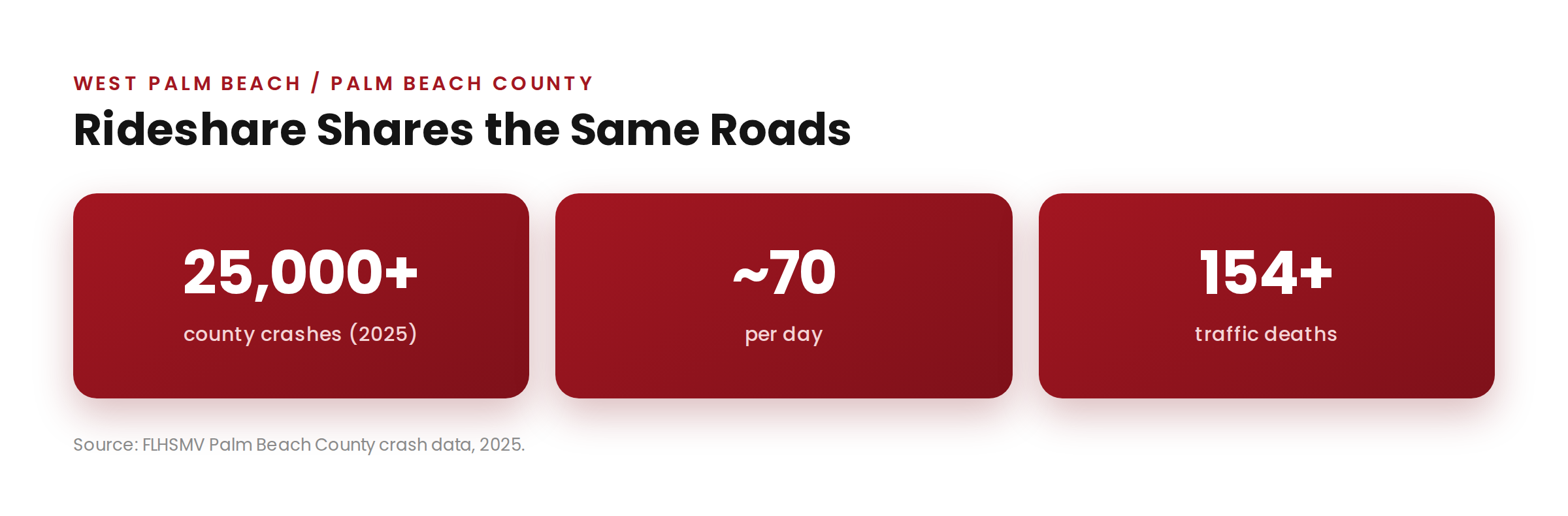
Palm Beach County by the numbers. Palm Beach County recorded roughly 25,000 crashes in 2025, close to 70 every day, according to preliminary FLHSMV data. Nearly 30 of those daily crashes caused injuries. If you were hurt, the figures show you are far from alone.
Seriously injured crash victims in the county are treated at St. Mary’s Medical Center in West Palm Beach, one of Palm Beach County’s two state-designated Level I trauma centers. Lawsuits are filed in the 15th Judicial Circuit at the main courthouse on North Dixie Highway. If a commercial truck was involved in your Lyft crash, the analysis shifts again toward the trucking company’s coverage and safety records; our truck accident page covers those claims. For the full range of cases the firm handles across the county, start at our West Palm Beach injury practice.
Proven Results and Real Client Reviews
Elstein Legal has recovered millions in verdicts and settlements for injured Floridians. Representative results include a $7,900,000 recovery in a car-accident wrongful-death case and $2,550,000 for a head-on collision that caused neck and back injuries.
Clients tend to talk less about numbers and more about working with Brian directly.
“Brian is absolutely the best! He was by my side every step of the way, and made me feel so comfortable. I highly recommend him, and hope that he can be your attorney!”
Chloe Fretwell, verified Google review
“The experience was great the communication excellent and I was always informed step by step of the process I would definitely recommend.”
Margarita Lugo, verified Google review
Those reviews are part of a 5/5 rating from more than 120 Google reviews. When you are ready, schedule a free case evaluation and Brian will look at your case personally.
Past results do not guarantee, warrant, or predict future outcomes.
Talk to a West Palm Beach Lyft Accident Lawyer Today
A Lyft crash claim moves fast, and the insurers start building their defense the day it happens. The sooner Brian reviews your case, the more he can do to protect it. Call (305) 299-2835, day or night, or schedule a free case evaluation online. Brian Elstein will handle your case personally, and you pay nothing unless he wins.