







You put your health in the hands of a doctor or a hospital, and instead of getting better, you were harmed. A missed diagnosis or a botched procedure can change a life in minutes and take years to undo. Medical malpractice claims are among the hardest injury cases to win in Florida, because the law forces patients through extra steps before a lawsuit can even be filed. If a negligent provider in West Palm Beach hurt you or someone you love, you need a lawyer who understands how the other side builds its defense. Brian Elstein spent years being that other side.
Why Choose Elstein Legal for Your West Palm Beach Malpractice Case
Before Brian Elstein represented injured patients, he worked for the insurance companies. He defended and put a value on the same kinds of claims he now brings, which means he learned firsthand how carriers investigate malpractice files and where they decide to push back. That background matters more in a medical negligence case than almost anywhere else. The doctors and hospitals on the other side are backed by malpractice insurers with deep resources and defense lawyers who handle these cases every week. Brian knows their playbook because he used to run it. You can read more about Brian Elstein’s insurance defense background and how it shapes the way he handles your case.
A few things set the firm apart:
- You work with Brian, not a middleman. Elstein Legal is a solo practice. The attorney you hire is the attorney who handles your case, start to finish, with no handoff to a paralegal or a junior associate.
- He knows how malpractice carriers value a claim. Years on the defense side taught Brian what insurers look for when they decide to fight or settle. He puts that to work pressing for the real value of your case.
- No fee unless he wins. The firm handles medical malpractice cases on contingency. You owe nothing unless there is a recovery, and the cost of building a malpractice case is real, so that protection matters.
- Reachable around the clock. You can contact the firm 24 hours a day, including nights and weekends, because a medical crisis does not wait for business hours.
What Counts as Medical Malpractice in Florida
Not every bad outcome is malpractice. Medicine carries risk, and even careful treatment can fail. A disappointing result on its own does not prove anyone did anything wrong. Under Florida law, a medical malpractice claim exists only when four elements are present:

- Duty. A provider-patient relationship existed, so the provider owed you a recognized duty of care.
- Breach. The provider failed to meet the professional standard of care, meaning the level of skill and caution a reasonably careful provider would have used in the same circumstances.
- Causation. That failure, rather than your underlying condition, is what caused your injury. Causation is where most malpractice cases are won or lost.
- Damages. You suffered real harm because of it, such as added medical bills, lost income, lasting disability, or the loss of a loved one.
The standard of care is the heart of the case. Proving a provider fell below it almost always requires testimony from another qualified medical expert, which is why Florida law builds an expert review into the process from the very start.
How a Florida Medical Malpractice Claim Moves Forward
Florida makes patients clear a gatekeeping process before a malpractice lawsuit can be filed at all. This pre-suit requirement, set out in § 766.106 of the Florida Statutes, is a big reason these cases take longer than a typical injury claim. It is also why having a lawyer involved early makes a real difference. Here is how a claim generally moves forward:
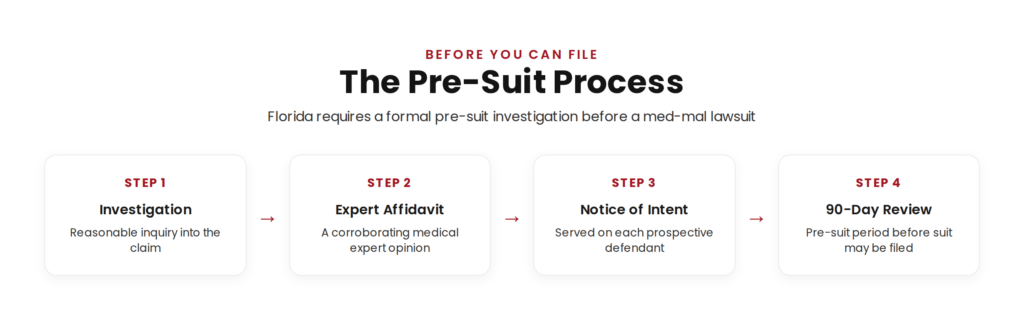
- Case investigation. The firm gathers your medical records and has them reviewed to see whether the care fell below the standard.
- Expert affidavit. A qualified medical expert in the relevant field must review the file and sign a written affidavit corroborating that malpractice reasonably occurred. Without that affidavit, the claim cannot go forward.
- Notice of intent. Formal notice is served on each provider you intend to sue, which opens a 90-day pre-suit period.
- Pre-suit period. For 90 days, both sides investigate and the defense can respond. Many cases resolve during this window, before a lawsuit is ever filed.
- Filing suit. If the case does not settle, the lawsuit is filed. In Palm Beach County that means the 15th Judicial Circuit.
Miss a step or a deadline in this process and the case can be lost on procedure before the facts are ever heard. That risk is the main reason to talk to a lawyer as soon as you suspect something went wrong.
Florida Medical Malpractice Law, Stated Correctly
Plenty of law firm websites get Florida malpractice deadlines wrong, or lift the rules straight from a car accident page where they do not belong. The law that governs your claim is specific. Getting it right is the difference between a live case and a missed deadline.
| Your situation | The deadline that applies |
|---|---|
| The general rule | Two years from the date you knew, or reasonably should have known, of the injury and its possible cause |
| Outer limit (statute of repose) | Four years from the date of the malpractice, no matter when you discovered it |
| Fraud or intentional concealment | Extended to seven years |
| Injured children | The four-year repose cannot bar a claim before the child’s eighth birthday |
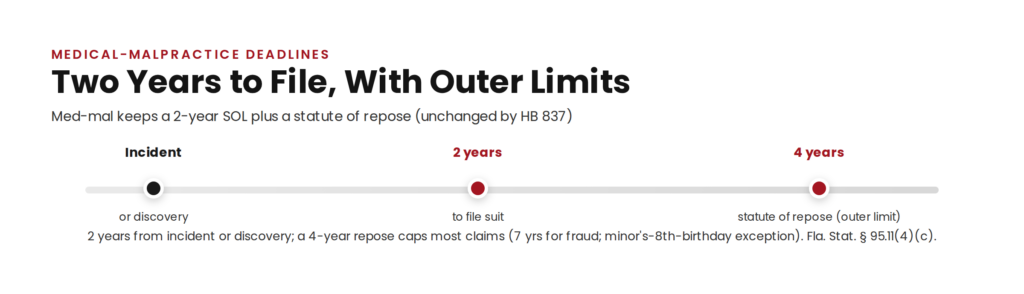
The two-year clock and the four-year outer limit work together, and they are easy to confuse. Your two-year period usually starts when you discover the harm, which can be well after the treatment itself. The four-year statute of repose is a hard ceiling: with narrow exceptions, it cuts off claims four years after the malpractice happened even if the harm had not yet surfaced. This structure comes from § 95.11 of the Florida Statutes, and unlike the general negligence deadline, it was not changed by the 2023 tort reform law.
Two more points deserve plain statements, because competitors routinely miss them.
Medical negligence keeps pure comparative fault. Most Florida injury claims now run under a 50 percent bar, where a person found more than half responsible for their own harm recovers nothing. Malpractice claims brought under Chapter 766 are carved out of that rule. They keep pure comparative fault, so your recovery is reduced by your share of responsibility but is never erased entirely, even where a jury places the larger share of blame on you.
There is no PIP or 14-day deadline on this page. Those rules belong to people injured in motor vehicle crashes, and they do not touch a malpractice claim. Your case runs on the medical malpractice deadlines above, not on no-fault auto insurance rules. Any site that tells a malpractice victim to seek care within 14 days to protect a claim is copying from the wrong page.
Who Is Responsible and What a Claim Is Worth
Malpractice liability reaches well beyond the individual doctor. Depending on what happened, responsibility can fall on a surgeon, a nurse, an anesthesiologist, a radiologist, a hospital, or a physician group. A hospital can be liable for its own staff and, in some situations, for the contractors working under its name. Sorting out who is actually on the hook and which insurance policies respond is part of the job, and it is a part Brian knows from the inside.
What a claim is worth depends on the harm. Medical care already provided and still to come is one piece of it. Lost income and reduced earning power are another. The lasting effect on your daily life matters too, and Florida law lets a jury account for all of it. One rule to be aware of: Florida limits recoverable past medical damages to the amounts actually paid or payable, rather than the full sticker price on a hospital bill. How those damages are documented shapes what you can recover, which is one more reason to bring in a lawyer early rather than after the records have gone cold. Some malpractice injuries are permanent from the moment they occur, such as a brain injury after oxygen loss or a nerve injury during surgery. A mistake that leaves someone permanently disabled is measured across a lifetime of care rather than the bills that arrived first.
When malpractice causes a death, the family may bring a separate claim. A wrongful death claim follows its own rules on how it works and who is entitled to recover.
Birth injuries follow their own path. Cases involving cerebral palsy and other birth-related neurological injuries can fall under Florida’s NICA program, which has its own rules and is not a standard court claim. If your child was hurt during labor or delivery, our cerebral palsy and birth-injury page explains whether NICA applies.
Medical Malpractice in Palm Beach County
West Palm Beach and the surrounding county hold some of South Florida’s busiest hospitals. St. Mary’s Medical Center on 45th Street is one of only two state-designated Level I trauma centers in Palm Beach County. Good Samaritan Medical Center sits downtown near the Intracoastal. JFK Medical Center to the south and Jupiter Medical Center to the north round out the larger systems, alongside the Bethesda and Palms West hospitals serving the county’s outer communities. More facilities and more procedures mean more room for something to go wrong.
A malpractice suit that reaches court here is filed in the 15th Judicial Circuit, based at the main Palm Beach County Courthouse at 205 North Dixie Highway in West Palm Beach. You do not need to know any of that to start, though. Brian handles the local process so you can focus on recovering. He also represents injured clients across the county — from crashes to premises cases — through the firm’s West Palm Beach injury practice.
Our Results
Elstein Legal has recovered millions of dollars in verdicts and settlements for injured people across South Florida. That record includes a $2,000,000 recovery in a medical malpractice case built on a failure to diagnose and treat a stroke, the kind of missed-diagnosis claim that turns on causation and expert testimony.
Clients describe the experience in their own words. One recent client, April Qualls, wrote:
Brian and his Secretary went above and beyond for our case, I have never found a better attorney then Brian, when he is committed, he doesn’t seem to fail.
April Qualls, Google review
The firm holds a 5 out of 5 rating across more than 120 Google reviews. Past results do not guarantee, warrant, or predict future outcomes. Every case turns on its own facts.
Talk to a West Palm Beach Medical Malpractice Lawyer
If you think a doctor or hospital in West Palm Beach caused you harm, the clock is already running. The pre-suit steps also take time to complete, so the sooner Brian can review your records, the more he can do with them. The consultation is free. The firm works on contingency, and someone is available 24 hours a day.
Call (305) 299-2835 or reach the firm through its free case evaluation page. You have already spent enough time on the wrong side of a medical mistake. Let a former insurance defense lawyer put that experience to work for you.