

You were hurt on property somebody else was responsible for, and the first question is not how badly. It is which claim your facts actually make. Brian Elstein defended insurance companies before he represented injured people, so he knows which version of your story an adjuster is already writing, and which one the statute supports.






Premises liability sounds like one kind of case. It is four, and they are not interchangeable. A hazard on a supermarket floor, a stair tread that gave way, an attack in a parking garage that had no working lights, a dog loose in a rented yard: all four arrive at a lawyer’s office described the same way. Each one turns on a different rule and a different burden of proof, and they frequently point at different defendants.
Most people hurt on someone else’s property arrive with a place and an injury and no idea what the claim is called. That is the ordinary situation, not a failure of preparation. Working out which of the four your facts fit is the first real piece of legal work in the case, and it is what this page is for.
One rule runs across all four, and it is the one the other side leans on hardest. Florida’s comparative fault statute lets a defendant argue that you should have seen the hazard yourself. If you have an answer ready for it, the rest of the case comes down to evidence. If you do not, a good claim gets discounted before anybody talks about money.
Before you go further, know that the deadline for most of these claims is two years, and it is not four, whatever an older page may still tell you. And the person who owed you a duty is often not the business whose name was on the door.
Why Choose Elstein Legal
Brian Elstein used to work for the insurance companies. He defended injury claims before he started bringing them, so he knows how the other side builds a premises file, starting with which photographs get taken in the first hours and how an incident report written by a store manager gets used eighteen months later. He also knows how quickly a claim gets recharacterized as something the injured person walked into.
That background is why this page opens with which claim you have instead of with sympathy. In a premises case, naming the right theory and the right defendant early is usually worth more than anything said afterward.
Brian handles cases personally, from one office in South Miami, on a contingency fee. No fees unless we win. Over $50 million recovered. Call (305) 299-2835, days, nights or weekends.
Past results do not guarantee, warrant, or predict future outcomes.
Premises Liability Is Four Claims, Not One
The phrase covers a family of theories built on one idea: whoever controls a property owes the people lawfully on it a duty of reasonable care. What that duty requires, and what you have to prove to show it was breached, changes completely depending on what hurt you.
| The theory | What hurt you | What you have to show | Authority |
|---|---|---|---|
| Transitory foreign substance | Something on the floor of a business that should not have been there | The business had actual or constructive knowledge of it | Fla. Stat. § 768.0755 |
| Dangerous condition of the property | A defect in the premises themselves | The condition was unreasonably dangerous and the occupier knew or should have known | Common law occupier duty |
| Negligent security | Another person, where the occupier’s own security failures made the attack possible | Foreseeability, and that reasonable measures were absent | Common law occupier duty |
| An animal on the property | A dog or another animal | Strict liability against the owner, plus the occupier’s separate duty | Fla. Stat. § 767.04 |
A hazard on the floor of a business
Florida treats this one differently from every other premises claim, and the difference is statutory. Under Fla. Stat. § 768.0755, a person injured by a transitory foreign substance in a business establishment must prove the business had actual or constructive knowledge of the dangerous condition and should have acted on it. Constructive knowledge means the condition existed long enough that the business should have found it, or that it happened with enough regularity to be foreseeable.
That is a real burden, and it is why timing matters more here than almost anywhere else. How long the spill sat and when the floor was last checked are the questions the case turns on, along with whether the same thing had happened there before. Claims of this shape get more room on the page dealing with a fall on a wet floor.
A defect in the property itself
Nothing had to be dropped or spilled for a property to be unsafe. A stair with no handrail, a riser built out of specification, a walkway with no working light, a balcony rail that moved when somebody leaned on it, a gate latch that never held. Conditions like these are part of the premises, not something temporarily sitting on them, so the argument is not about how long a hazard went unnoticed. It is about whether the condition was unreasonably dangerous, and whether the person responsible for the property knew or should have known.
An inspection helps a case of this kind and delay hurts it, because the condition tends to get repaired quickly once somebody is hurt. Photographs taken on the day, by anyone at all, are frequently the only record of how the property looked.
Harm inflicted by another person
Negligent security is the theory most people do not realize exists. When somebody is assaulted, robbed or shot on a property, the claim against the occupier is not that the occupier committed the attack. It is that the occupier’s own failures, in lighting, in access control, in staffing, in responding to trouble that had already happened there, made a foreseeable attack possible. Florida has no dedicated statute for it. The duty is a common law occupier duty, and you prove it through foreseeability instead of a code section.
Foreseeability comes from the history of the place, not from the attack itself. What had already happened on that property or immediately around it, what the occupier had been told about it, what security existed on paper, and whether any of it was actually working on the night all go to the question. Police call records, prior incident reports and the security contract are usually where the answers sit.
A parallel criminal case does not decide the civil one. The two run on separate tracks with separate rules, and that interaction is worked through on the page covering a shooting at a venue that hired no security.
An animal on the property
Two duties can run at once here, and they point at different people. Fla. Stat. § 767.04 imposes strict liability on the dog’s owner, expressly regardless of the former viciousness of the dog or the owner’s knowledge of it, so Florida has no one bite rule. Any negligence by the person bitten reduces the owner’s liability proportionally rather than ending the claim, and the statute’s “Bad Dog” sign defense does not apply to a child under six or where the owner’s own negligence caused the injury.
Separately, whoever controlled the property may owe a duty of their own, and that is a different person from the dog’s owner whenever a tenant’s dog injures somebody in a landlord’s building. Where the animal was loose because the occupier let it be, the claim looks like an animal the occupier allowed to run loose.
If your facts do not sit comfortably in any of the four, better to find that out early. A drowning or a near drowning involving an unfenced pool on a rented property is squarely an occupier duty question and has its own page. And a claim that turns out to be a crash, a medical case or something else entirely belongs somewhere other than here, which is what our wider Miami injury practice is for.
The Person Who Owed You a Duty May Not Be the Name on the Door
The owner of a property and the occupier of it are frequently different people with different duties, and almost nobody arrives knowing that. Suing the wrong one wastes time that a two year deadline will not give back.
Take an ordinary Miami shopping plaza. A property owner holds the land, a management company runs the site, and a tenant business operates the unit you walked into. A contractor cleans the floors overnight, and another was hired to provide security. Each of those parties may owe a duty, and the duties are not the same duty.
| Who might be liable | What their duty usually concerns |
|---|---|
| The property owner | The condition of the structure and of common areas |
| The tenant or business in possession | The condition of the space it controls and the safety of people it invites in |
| The property manager | Inspection, maintenance and repair under its management agreement |
| A maintenance or cleaning contractor | The work it was hired to perform, and how it performed it |
| A security contractor | The measures it agreed to provide, where the claim is negligent security |
Control and contract decide which of them is answerable, and the documents that settle it are not public. Leases, management agreements, maintenance contracts and certificates of insurance all sit with the parties you are making a claim against. Getting them is ordinary litigation work, not something you should be expected to solve before you call anyone.
Insurance follows the same structure. A tenant carries its own general liability policy, an owner carries another, a management company carries a third, and contracts between them often require one party to indemnify another or to name it as an additional insured. Those documents decide which policy responds, not who looked responsible from the sidewalk, and more than one policy can be on the hook for the same injury.
The practical consequence is that a claim naming only the business you recognize can miss the party that actually carried the duty, and it can miss the policy that actually pays.
Being Told You Should Have Watched Where You Were Going
Every premises defense arrives at the same argument eventually. The hazard was open and obvious, you were looking at your phone, you were wearing the wrong shoes, you had been there before and knew the step was uneven.
Florida answers that argument with modified comparative fault, at Fla. Stat. § 768.81(6), and the rule is precise. If you were found to be more than 50% at fault, you cannot recover any compensation. At 50 percent or less, your recovery is reduced by your share, so a person found exactly 50 percent responsible still recovers half. Putting that threshold below half instead of above it is wrong, and wrong in the direction that costs a reader a claim. Florida is a modified comparative negligence state, not a pure one, and the two are not the same rule.
| Fault assigned to you | Effect on a $400,000 claim |
|---|---|
| 0 percent | $400,000 |
| 20 percent | $320,000 |
| 50 percent | $200,000, the last point at which recovery survives |
| More than 50 percent | Nothing |
Because that line turns a percentage straight into money, the argument over it starts immediately, and it is fought with evidence that decays. Surveillance video is routinely overwritten within days. Incident reports get written by the people whose conduct is in question. Inspection logs, sweep sheets, work orders and prior complaints about the same condition all sit with the defendant, and witnesses who saw what happened walk out of the building without leaving a name.
So being partly to blame does not end a claim. It sets a number, and that number stays arguable for as long as the evidence that fixes it still exists.
Two Years to File, and Plenty of Sites Still Say Four
Most Florida negligence claims, premises claims included, must be filed within two years, at Fla. Stat. § 95.11(5)(a).
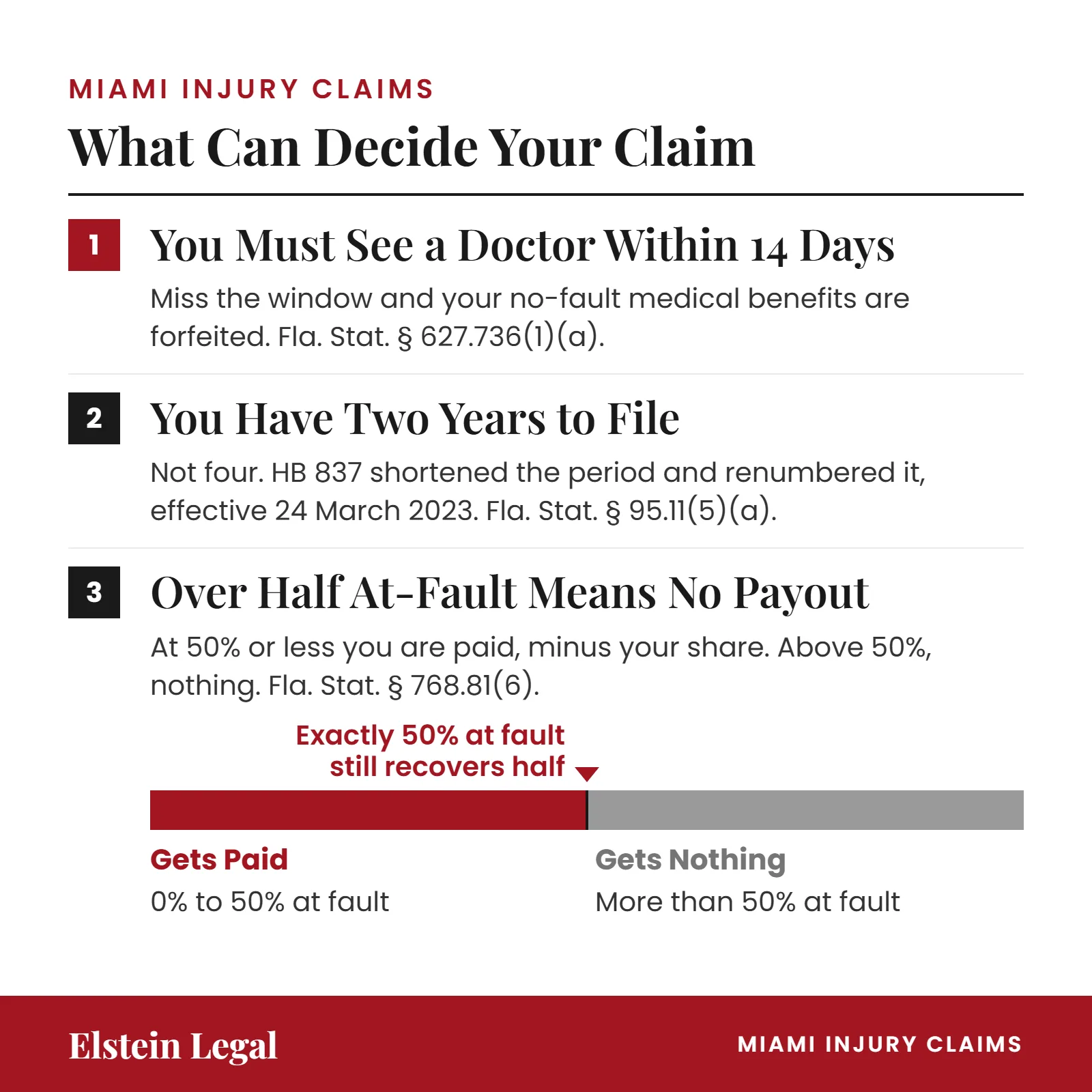
That period used to be four. HB 837, chapter 2023-15, shortened it for causes of action accruing on or after 24 March 2023, and the same bill renumbered the statute. The renumbering is why the subsection matters as much as the number. Subsection (3) is the four year subsection and subsection (5) is the two year one. There is no two year subsection (4), so any page citing subsection (4)(a) of that statute is using lettering that no longer exists.
| Claim | Deadline | Provision |
|---|---|---|
| A premises injury, general negligence | Two years | § 95.11(5)(a) |
| Where a premises injury is fatal | Two years | § 95.11(5)(e) |
| A separate claim against a product on the property | Four years, with a statute of repose | § 95.11(3)(d), repose § 95.031(2)(b) |
| A claim involving a government entity | Separate presuit notice rules apply. No flat period is stated here | § 768.28 |
Older figures survive online because they were once correct, which is what makes them read as authoritative. Some pages still publish four years, and a few link to an archived version of the statute that genuinely said so at the time. Check the year on any statute page you are sent before you rely on it.
Two years is also less time than a premises case tends to need. Identifying the right defendant and obtaining the contracts that establish who controlled the property both happen inside that window, and so does preserving video, which is measured in days and not in years.
Where a Miami Premises Case Is Filed
Miami-Dade County sits in Florida’s 11th Judicial Circuit, and circuit civil matters are now heard at the Osvaldo N. Soto Miami-Dade Justice Center, 20 NW 1st Avenue, Miami, Florida 33128. That building had its ribbon cutting on 10 November 2025 and holds 46 equipped courtrooms with four more shelled for future use. It replaces the historic Miami-Dade County Courthouse, which had served since 1928, so any page still directing readers to the old Flagler Street address is sending them to a building that no longer takes these filings. A Hialeah District Court also operates at 11 E. 6th Street.
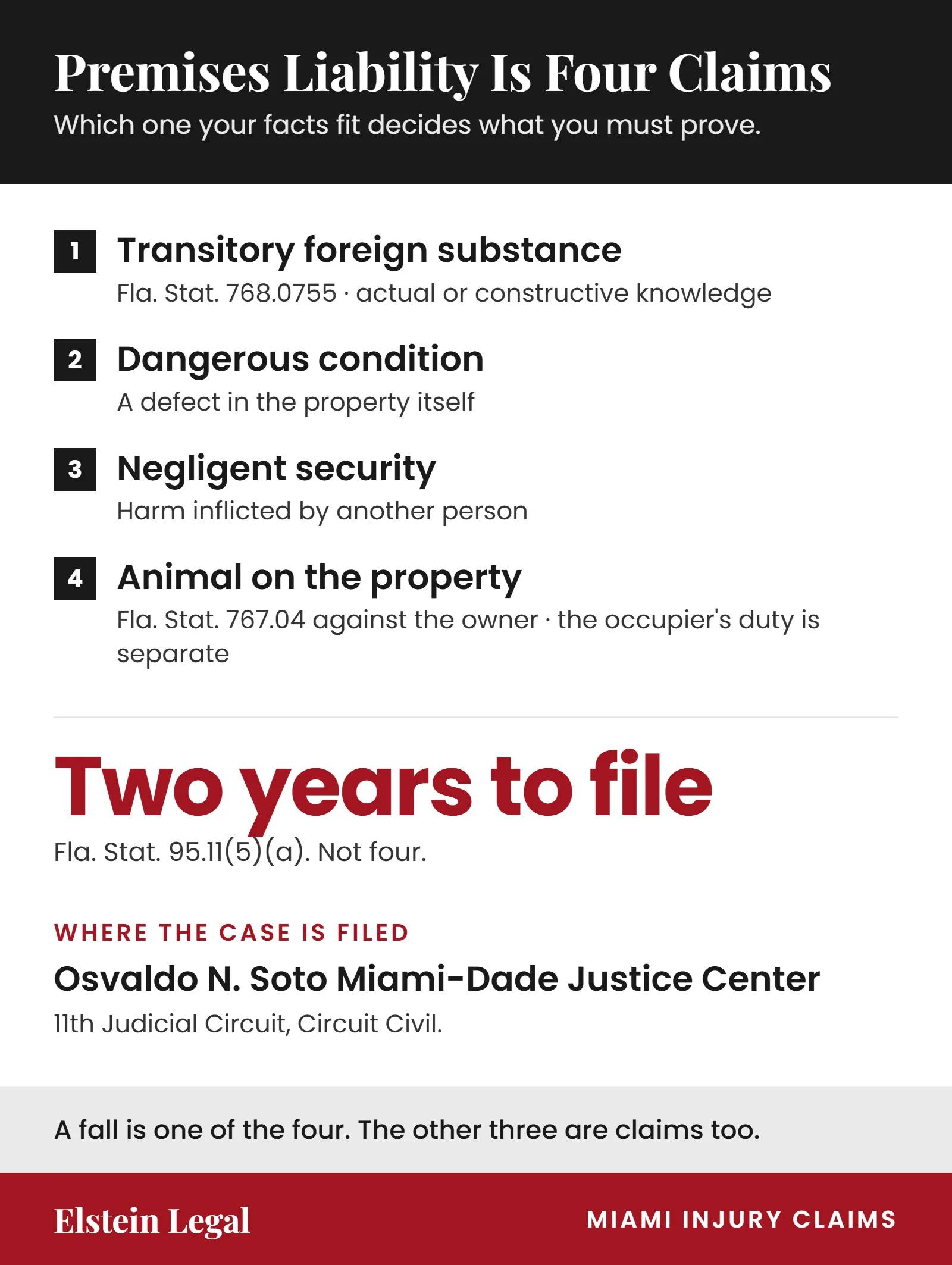
Venue rarely changes the outcome of a premises case, but it changes the practical shape of one. Where the case is heard sets which judges hear it and how long it takes to reach a trial date, and it is where you go when you are needed in person. A business open to the public anywhere in Miami-Dade owes the duty that § 768.0755 describes, whether it sits in Brickell, in a plaza off the Palmetto or beside the Dolphin Expressway. The address on the door changes the logistics far more than it changes the duty.
Most premises claims are resolved before a courtroom is involved at all. Knowing where the case would go if it is not resolved still matters, because that is the forum every settlement position gets measured against, and it is one of the first things an insurer’s file records.
Rules That Do Not Reach a Premises Claim
Some of the most confident advice people receive after being hurt on a property comes from the motor vehicle world, and it does not apply.
| Rule | Why it does not govern a premises claim |
|---|---|
| Personal injury protection, § 627.736 | A motor vehicle benefit. Nothing in it stands behind an injury on a property |
| The serious injury threshold, § 627.737(2) | Belongs to motor vehicle claims only |
| Workers’ compensation | A separate system, where an injury at your own workplace usually belongs |
| Product liability’s four year period, § 95.11(3)(d) | Governs a claim against the product, not the premises claim, which stays at two years |
| § 768.21(8), the “free kill” provision | Bars certain non-economic damages in medical malpractice death cases only, even where a premises injury was fatal |
Florida’s no fault system is the clearest example. Personal injury protection is a motor vehicle benefit, and nothing in it stands behind an injury on a property. Where a crash victim has a first layer of coverage that pays medical bills regardless of fault, a person hurt in a store or a stairwell has no equivalent, which is one reason identifying every responsible party matters more here than it does after a collision.
Workers’ compensation is another. Somebody hurt at their own workplace is usually inside the comp system instead of bringing a premises claim against their employer, and that is a different process with different rules. Comp can sit alongside a claim against a third party who controlled the property, so it is a question to ask rather than assume either way.
If a defective product on the premises caused the injury, a gate latch that failed or a bracket that sheared, that is a separate product claim on its own clock at § 95.11(3)(d), with a statute of repose at § 95.031(2)(b) whose length depends on the product, while the premises claim itself stays at two years. > If the property belongs to a government, stop reading web pages and make a call. A fall in a public building, a county park or a school is a real premises fact pattern, and § 768.28 layers presuit notice requirements and damages limits on top of the ordinary rules. Those requirements bite well before any filing deadline does, and the analysis is specific to the agency and the claim. No number for either belongs on a page, including this one.
Where a premises injury proves fatal, the case changes shape instead of merely getting larger. A wrongful death action is brought by the personal representative of the estate under § 768.20, not by the spouse, the children or the parents, who are beneficiaries under § 768.18(1) and recover through the action. Getting that wrong wastes weeks while a two year deadline runs. Claims involving a death on someone else’s property proceed on that footing.
Talk to Brian
Bring whatever you have. Photographs of the condition, the incident report if the business gave you one, the name of the business and of anyone who saw it happen, and your medical records so far. Most people have some of that and not all of it, and the missing pieces are the work, not a condition of starting.
Ask quickly, and in writing, that any video of the area be preserved, because most systems overwrite themselves long before a claim is filed. And be careful about giving a recorded statement describing where you were looking until somebody has explained how that answer gets used under § 768.81(6).
The firm has published a $12,250,000 recovery in a negligent security shooting that left the client paraplegic, and $1,150,000 for a trip and fall outside a restaurant. Between them they cover two of the four theories on this page. Read them as evidence of how the firm handles a carrier, not as a prediction about your case, and see the settlements the firm has published for the rest.
Past results do not guarantee, warrant, or predict future outcomes.
There is no fee to talk and no fee unless there is a recovery. Call (305) 299-2835 or bring the details to Brian. Why the first conversation tends to be about who controlled the property is explained in what an adjuster does with a premises file.