

Florida’s Dog Bite Law, and Where It Stops






If a dog bit you in Florida, the law starts out further on your side than you might expect. The owner is liable even if the dog had never shown a sign of aggression and had no history at all. You do not have to prove carelessness.
That is the first half of the statute, and the half that usually gets explained.
The second half is where these claims are won and lost. The same section reduces what you recover by your own share of the blame, and it gives an owner a complete defense for a posted sign, subject to two exceptions. Above all of it sits a separate statute that ends a claim outright once your share of the fault passes one number.
What follows sets out both halves, with the pincite for every rule.
Why Choose Elstein Legal
Brian Elstein used to work for the insurance companies. He defended personal injury claims before he began bringing them, so he has watched a carrier build the other side of a dog bite file: the provocation argument, the photograph of a sign, a fault percentage worked up out of a statement taken days after the injury.
That is why this page gives as much room to the limits of § 767.04 as to the rule itself. The limits are where the claim gets decided.
Every matter is handled personally by Brian, from one office in South Miami, on a contingency fee. No fees unless we win. Over $50 million recovered. Reach him at (305) 299-2835, days, nights or weekends.
Past results do not guarantee, warrant, or predict future outcomes.
The Rule, and the Words That Matter In It
Fla. Stat. § 767.04 opens with a single sentence that does most of the work:
“The owner of any dog that bites any person while such person is on or in a public place, or lawfully on or in a private place, including the property of the owner of the dog, is liable for damages suffered by persons bitten, regardless of the former viciousness of the dog or the owners’ knowledge of such viciousness.”
Three things in that sentence decide most claims.
| The words | What they do |
|---|---|
| “is liable for damages” | Liability attaches to ownership. There is no requirement to prove the owner was negligent, badly trained the dog, or let it off a leash |
| “regardless of the former viciousness of the dog or the owners’ knowledge” | A clean history is not a defense. The owner’s belief that the dog was gentle is not a defense either |
| “on or in a public place, or lawfully on or in a private place, including the property of the owner” | Where you were standing matters. A guest, a delivery driver and a meter reader are all covered. So is someone bitten on the owner’s own land |
Lawful presence is defined in the statute rather than left to argument. A person is lawfully on private property when they are there “in the performance of any duty imposed upon him or her by the laws of this state or by the laws or postal regulations of the United States, or when the person is on such property upon invitation, expressed or implied, of the owner.” An implied invitation is enough, which is why the walkway to a front door rarely becomes the argument an owner hopes it will.
One further line is easy to miss. The remedy in § 767.04 is “in addition to and cumulative with any other remedy provided by statute or common law,” so it does not replace an ordinary negligence claim. Both can be pleaded.
No, Florida Is Not a One-Bite State
The answer is short. Florida is not a one-bite state.
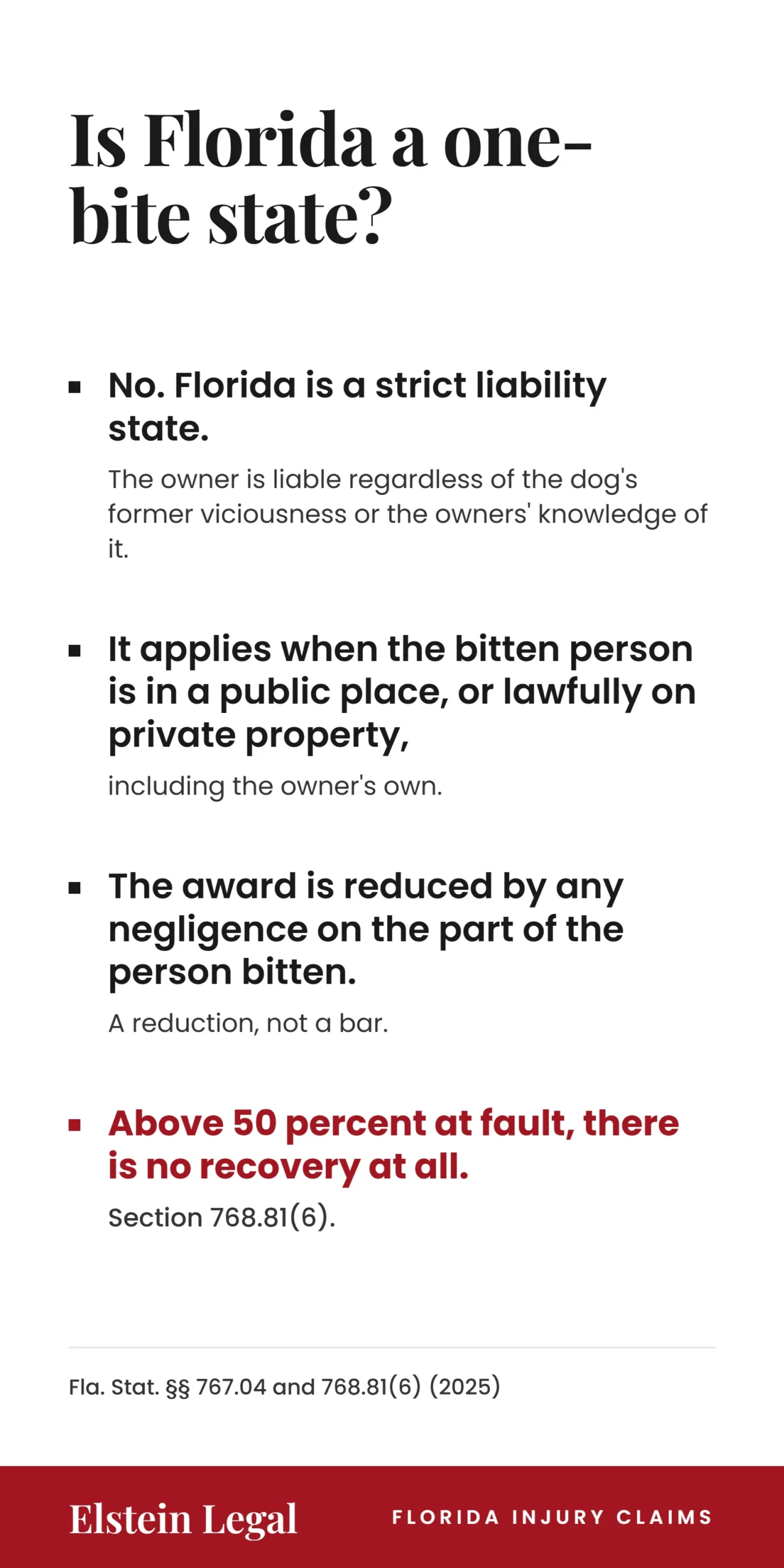
That phrase comes from the older common law approach, under which an injured person had to show the owner already knew the animal was dangerous. A dog effectively got one free bite, because the first one established the knowledge.
Florida wrote that requirement out by statute. The clause doing the work is the one quoted above: liability attaches “regardless of the former viciousness of the dog or the owners’ knowledge of such viciousness.” A first bite and a fifth are treated the same way.
A history still changes the shape of a case rather than whether one exists. Earlier incidents or a complaint to animal control can matter to damages and to a separate negligence theory, but none of them is something you have to produce first.
Three Ways the Recovery Shrinks or Disappears
This is the part that usually gets left out, and the part a carrier reaches for first.
| Mechanism | What it does | Where it comes from |
|---|---|---|
| The statute’s own reduction | Your award is reduced by the percentage that your own negligence contributed to the biting incident. A proportional reduction, not a bar | § 767.04 |
| The “Bad Dog” sign defense | A readable sign, prominently displayed on the premises, is a complete defense, subject to two exceptions | § 767.04 |
| The comparative fault ceiling | More than 50 percent at fault and the claim recovers nothing at all. At 50 percent or less, the award is reduced by that share | § 768.81(6) |
The reduction inside § 767.04
The statute says that “any negligence on the part of the person bitten that is a proximate cause of the biting incident reduces the liability of the owner of the dog by the percentage that the bitten person’s negligence contributed to the biting incident.”
Two things follow from that. This is arithmetic rather than an on-off switch: a finding that you were 20 percent responsible removes 20 percent, and the rest of the claim survives.
The second point is about provocation. That word does not appear in § 767.04 at all. What the statute talks about is negligence on the part of the person bitten, so an owner saying you provoked the dog is arguing under that clause, and it is answered the way any negligence allegation is: what you did, and whether it was a proximate cause of the bite.
The ceiling that ends a claim
Fla. Stat. § 768.81(6) is the rule most dog bite explanations leave out, and it is the one that can cost everything. It reads: “Any party found to be greater than 50 percent at fault for his or her own harm may not recover any damages.”
Note where the line sits. At exactly 50 percent you still recover, reduced by half. Past 50 percent you recover nothing. Florida is a modified comparative negligence state rather than a pure one, and the difference is the whole claim.
Whether that reaches a dog bite case is a fair question, since § 767.04 is strict liability rather than negligence. The statute answers it: § 768.81(1)(c) defines a “negligence action” for that section as one “based upon a theory of negligence, strict liability, products liability, professional malpractice whether couched in terms of contract or tort, or breach of warranty and like theories.” Strict liability is named, so the ceiling applies.
A dog bite claim therefore carries two fault mechanisms at once. One trims the award in proportion. The other removes it, which is why an insurer arguing that you were most of the reason the bite happened is not arguing about the size of the check.
The “Bad Dog” Sign, and the Two Things That Defeat It
Section 767.04 gives an owner one complete defense, and it is unusual enough to deserve its own section:
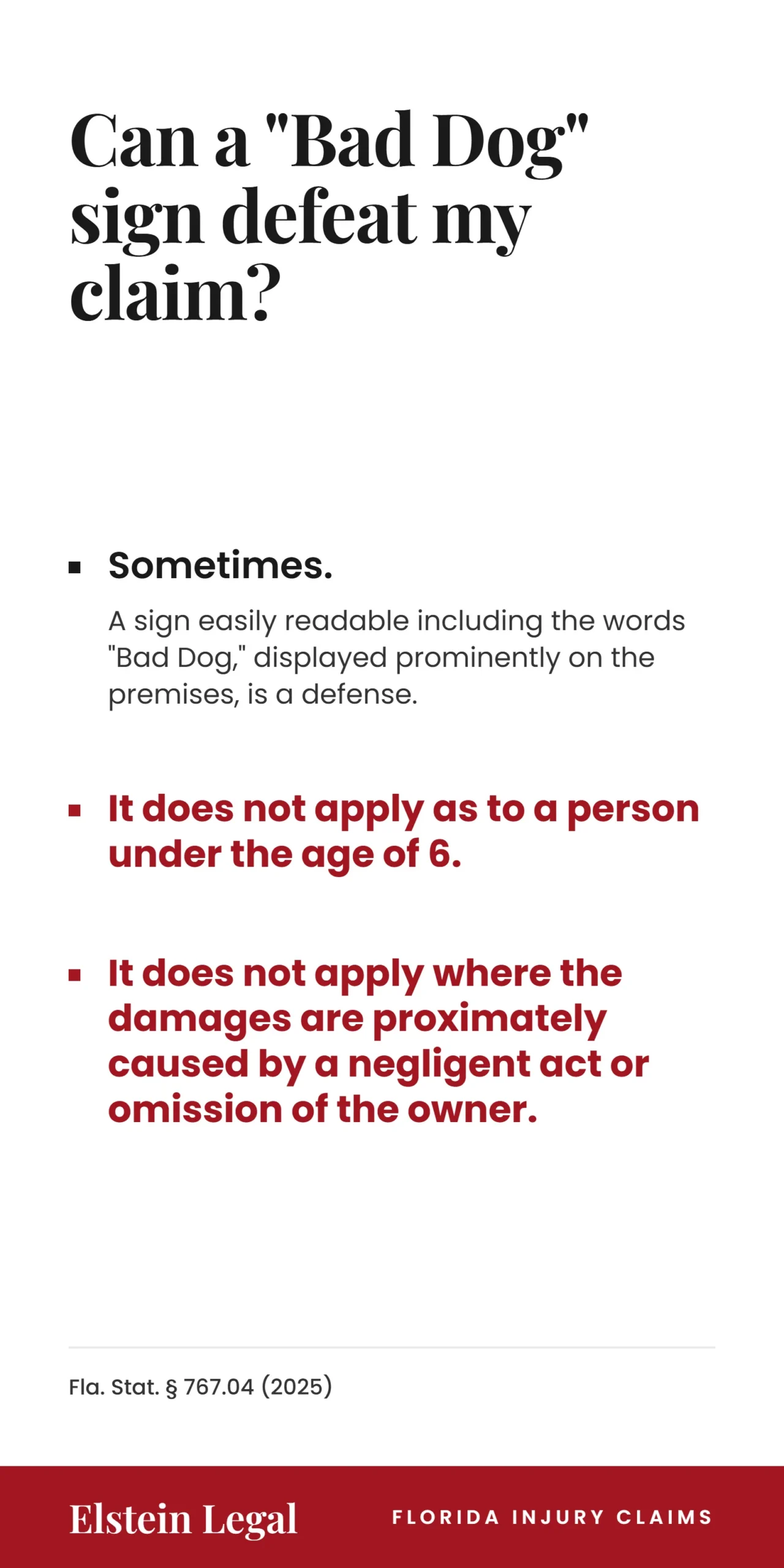
“However, the owner is not liable, except as to a person under the age of 6, or unless the damages are proximately caused by a negligent act or omission of the owner, if at the time of any such injury the owner had displayed in a prominent place on his or her premises a sign easily readable including the words ‘Bad Dog.'”
Three conditions have to be met before the defense is in play. The sign has to be easily readable, it has to include the words “Bad Dog,” and it has to have been displayed in a prominent place on the premises at the time of the injury. A sign in a garage, one facing the wrong way, or one that went up after the bite is worth photographing early, because the state of the sign on the day is a question of fact. The defense is also built around a sign on the owner’s own premises, so where the bite happened is part of whether it applies.
Then come the two exceptions, and they are the reason the defense is narrower than it sounds.
- It does not apply to a person under the age of 6. A sign is no defense to a claim brought for a young child, whatever it said and wherever it was posted. The statute draws the line at age, not at whether the child could read.
- It does not apply where the damages were proximately caused by a negligent act or omission of the owner. A sign protects an owner who did nothing else wrong. It does not protect one who left the gate open or put a visitor in a room with a dog known to lunge. The negligence question comes back into the case through this exception.
So the defense covers a narrow situation: an adult visitor, a readable sign properly posted, and an owner whose own conduct did not cause the injury. Remove any one and it is in trouble.
Two Years to File, and the Clock Starts at the Bite
Most Florida personal injury claims, dog bites included, have to be filed within two years, under Fla. Stat. § 95.11(5)(a), for causes of action accruing on or after 24 March 2023. That deadline was shortened by HB 837, enacted as chapter 2023-15.
Older material online has not caught up. HB 837 both changed the period and renumbered the statute, so a page citing a subsection that no longer exists is quoting a superseded version. If a source gives you a different deadline, check it against the current text.
Filing is also not the only clock. Evidence goes stale faster than the statute runs, and medical records, photographs of the wound as it healed, and the name of anyone who saw it happen are all easier to obtain in the first month than in the twenty-third.
Breed Bans Are Gone, Including Miami-Dade’s
For decades Miami-Dade County banned pit bulls. It does not any more, and the reason is a change to the state statute that local governments cannot work around.
Fla. Stat. § 767.14 now reads:
“This act does not limit any local government or public housing authority from adopting an ordinance or a policy, respectively, to address the safety and welfare concerns caused by attacks on persons or domestic animals; placing further restrictions or additional requirements on owners of dogs that have bitten or attacked persons or domestic animals; or developing procedures and criteria for the implementation of this act, provided that no such regulation is specific to breed, weight, or size and that the provisions of this act are not lessened by such additional regulations or requirements.”
Three things in that text are wider than they are usually reported.
- The prohibition covers breed, weight and size. It is wider than a ban on breed bans. A rule aimed at dogs over a certain weight runs into the same sentence.
- It reaches public housing authorities as well as local governments. A housing authority policy is named alongside a municipal ordinance, so the same limit applies to both.
- There is no grandfather clause in the current text. Older ordinances are not carved out, which is what made Miami-Dade’s ban fall rather than survive as an exception.
The change came through SB 942, enacted as chapter 2023-253 and effective 1 October 2023, which removed the exemption that had protected breed-specific ordinances adopted before a set date. Miami-Dade’s ban ended when it took effect.
Local governments can still regulate dogs that have actually bitten or attacked. What they cannot do is write a rule that turns on what a dog is rather than on what it has done.
Keep this separate from the dangerous dog act
Section 767.14 sits inside the dangerous dog act at §§ 767.10 to 767.16, a classification and control scheme run by animal control.
That is a different thing from § 767.04, and merging the two produces a conclusion that is backwards. A dog does not have to be declared dangerous before its owner is liable for a bite. Liability under § 767.04 attaches to the first bite by a dog nobody had ever complained about. A classification matters to what animal control does next, but it is not a precondition to your claim.
What Does Not Apply to a Dog Bite Claim
A fair amount of Florida injury law is written for motor vehicle crashes, and it does not travel.
| Frequently imported | Why it has no role here |
|---|---|
| PIP and the 14-day rule, § 627.736 | PIP is motor vehicle coverage. Section 627.736(1) sets out who it reaches, and every category is tied to an insured motor vehicle. A dog bite is not a motor vehicle claim, so no PIP benefit responds and no 14-day treatment deadline applies |
| The four-prong injury threshold, § 627.737(2) | It is the no-fault tort exemption, which exists so a crash victim can step outside PIP. With no PIP in the picture, there is nothing to step outside of |
| Motor vehicle coverage minimums | Florida’s financial responsibility rules govern vehicles. They say nothing about a dog, and no figure from them belongs in a dog bite conversation |
| § 768.0755, constructive knowledge | That is the premises liability rule for a transitory substance on a floor, such as a spill. It is a different theory with a different burden and it does not govern a bite |
Where These Claims Are Usually Paid From
Few dog bite claims are paid by the owner personally. The coverage that usually responds is the owner’s homeowners or renters insurance, which commonly includes liability coverage for injuries caused by a member of the household, a dog among them.
That is worth knowing early. Making a claim usually means dealing with a carrier rather than with a neighbor or a family member, and the questions will come from an adjuster working through the fault arguments set out above.
Whether a particular policy responds, and for how much, is a question about that policy rather than about Florida law. Terms vary, and the reliable answer comes from the declarations page and the endorsements. Where the injury is serious, an umbrella or excess policy above the primary one is worth looking for, since neither is ever volunteered.
If an owner has no coverage at all the claim is not over, but the question shifts from what happened to what can be collected.
Where a South Florida Dog Bite Claim Is Heard
The law on this page reads the same in every Florida county. What changes is which court the claim lands in, and where in the county that court sits.
Miami-Dade County, the 11th Judicial Circuit. Circuit civil matters are heard at the Osvaldo N. Soto Miami-Dade Justice Center at 20 NW 1st Avenue in Miami, which opened in November 2025. That covers a bite inside the City of Miami, an attack on Miami Beach and a Hialeah case in the same county system.
Broward County, the 17th Judicial Circuit. Circuit civil goes to the Broward County Central Courthouse at 201 SE 6th Street in Fort Lauderdale, which is where a Fort Lauderdale claim and a bite in Pompano Beach both end up.
Palm Beach County, the 15th Judicial Circuit. Circuit civil is heard at the main courthouse at 205 N. Dixie Highway in West Palm Beach. That surprises people, because the South County Courthouse in Delray Beach does not hear circuit civil and there is no courthouse in Boca Raton at all. So a West Palm Beach injury is heard downtown, and so are a Delray Beach claim that is not heard in Delray Beach and a Boca Raton dog bite.
None of that changes the statute. It changes where the file goes, and it is part of why the answer to “how long will this take” differs by county.
If a Dog Has Bitten You
Photograph the injury, the place it happened and any sign that was posted, before any of it changes. Get the owner’s name and address, and the name of anyone who saw it. Keep every medical record. If animal control was involved, ask for the report number.
Then, if you want someone to look at it, tell us what happened. There is no fee to ask and no fee unless there is a recovery, and the file will be read by the years Brian spent on the carrier’s side of these files. Other Florida injury questions are covered the same way in the rest of the reference section, and you can call (305) 299-2835 at any hour.
Frequently Asked Questions
The owner says I provoked the dog. Does that end my claim?
Not by itself. Section 767.04 does not use the word provocation. It says that any negligence on your part that was a proximate cause of the biting incident reduces the owner’s liability by your percentage of responsibility, which is a reduction rather than a bar. An argument about provocation is really an argument about that percentage. The one place it becomes decisive is the separate ceiling at § 768.81(6): if you are found more than 50 percent at fault you recover nothing, and at 50 percent or less you recover your damages reduced by that share.
I was bitten on the owner's own property. Am I still covered?
Yes, if you were lawfully there, and the statute says so expressly by including “the property of the owner of the dog.” You are lawfully on private property when you are performing a duty imposed by Florida law or by United States postal regulations, or when you are there on the owner’s invitation, express or implied. A guest, a delivery driver, a postal carrier and a contractor are all inside that definition.
Who actually pays a dog bite claim?
Usually the owner’s homeowners or renters insurance, which commonly covers injuries caused by a household member’s dog. Whether a specific policy responds, and to what extent, depends on that policy’s own terms rather than on Florida law, so the declarations page and the endorsements are what answer it. Where the injury is serious, an umbrella or excess policy above the primary one is worth looking for as well.
How long do I have to bring a claim?
Two years from the date of the bite, under Fla. Stat. § 95.11(5)(a), for causes of action accruing on or after 24 March 2023. That period was shortened by HB 837, chapter 2023-15, and older material online may still quote the previous rule or a subsection that no longer exists. The practical deadline is shorter than the legal one, because photographs, medical records and witnesses all get harder to gather as time passes.
My child was bitten. Does anything change?
One thing changes in your favor. The “Bad Dog” sign defense in § 767.04 does not apply as to a person under the age of 6, so an owner who posted a sign cannot use it against a claim brought for a young child. The rest of the statute works the same way it does for an adult, including the strict liability rule and the reduction for any negligence on the part of the person bitten.
Can my city or county still ban a breed of dog?
No. Section 767.14 bars any local government or public housing authority from adopting a regulation that is specific to breed, weight or size, and the current text contains no exemption for older ordinances. That is what ended Miami-Dade County’s pit bull ban when SB 942, chapter 2023-253, took effect on 1 October 2023. Local governments can still place further restrictions on the owners of dogs that have bitten or attacked, because those rules turn on what a dog has done rather than on what it is.
Does the dog have to be declared dangerous before the owner is liable?
No, and this is the most common misunderstanding about Florida dog bite law. The dangerous dog act at §§ 767.10 to 767.16 is a separate classification and control scheme, handled by animal control, which governs what happens to a dog after an attack. Liability for the bite itself comes from § 767.04, which applies regardless of the dog’s history and regardless of what the owner knew. A classification can support a separate negligence argument, but it is never a precondition to your claim.
Reach Brian Elstein, Miami Personal Injury Lawyer
The consultation is free and there is no fee unless we win. Tell Brian what happened and find out what your case is really worth.
Find out what your case is worth
Free, confidential evaluation. We’ll contact you right away.