







A slip and fall sounds minor until it happens to you. A wet floor in a grocery store, a broken stair in a condo common area, an unmarked spill at a resort, a slick sidewalk after an afternoon storm: any of these can put you on the ground and send you to the emergency room with a fracture or a head injury. Attorney Brian Elstein represents people across West Palm Beach who were hurt on someone else’s property, and he brings a background few plaintiff lawyers can match. He spent the early part of his career defending insurance companies in these exact cases. Now he uses what he learned on the other side to hold property owners and their insurers accountable.
Why Choose Elstein Legal After a West Palm Beach Fall
Most personal injury lawyers have only ever represented plaintiffs. Brian Elstein worked the other side of the table first, as an attorney for the insurance carriers, learning how they investigate premises claims and how they decide what a fall is worth. That experience is the reason his cases tend to get taken seriously rather than lowballed.
- He knows the insurance playbook. Before representing injured clients, Brian defended carriers and their adjusters. He knows the tactics used to minimize a fall claim, and he knows how to answer them.
- Your case is handled by Brian personally. Elstein Legal is a solo practice. The lawyer you hire is the lawyer who works your file, with no handoff to a junior associate or paralegal.
- No fee unless he recovers for you. The firm works on contingency under its “No Fees Unless We Win” model. You pay nothing up front, and you owe nothing unless there is a recovery.
- Reachable when you need him. The firm answers the phone around the clock, including nights and weekends, because an injury does not wait for business hours.
You can read more about Brian Elstein’s background representing insurers before he switched sides.
What to Do After a Slip and Fall in West Palm Beach
What you do in the first hours after a fall shapes the strength of your claim. Property owners and their insurers move fast to lock in their version of events, so protect yours.

- Report the fall and get it in writing. Tell the store manager, HOA, or property staff right away and ask for a written incident report. Get a copy or the report number before you leave.
- Photograph the hazard before it disappears. A spill gets mopped and a broken tile gets replaced within hours. Photos and video of the actual condition, taken from several angles, are often the difference maker in a premises case.
- Collect witness information. Write down the names and phone numbers of anyone who saw the fall, plus the employee you reported it to.
- See a doctor the same day if you can. A gap between the fall and treatment hands the insurer an argument that you were not really hurt. Prompt medical records tie the injury directly to the incident.
- Keep your shoes and clothing. What you were wearing can rebut a later claim that your footwear, not the hazard, caused the fall.
- Call a lawyer before you talk to the property’s insurer. Adjusters call early and record statements that get used to shift blame onto the injured person. A short conversation with counsel first keeps you from saying something that undercuts your own case.
Florida Premises Liability Law, Stated Correctly
Slip and fall cases turn on a specific Florida statute, and a surprising number of websites state it wrong. Here is the law as it actually reads in 2026.
The business must have known about the hazard (§ 768.0755)

To win a slip and fall on business property, you cannot simply prove you fell on a dangerous condition. Florida’s premises statute, § 768.0755, requires you to show that the business had actual or constructive knowledge of the transitory foreign substance, such as a spilled liquid or dropped food, and should have taken action to fix it.
Actual knowledge means an employee knew about the spill, for example because someone reported it or an employee created it. Constructive knowledge is proven by circumstantial evidence: either the dangerous condition existed long enough that the business should have discovered it acting reasonably, or the condition happened with enough regularity that it was foreseeable. Proving that knowledge is the crux of nearly every store fall, and it is where a lawyer who used to defend these claims earns his keep. Brian knows what surveillance footage and cleaning records a defense team will hunt for, so he goes after that evidence early, before it is overwritten or lost.
In practice, constructive knowledge is built from the details around the fall. How long had the spill been there? A tracked-through puddle with cart marks or dried edges tells a different story than a drink dropped seconds earlier. Was there a recurring problem, such as a produce cooler that regularly leaked or an entrance that always flooded in the rain? Did the business follow its own inspection schedule, and can it produce the logs to prove it? Florida courts let a jury infer that a business should have known about a hazard when the surrounding circumstances point that way, and assembling those circumstances is a large part of the work in a fall case.
The deadline is two years, not four
Florida cut its personal injury statute of limitations from four years to two under HB 837, effective March 24, 2023. For a fall that happens today, you generally have two years from the date of injury to file suit under § 95.11(4)(a). Many older articles, and even some law firm pages, still list the old four year figure. Do not rely on it. Miss the two year window and your claim is almost always barred, no matter how strong the facts were.
Being partly at fault does not end your case
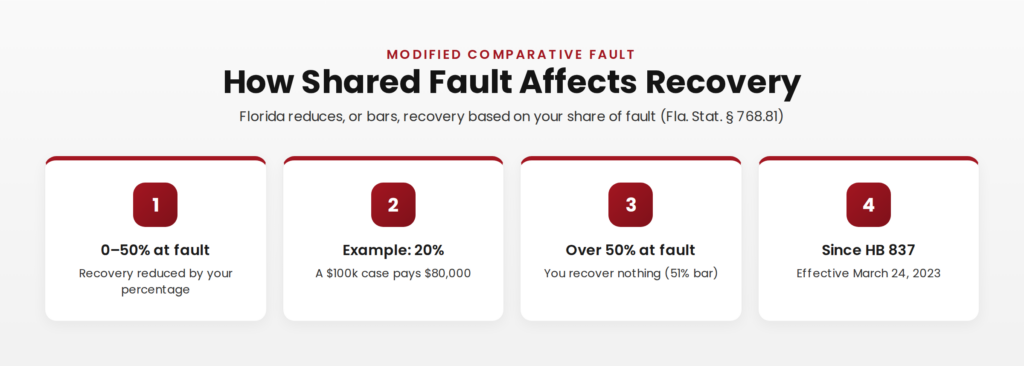
Property owners routinely argue that you should have watched where you were going. Even if that is partly true, it does not necessarily sink your claim. Under Florida’s modified comparative negligence rule, § 768.81, your recovery is reduced by your own share of fault, and you are barred from recovering only if you are found more than 50 percent responsible. A jury that assigns the store 80 percent of the blame and you 20 percent still awards you 80 percent of your damages.
Because a slip and fall does not involve a motor vehicle, Florida’s PIP no-fault system and its 14 day treatment rule do not apply to your medical bills here. Those rules govern car crashes. In a premises case, your losses are pursued directly against the at-fault property owner’s liability insurance.
Who Is Responsible, and What a Fall Claim Is Worth
Liability in a premises case depends on where you fell and who controlled that space. It is not always the obvious party. Depending on the facts, the responsible party might be the store or business operating the space, the landlord or building owner, the property management company, a condominium or homeowners association responsible for a common area, or a maintenance or cleaning contractor whose work created the hazard. Sometimes more than one of them shares the blame. Sorting out who controlled the area, and who had the duty to inspect and repair it, is one of the first jobs in your case.
A fall that fractures a hip or causes a head injury can leave an older adult needing help with ordinary daily tasks indefinitely, and lasting harm that changes how someone lives is documented differently from a sprain that heals in a month.
Once liability is established, the value of your claim comes down to your losses.
| Type of loss | What it can cover in a fall case |
|---|---|
| Medical expenses | Emergency care, imaging, surgery, physical therapy, future treatment |
| Lost income | Time missed from work, plus reduced earning capacity if you cannot return to your old job |
| Pain and suffering | Physical pain, limited mobility, the toll the injury takes on daily life |
| Out-of-pocket costs | Assistive devices, transportation to appointments, paid help at home |
There is no formula that fits every fall. A bruised hip resolves in weeks, while a fractured wrist or a traumatic brain injury can mean surgery and long months of rehabilitation, sometimes with limits that never lift. One factor worth knowing: under Florida law the past medical damages you can claim are tied to amounts actually paid or payable, not inflated billed figures (§ 768.0427). Because Brian once helped insurers put a number on these exact claims, he knows which facts push a case value up and which arguments carriers use to push it down.
Insurers rarely open with a fair number. A common first move is to blame the injured customer for not watching the floor, then to argue the injury was pre-existing or exaggerated. Another is to offer a fast, low settlement before you know the full extent of your injury, hoping you take it and sign a release. Having sat on the carrier side of these negotiations, Brian recognizes those plays for what they are and builds the file, medical proof and liability evidence together, so the offer reflects what the claim is actually worth.
Why Palm Beach County Falls Happen Where They Do
West Palm Beach and the surrounding county draw heavy retail and tourist foot traffic, and much of the local housing sits in condominium and homeowner-association communities built around shared common areas: walkways, lobbies, pool decks, parking lots. That mix produces a steady stream of premises injuries: wet grocery aisles, freshly mopped floors left unmarked, broken stairs and loose handrails in common areas, and slick entryways during the region’s frequent rain. A fall at a beachfront resort or a busy shopping center raises the same core question as a fall at a corner store, namely whether the owner knew or should have known about the danger.
Where you fell often shapes who is on the hook. In a national grocery or drugstore chain, the corporate operator and its insurer defend the claim, usually with practiced tactics and preserved video. In a condo or HOA setting, the association and its management company may share responsibility for a hazard in a common area, and the governing documents matter. At a hotel or resort, housekeeping and maintenance routines become central, and the venue may try to point the finger at a contractor. Identifying the right defendant early keeps a claim from stalling against a party that did not control the space.
Where West Palm Beach fall cases are handled
A West Palm Beach premises case is generally filed in the 15th Judicial Circuit, which sits at the main Palm Beach County courthouse at 205 North Dixie Highway. Serious falls in the area are often treated at St. Mary’s Medical Center, one of only two state-designated Level I trauma centers in Palm Beach County.
A slip and fall is one of several related premises claims. If you were hurt by an animal on someone’s property, that is a dog bite matter, while broader hazards on residential or commercial property fall under premises liability.
When a fall proves fatal, the family may have a wrongful death claim. All of it is part of our West Palm Beach injury practice.
A Track Record of Real Recoveries
Elstein Legal has recovered millions in verdicts and settlements for injured clients. Among them is a $1,150,000 recovery in a trip and fall outside a restaurant that caused neck and back injuries. The firm’s premises and negligent-security results also include a $12,250,000 recovery in a negligent security case and a $7,900,000 wrongful death settlement.
Clients describe the same hands-on experience the firm promises.
Brian is absolutely the best! He was by my side every step of the way, and made me feel so comfortable.
Chloe Fretwell, Google review
Margarita Lugo said the communication was excellent and that she was “always informed step by step of the process.”
Elstein Legal holds a 5 out of 5 rating across more than 120 Google reviews. Past results do not guarantee, warrant, or predict future outcomes.
Talk to a West Palm Beach Slip and Fall Lawyer
If you were hurt in a fall on someone else’s property, get advice before the property’s insurer gets ahead of you. Call Elstein Legal at (305) 299-2835, day or night, or request a free case evaluation through our contact page. There is no fee unless Brian recovers for you.