


Picture a full lot on a Saturday in December: two cars back out at the same moment, and nobody was going fast. Brian Elstein defended insurance companies before he started representing injured people, and from that side of the file he saw how a crash like that tends to be framed. It gets treated as minor. Both drivers were moving slowly, the thinking goes, so both share the blame, and the offer is built on that assumption.
Florida’s comparative fault rule gives that argument real weight, which is why it helps to know the rules before an adjuster explains them to you. You can read more about what Brian learned on the insurance side.
A parking lot is private property, and it is easy to assume the usual rules switch off there. The rules that matter most to your claim still apply, some of them by their own words, and the lot itself can bring a second party into the claim.
Why talk to Elstein Legal about a parking lot crash
Brian spent years defending insurers before he began representing the people bringing claims against them, and the results show it. In one case the carrier’s highest offer was $35,000 before the firm took over, and the claim resolved for $240,000 in under two months. In another, a carrier did not timely tender a $15,000 policy limit, and the recovery through its bad faith was $2,250,000.
Over $50 million recovered. Brian handles every case personally, on a contingency fee, so there are no fees unless we win. Call (305) 299-2835.
Past results do not guarantee, warrant, or predict future outcomes.
Do Traffic Laws Apply in a Florida Parking Lot?
For the duties that matter most after a crash, yes, and Florida’s statutes say so in their own text.
The clearest is Fla. Stat. § 316.027(2)(a). It covers the driver of a vehicle involved in a crash “occurring on public or private property” that results in injury to a person other than serious bodily injury. That driver must stop at the scene, or as close to it as possible, and remain there until the information and assistance duties in § 316.062 are met. A store lot or the spaces outside an apartment building are private property, and the statute names private property directly.
Two companion provisions carry no road limitation in their text either. Section 316.061(1) requires the driver of any vehicle involved in a crash that damages only a vehicle or other property driven or attended by someone to stop and remain until § 316.062 is satisfied. Section 316.062(1) then sets out what stopping is for. A driver in a crash that injures someone, or that damages a vehicle or property someone is driving or attending, gives a name, address and the vehicle’s registration number, shows a license on request, and renders reasonable assistance to anyone injured.
This page does not tell you that every Florida traffic rule applies inside a lot. Whether a particular rule of the road, such as a right-of-way or speed provision, reaches private property is a separate question that depends on the rule. In practice it matters less than you might expect, because fault in a lot comes down to a more basic standard: whether each person took reasonable care for the conditions. More on that below.
What You Have to Do After a Parking Lot Crash
The steps below follow the statutes above, plus the practical work that protects a claim.
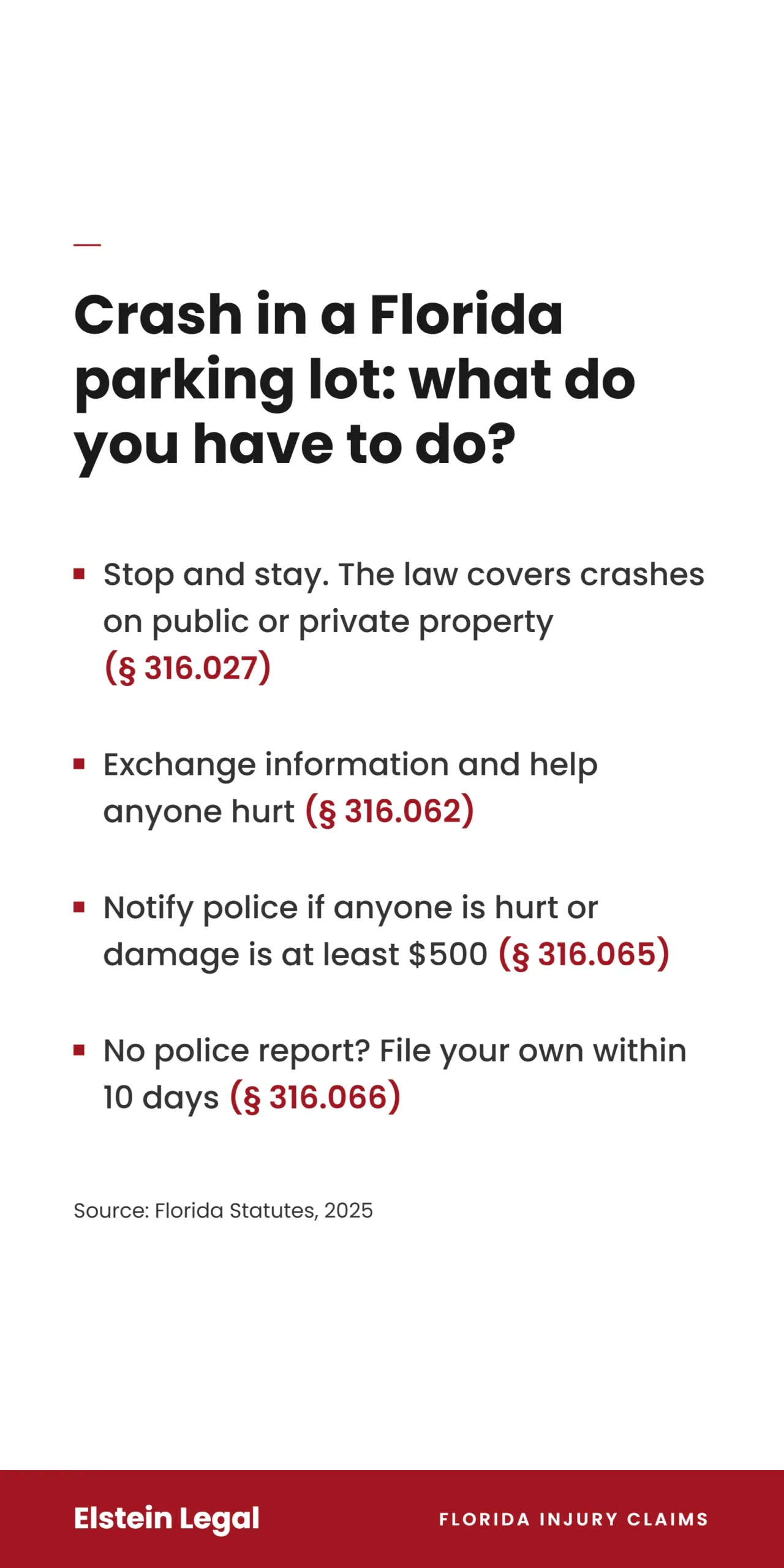
- Stop and stay. For a crash with an injury, that duty comes from § 316.027(2)(a). For a damage-only crash involving a vehicle or property someone was driving or attending, it comes from § 316.061(1).
- Exchange information and help anyone hurt. Name, address, registration number, your license on request, and reasonable assistance to an injured person, under § 316.062(1).
- Notify law enforcement when the law requires it. Under § 316.065(1), a crash that causes injury, death, or apparent damage to any vehicle or other property of at least $500 must be reported by the quickest available means. The wider rules are in Florida’s crash reporting requirements. Notice goes to the local police department inside a city’s limits, and otherwise to the county sheriff or the nearest Florida Highway Patrol station.
- If no law enforcement report is required, file your own. Under § 316.066(1)(e), the driver of a vehicle in a crash that damages a vehicle or other property, where no law enforcement report is required, must submit a written report to the Department of Highway Safety and Motor Vehicles within 10 days.
- Record the lot itself. Photograph the vehicles where they stopped, then the lighting, signs, painted arrows and lane markings. Get the names and numbers of witnesses. Ask the business or property manager early, in writing, whether cameras covered the area and whether the footage can be kept.
- Get medical care quickly. PIP requires initial care within 14 days of the crash, whatever the speed of the impact.
Will an officer come out? It depends. Florida’s short-form crash report provision, § 316.066(1)(c), speaks to crashes on the public roadways, so whether an officer writes a full report for a crash in a lot can vary. Your own duties above do not depend on it.
Does PIP Cover a Parking Lot Accident?
In the ordinary case, yes. Personal injury protection turns on a motor vehicle, not on whether that vehicle was on a public street.
Under Fla. Stat. § 627.736(1), PIP pays 80 percent of all reasonable expenses for medically necessary care, up to the $10,000 limit, if the injured person receives initial services and care within 14 days after the motor vehicle accident. Miss that window and the medical benefit is lost, however the injury develops afterward.
PIP also reaches further than the people inside the cars. The statute lists who it covers, including the named insured, relatives living in the household, the driver, passengers, and “other persons struck by the motor vehicle and suffering bodily injury while not an occupant of a self-propelled vehicle.” A shopper hit while walking to the store falls in that last group.
One qualification matters. It is generally the injured person’s own household PIP that responds first, so whether a benefit is available to you depends on the auto policies in your household. That is worth checking in the first week, not the fifth. For the wider picture, see how PIP pays no matter who caused the crash.
Who Is at Fault in a Parking Lot Crash?
Fault in a lot comes down to the ordinary negligence question: did each driver take reasonable care for the conditions? Lots are full of conditions. Cars reverse out of spaces, and people walk between parked vehicles where they are hard to see.
The situations below come up again and again. They are not statutes, and nothing in this table is a rule of who must yield to whom. They are the facts an adjuster, and eventually a jury, will weigh.
| Situation | What the evidence usually turns on |
|---|---|
| Two cars backing out at the same time | Which car was moving first, how far each had come out, and what each driver could see behind them |
| A car pulling out of a space into a driving lane | Whether traffic in the lane was visible, and how fast it was traveling |
| A driver cutting across empty spaces or against painted arrows | Whether other drivers could reasonably anticipate that route |
| A driver searching for a space and not watching for people on foot | Where the driver’s attention was, and what the sight lines allowed |
| A crash at the lot’s exit onto the street | Whether the exiting driver waited for a safe gap in traffic |
Then comes the split. Under Fla. Stat. § 768.81(6), a party found greater than 50 percent at fault for their own harm recovers nothing. At 50 percent or less, the award is reduced by your share, so someone found exactly half responsible still recovers half.
Two slow-moving cars in a lot is precisely where shared fault gets argued, because each driver was moving and each could have looked a second longer. The answer to that argument is evidence: the photographs, the camera footage, the witness who saw which car was already in the lane. That is the same evidence work that drives a Miami crash claim on the street, and it matters just as much here.
Hit While Walking Through a Parking Lot
A lot puts people on foot among drivers who are reversing and hunting for spaces. If a car strikes you there, PIP can reach you as a person struck by a motor vehicle, subject to the household policy question above.
Fault is still judged by reasonable care on both sides. A driver has to watch for people walking between cars and crossing the lanes, and a person on foot is expected to take reasonable care too, so the same § 768.81(6) rule applies to the claim. The rules written for pedestrians on roadways are a separate subject, covered in fault when a driver hits someone on foot.
If the crash happened in Miami-Dade, the firm’s page for people struck on foot in Miami walks through that claim in more depth.
When the Property Owner Shares Responsibility
A parking lot has an owner, and often a business that controls it. Whoever controls the property owes the people lawfully on it a duty of reasonable care for the condition of the premises. When a lot’s design, lighting or upkeep helps cause a crash or an attack, the owner can become part of the claim alongside the driver.
What that looks like in practice:
- A layout that funnels traffic into a blind corner, or markings worn so faint that drivers no longer follow them.
- Lights left out in a section of the lot that the owner knew people used after dark.
- An attack in a lot where earlier incidents gave the owner reason to anticipate that kind of harm, and no reasonable steps were taken.
The last example turns on foreseeability, meaning whether the owner had reason to expect the harm and failed to act. Every one of these claims depends on its facts, and the evidence usually sits with the property owner, which is another reason to ask for camera footage early. For more, see what a property owner owes the people on its land.
A fall in a lot is a different kind of claim. Slipping on a wet entrance or tripping over a broken wheel stop is not the same as being hit by a car, and it follows its own rules about what a business knew. That claim is explained in what you need to prove after a fall.
Deadlines and Your Next Step
Two clocks start on the day of the crash. PIP’s 14-day window for initial care is the short one. The longer one is the filing deadline: most Florida negligence claims must be filed within two years, under Fla. Stat. § 95.11(5)(a). If a city, county or other government body owns the lot or the vehicle involved, the claim follows a separate track with its own notice requirements, so raise that early.
If you were hurt in a parking lot crash, the first conversation costs nothing. Brian will look at which policies may apply and whether the lot owner belongs in the claim. Call (305) 299-2835, or tell the firm what happened in the lot. No fees unless we win.
Frequently Asked Questions
Do I have to call the police after a parking lot accident in Florida?
If the crash causes injury, death or apparent damage to any vehicle or property of at least $500, Fla. Stat. § 316.065(1) requires the driver to notify law enforcement by the quickest available means. For a crash that damages a vehicle or property and does not require a law enforcement report, § 316.066(1)(e) requires the driver to submit a written report to the Department of Highway Safety and Motor Vehicles within 10 days. Whether an officer writes a full report for a crash on private property can vary, and your own duties do not depend on it.
Does PIP cover a parking lot accident?
In the ordinary case, yes. PIP turns on a motor vehicle, not a public road. Under Fla. Stat. § 627.736(1) it pays 80 percent of reasonable medical expenses up to the $10,000 limit, provided initial care is received within 14 days after the accident. Whether a benefit is available to you depends on the auto policies in your household.
Who is at fault when two cars back into each other?
Fault turns on whether each driver took reasonable care, so the evidence decides it: which car was moving first, how far each had come out, and what each driver could see. This is the situation where shared fault gets argued hardest. Under § 768.81(6), a person found more than 50 percent at fault recovers nothing, and at 50 percent or less the award is reduced by that share.
I was hit by a car while walking to my car. Does PIP apply?
It can. Fla. Stat. § 627.736(1) reaches “other persons struck by the motor vehicle” who are hurt while not an occupant of a self-propelled vehicle, which includes a person on foot in a parking lot. It is generally your own household PIP that responds first, so whether a benefit exists depends on the policies in your household. The 14-day rule for initial care applies to you as well.
Can I sue the store or the property owner?
Possibly. Whoever controls the lot owes people on it a duty of reasonable care for the condition of the premises. If poor design, missing lighting or neglected upkeep helped cause the crash, or if an attack in the lot was foreseeable and reasonable steps were not taken, the owner may share responsibility. These claims depend heavily on the facts, so ask early about camera footage and incident records.
What if the other driver left without leaving a note?
If you were in or with your vehicle, the other driver had a duty to stop and remain under Fla. Stat. § 316.027(2)(a) for an injury crash, or § 316.061(1) for a damage-only crash, because both apply to crashes on private property by their terms. Report it, photograph the damage and the area, and ask nearby businesses about cameras. Your own auto policy may be where the claim goes, depending on the coverage you bought.
How long do I have to file a claim after a parking lot accident?
Most Florida negligence claims must be filed within two years, under Fla. Stat. § 95.11(5)(a). Two shorter clocks matter sooner: PIP requires initial medical care within 14 days, and after a property-damage crash that does not require a law enforcement report, the driver has 10 days to submit a written report. A claim against a government body follows its own notice rules, so raise it with a lawyer early.


